Table of Contents
- Why Parents Choose Between Daycare Options: The Real Question
- Language Development: Spanish Immersion Leads the Way
- Cognitive Growth and Academic Readiness Compared
- Cultural Awareness and Global Perspective Benefits
- Social Skills Development in Our Bilingual Community
- Long-Term Academic Success: What Research Shows
- Why Our Full Spanish Immersion Approach Outperforms Traditional Care
- The Farmington Advantage: What Sets Us Apart
- Peace of Mind Knowing Your Child Is Thriving
- Schedule Your Tour and See the Difference Today
Why Parents Choose Between Daycare Options: The Real Question
You’re standing in your kitchen on a Monday morning, coffee in hand, and you’re wondering: is my child getting the most out of their daycare hours? It’s not just about safe supervision anymore. You want your child to thrive intellectually, emotionally, and socially while you’re building your career. That’s the question keeping many Farmington-area parents up at night.
The choice between a traditional daycare and a Spanish immersion program isn’t really about picking the “safer” option. Both can be wonderful. The real question is simpler: which environment will give my child the strongest foundation for learning, confidence, and future academic success?
We talk to parents like you every week. What they’re really asking is whether those immersion hours actually matter, or if they’re just a trendy add-on. The honest answer? The science is clear, and it’s compelling. When you choose the right Spanish immersion program, your child doesn’t just learn a second language. They get a measurable cognitive boost that shows up in reading, math, critical thinking, and even emotional intelligence.
Here’s what we know: most traditional daycares focus on age-appropriate activities, safety, and social play. Those things matter. But they operate in one language only. A true bilingual immersion program restructures the entire learning environment around language and cognitive development. Your child’s brain is wired to absorb multiple languages effortlessly between six weeks and six years old, and when we harness that window, everything else benefits.
By the end of this guide, you’ll understand exactly how Spanish immersion stacks up against traditional care, and why we believe it’s the cognitive edge your child deserves.
Language Development: Spanish Immersion Leads the Way
The window for natural language acquisition closes gradually, but it’s widest right now. Children who are immersed in two languages during their early years develop phonetic awareness, listening skills, and vocabulary at rates that outpace single-language peers.
Here’s what happens in your child’s brain during Spanish immersion. Instead of hearing one set of sounds, grammar patterns, and word associations, they’re building neural pathways for two complete language systems simultaneously. This isn’t confusion. It’s expansion. Bilingual children typically show a slight initial vocabulary lag in each language compared to monolingual peers, but by age four, they catch up in total word knowledge across both languages and pull ahead.
In a traditional English-only daycare, your child learns roughly 1,500 to 2,000 words in English by age three. In a full Spanish immersion program, they’re building vocabulary in both Spanish and English. Over time, this creates a richer, more flexible language toolkit.
The practical difference shows up quickly. Our children at Mis Tortuguitas are speaking in Spanish sentences by age two and a half. They’re singing songs, telling stories about their day, and code-switching (mixing languages naturally) in ways that show true bilingual confidence, not mere repetition.
What makes this powerful is permanence. Languages learned before age five tend to stick. Your child won’t forget Spanish after they leave our program. They’ll carry it forward into elementary school, where they’ll have an advantage in phonics, reading comprehension, and even learning additional languages later.
The key is immersion consistency. Part-time Spanish classes or “Spanish time” don’t produce the same results. When Spanish is the working language of the classroom, caregivers speak it throughout the day, songs are in Spanish, stories happen in Spanish, and daily routines flow in Spanish, your child’s brain treats it as a real, functional language. That’s when the cognitive magic happens.
Cognitive Growth and Academic Readiness Compared
Beyond language itself, bilingualism rewires how your child thinks. Research consistently shows that bilingual children develop stronger executive function skills: planning, working memory, impulse control, and the ability to switch between tasks.
Think of it this way. When your child hears Spanish all day and occasionally encounters English, they’re constantly toggling between two language systems. That mental switching exercise strengthens the same neural muscles they’ll use for math problem-solving, reading comprehension, and even impulse control at the dinner table. It’s like a daily workout for cognitive flexibility.
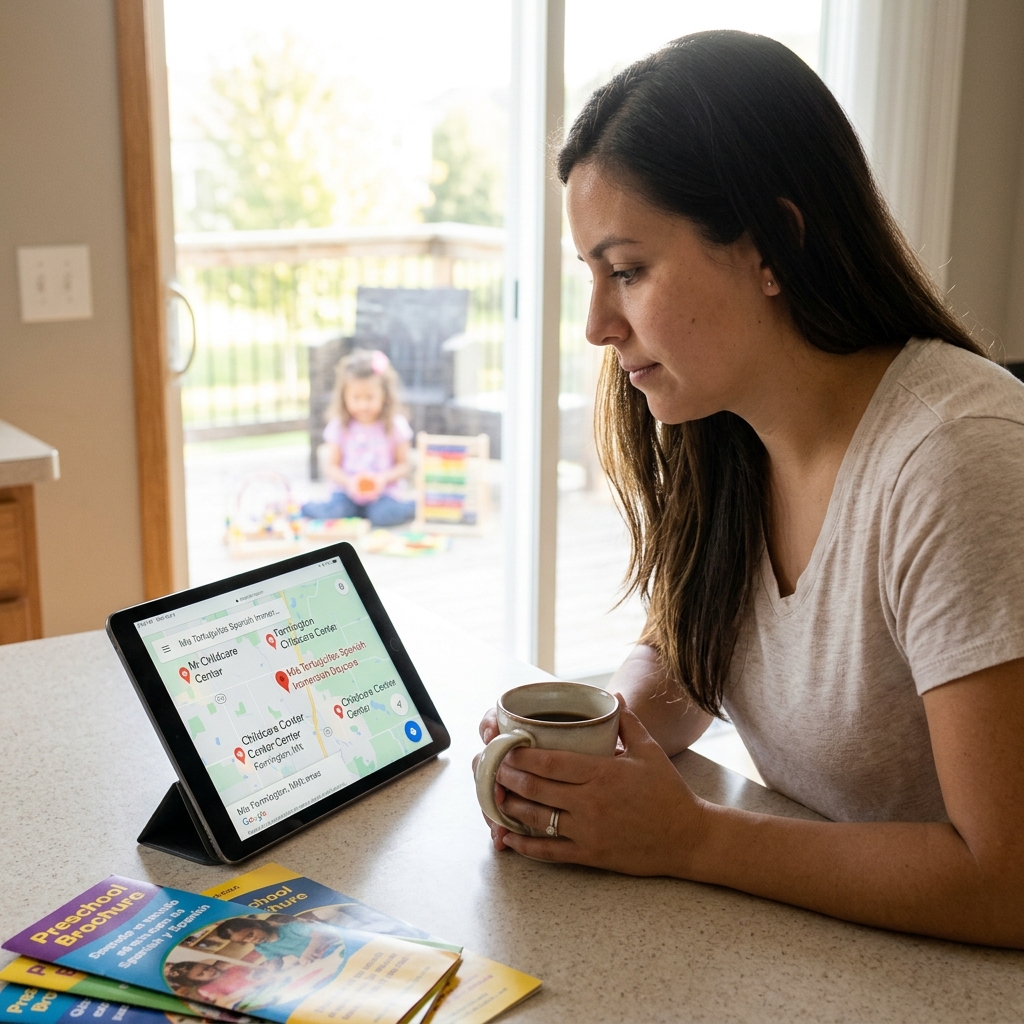
Traditional daycare provides wonderful social and play-based learning, which absolutely matters. But the cognitive demands are typically lower. A child plays with blocks, paints, sings songs, and practices social skills. All good. In a Spanish immersion classroom, that same block-building activity is happening in Spanish, with bilingual scaffolding, phonetic modeling, and richer language exposure layered into every moment.
The academic readiness gap becomes visible by age four. Bilingual children show stronger phonological awareness (the ability to recognize and manipulate sounds), better impulse control during structured activities, and higher performance on tasks requiring sustained attention. These aren’t innate differences. They’re the direct result of the cognitive demand the immersion environment places on the developing brain.
Our Spanish immersion preschool program intentionally builds school readiness into every day. Letter recognition, number sense, pre-reading skills, and writing foundations are woven through Spanish-language instruction. Your child isn’t just learning to be bilingual. They’re learning academic content through a bilingual lens, which deepens comprehension and retention.
When your child enters kindergarten after Spanish immersion, they arrive with stronger attention spans, better self-regulation, and a confidence that comes from mastering a genuinely difficult task. They’ve learned a language. Everything else feels manageable.
Cultural Awareness and Global Perspective Benefits
There’s something quietly powerful about growing up bilingual. It’s not just that your child can speak Spanish. It’s that they understand, on a deep level, that the world operates in multiple languages and worldviews. That awareness shifts how they see other people, other cultures, and their own place in the world.
Children immersed in Spanish from infancy begin to understand that Spanish-speaking communities have their own music, stories, celebrations, and ways of thinking. They’re not learning Spanish as a “foreign language.” They’re absorbing it as a natural part of how humans communicate. That distinction matters.
In a traditional English-only daycare, cultural awareness is often taught as a topic: “Today we learn about Cinco de Mayo” or “This month we celebrate Día de Muertos.” It’s educational and meaningful, but it’s framed as other. In a Spanish immersion environment, culture is lived. Your child celebrates with authentic music, learns real stories in Spanish, and builds relationships with bilingual role models who embody that culture every single day.
This early cultural fluency has long-term benefits. Research shows that children who grow up understanding multiple perspectives develop stronger empathy, more creative problem-solving skills, and better cross-cultural communication abilities. In an increasingly connected world, that’s not a nice-to-have. It’s foundational.
We intentionally weave Latin American and Spanish culture throughout our curriculum, not as add-ons but as the fabric of how we operate. Your child isn’t just learning Spanish words. They’re learning respect, curiosity, and belonging within a bilingual community.
Social Skills Development in Our Bilingual Community
You might wonder: will my child struggle socially if they’re learning in Spanish? The opposite is true. Bilingual children in immersion programs develop richer social skills because they’re navigating more complex communication scenarios from the start.
At Mis Tortuguitas, your child is building friendships, resolving conflicts, and collaborating on projects entirely in Spanish. They’re learning to express needs, comfort a friend, negotiate, and celebrate with peers who share their learning language. These aren’t small interactions. They’re the building blocks of emotional intelligence.
Bilingual children also tend to show stronger theory of mind: they understand earlier that other people have different knowledge, beliefs, and perspectives. When you’re constantly switching between two language systems, you naturally develop an awareness that communication isn’t one-size-fits-all. Your child learns to adjust how they speak, what words they use, and how they explain things based on their audience. That’s sophisticated social reasoning.
In a traditional daycare with mixed language backgrounds, peer communication happens in one language. In our Spanish immersion community, your child is part of a cohort that shares the same learning language. They bond over shared stories, songs, and daily rituals in Spanish. That shared linguistic identity creates a tight-knit group and gives your child a sense of belonging.
Our small class sizes mean every child gets to be seen and heard. We know your child’s personality, comfort level, and friendship patterns. We partner with families to support social growth, whether that’s building confidence in a shy child or channeling energy constructively in a spirited one. Your child isn’t just safe with us. They’re known.
Long-Term Academic Success: What Research Shows
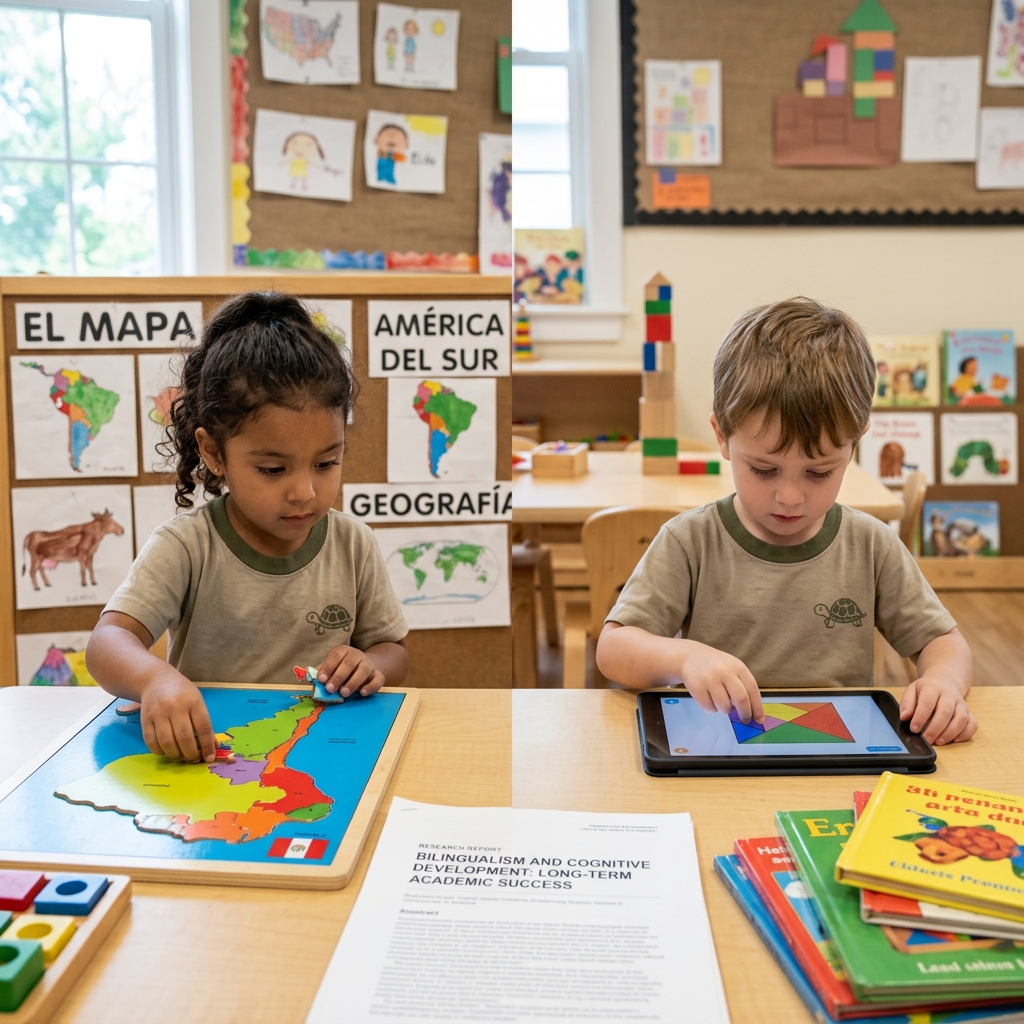
Here’s where the case for Spanish immersion becomes undeniable. The research on bilingual early childhood education shows consistent academic advantages that extend years into the future.
Studies from the American Council of Teachers of Foreign Languages and the National Institutes of Health show that children who attend quality bilingual preschool programs score higher on standardized reading and math assessments in elementary school compared to peers in English-only care. These aren’t marginal gains. We’re talking about meaningful advantages that persist across grade levels.
One landmark study tracked bilingual children through sixth grade and found they maintained higher executive function scores and better performance on complex problem-solving tasks. The cognitive advantages don’t fade. They compound.
Language skills are particularly durable. Children who achieve balanced bilingualism (functional ability in both Spanish and English) by age five tend to maintain both languages and continue developing both throughout school. They have more literacy pathways, stronger reading comprehension strategies, and higher performance in subjects requiring analytical thinking.
The academic advantage is especially pronounced for students who continue Spanish language study in elementary and middle school. If your child enters kindergarten already fluent in conversational Spanish and literate in Spanish phonics, adding English literacy is additive, not difficult. They’re expanding their existing skill set, not starting from scratch.
Beyond test scores, bilingual children show higher graduation rates, greater likelihood of pursuing advanced academics, and stronger educational persistence. The cognitive benefits don’t just help them succeed in kindergarten. They build a foundation for lifelong learning.
Why Our Full Spanish Immersion Approach Outperforms Traditional Care
We could tell you that our Spanish immersion daycare program is wonderful, and it is. But let’s be specific about what makes our approach different from traditional daycare or even part-time Spanish programs.
First, consistency. Every caregiver on our team is bilingual. Spanish isn’t taught as a subject. It’s the working language of our classroom. From 7:00 a.m. when your child arrives to 6:00 p.m. when you pick them up, Spanish surrounds them. That immersive consistency is what creates actual language acquisition, not just Spanish exposure.
Second, our curriculum is designed specifically for bilingual development. We’re not translating traditional English-only activities into Spanish. We’re building lessons that leverage the cognitive benefits of bilingualism. Letter recognition happens in both Spanish and English. Number sense is built through Spanish mathematical thinking. Stories come from Spanish-language literature. Every element is purposeful.
Third, our staff are trained in bilingual child development, not just bilingual communication. There’s a difference. Our caregivers understand language scaffolding, how to support children learning in a non-native language environment, and how to balance Spanish immersion with English skill development as children prepare for kindergarten. This expertise matters.
Fourth, we maintain small class sizes. This isn’t a luxury. It’s essential for immersion to work. When your child has a low student-to-teacher ratio, they get more language input, more individual attention, more opportunities to practice and be corrected gently, and more genuine relationships with bilingual adults. In larger, traditional daycare settings, achieving this level of bilingual interaction is nearly impossible.
Finally, we partner with your family. Spanish immersion is most powerful when it’s reinforced at home. We share bilingual resources, suggest activities, celebrate your child’s Spanish language milestones, and respect your family’s unique language goals. You’re not sending your child off to “get fluent.” You’re joining us in building a bilingual foundation together.
Traditional daycare can’t offer this level of immersion or specialization. They’re not trying to. Their focus is (rightfully) on safety and age-appropriate development. But if cognitive development and language acquisition matter to you, full Spanish immersion is categorically more effective.
The Farmington Advantage: What Sets Us Apart
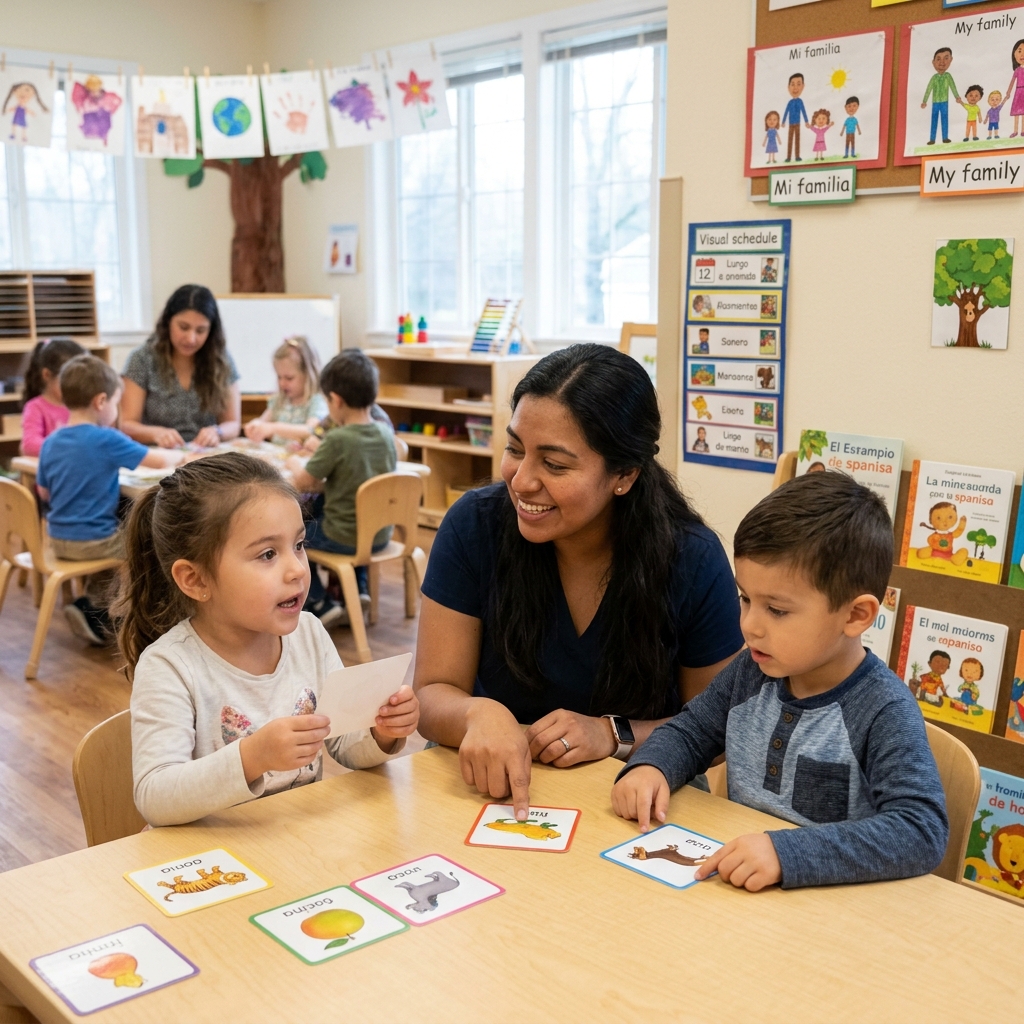
We’re Farmington’s first licensed Spanish immersion daycare, and that distinction comes with deep roots in this community. We understand the families we serve. We know the schools your child will attend. We’re embedded in the neighborhood in a way that franchise chains and traditional centers simply aren’t.
Being the first also means we’ve had the time to perfect our approach. We’re not experimenting. We’re the proven leader in Spanish immersion childcare across Farmington, Apple Valley, Lakeville, Eagan, and Rosemount. Families have trusted us with their youngest learners, and we’ve delivered results they see every day: children who love Spanish, children who are ready for school, children who are confident and curious.
Our facility is designed for bilingual learning. Our classroom materials, books, music, and visual aids reflect Spanish-speaking cultures. When your child walks in, they walk into an environment that whispers, “Spanish matters here. You belong here.” That environmental cue is powerful for young learners.
We also understand the specific needs of working parents in the Farmington area. We offer flexible scheduling, full-time and part-time enrollment, and drop-in options for busy families. We work with your schedule so you can access the best immersion education without logistical stress.
Most importantly, we treat every child like our own. Our bilingual teaching staff aren’t just qualified and licensed. They’re warm, patient, and genuinely invested in your child’s growth. They remember what your daughter loves to play, how your son falls asleep at nap time, and what makes your toddler laugh. Your child’s safety is our top priority, and their thriving is our joy.
Peace of Mind Knowing Your Child Is Thriving
Every parent needs to feel that their child is safe, happy, and growing. That peace of mind isn’t just emotional comfort. It’s what allows you to focus on work, to be present, to stop checking your phone every fifteen minutes wondering how they’re doing.
When you choose a full Spanish immersion program like ours, you get something extra: the confidence that your child is not just being cared for, they’re being developed. They’re building skills that will serve them for a lifetime. You’re making an investment in their cognitive future, not just their immediate safety.
We provide regular updates through photos, videos, and conversation. You’ll see your child learning. You’ll hear Spanish words they’ve picked up. You’ll watch them grow in confidence and curiosity. That visibility matters. You know what’s happening during those daycare hours. You’re a partner in the process.
We also maintain transparent communication about your child’s individual development. We notice when your child is ready for new language challenges. We celebrate milestones, whether that’s a first Spanish sentence, successful potty training, or a brave moment making a new friend. We share what we observe, and we listen to what you see at home. That partnership creates continuity and ensures your child gets what they need, when they need it.
The peace of mind comes from knowing you’ve chosen something genuinely excellent. Not just “good daycare.” Excellent Spanish immersion from a program designed specifically for bilingual child development. You can be proud of that choice, and your child will benefit from it for years to come.
Schedule Your Tour and See the Difference Today
Reading about Spanish immersion is one thing. Seeing it in action is completely different. When you walk through our doors, you’ll notice immediately: this is a warm, home-away-from-home where languages blend naturally and children thrive.
You’ll see toddlers singing in Spanish, preschoolers telling stories, and infants being cradled while caregivers narrate in Spanish. You’ll notice the books on our shelves, the art on our walls, the songs playing during snack time. You’ll feel the calm, nurturing environment where your child would spend their days.
Most importantly, you’ll talk with our team. Ask about our bilingual teaching approach. Ask how we support families. Ask what parents in our community say about the results they’ve seen. We’re confident in what we offer, and we love sharing it with families who care about their child’s cognitive and linguistic development.
Scheduling a tour is simple. Come see for yourself why families across Farmington, Apple Valley, Lakeville, Eagan, and Rosemount trust us with their children’s most important early years. Every tour is a chance to ask questions, meet our staff, and imagine your child thriving in a Spanish immersion environment designed just for them.
Contact us today to schedule your tour. We’d love to meet your family and show you what Spanish immersion really looks like.