Table of Contents
- Why Parents in Farmington Choose Spanish Immersion for School Readiness
- The Real Difference Between Full Immersion and Traditional Daycare Programs
- How Daily Spanish Immersion Builds Cognitive and Language Advantages
- Our Curriculum: Spanish-First Learning for Every Age Group
- Small Class Sizes and Bilingual Teaching Staff That Make the Difference
- Creating a Warm, Secure Home-Away-From-Home Environment
- School Readiness Outcomes: What Our Families Experience
- Full-Time and Part-Time Options That Work for Your Family's Schedule
- Enrollment in Farmington, Apple Valley, Lakeville, Eagan, and Rosemount
- Schedule Your Tour and See Our Spanish Immersion in Action
Why Parents in Farmington Choose Spanish Immersion for School Readiness
Working parents in Farmington know that early childhood education sets the tone for everything that follows. You’re not just looking for a safe place for your child while you’re at work—you want an environment where they’re growing, learning, and building skills that will serve them for years to come.
That’s where Spanish immersion comes in. More families in our community are recognizing that bilingual exposure during these critical early years gives children a genuine cognitive advantage. Research shows that children learning a second language develop stronger problem-solving skills, greater mental flexibility, and enhanced academic performance across all subjects—not just language arts.
When you choose a Spanish immersion daycare, you’re investing in more than just childcare. You’re giving your child a head start on school readiness while honoring the rich, Spanish-speaking heritage that many Farmington families value. Your child arrives at kindergarten not only ready for academics but also bilingual—a skill that opens doors throughout their education and career.
We treat every child like our own, which means we understand your hopes for your child’s future. Parents who come to us often share the same concern: “I want my child to be prepared, confident, and curious when they start school.” Daily Spanish immersion addresses all three.
The Real Difference Between Full Immersion and Traditional Daycare Programs
Not all daycare programs are created equal, and not all language programs are truly immersive. Understanding the difference can help you make the right choice for your family.
Traditional daycare focuses on care, safety, and basic social development. Spanish lessons might happen once or twice a week as a special activity. A teacher says “buenos días” at circle time, and that’s the extent of Spanish exposure. It’s a nice supplement, but it’s not authentic bilingual learning.
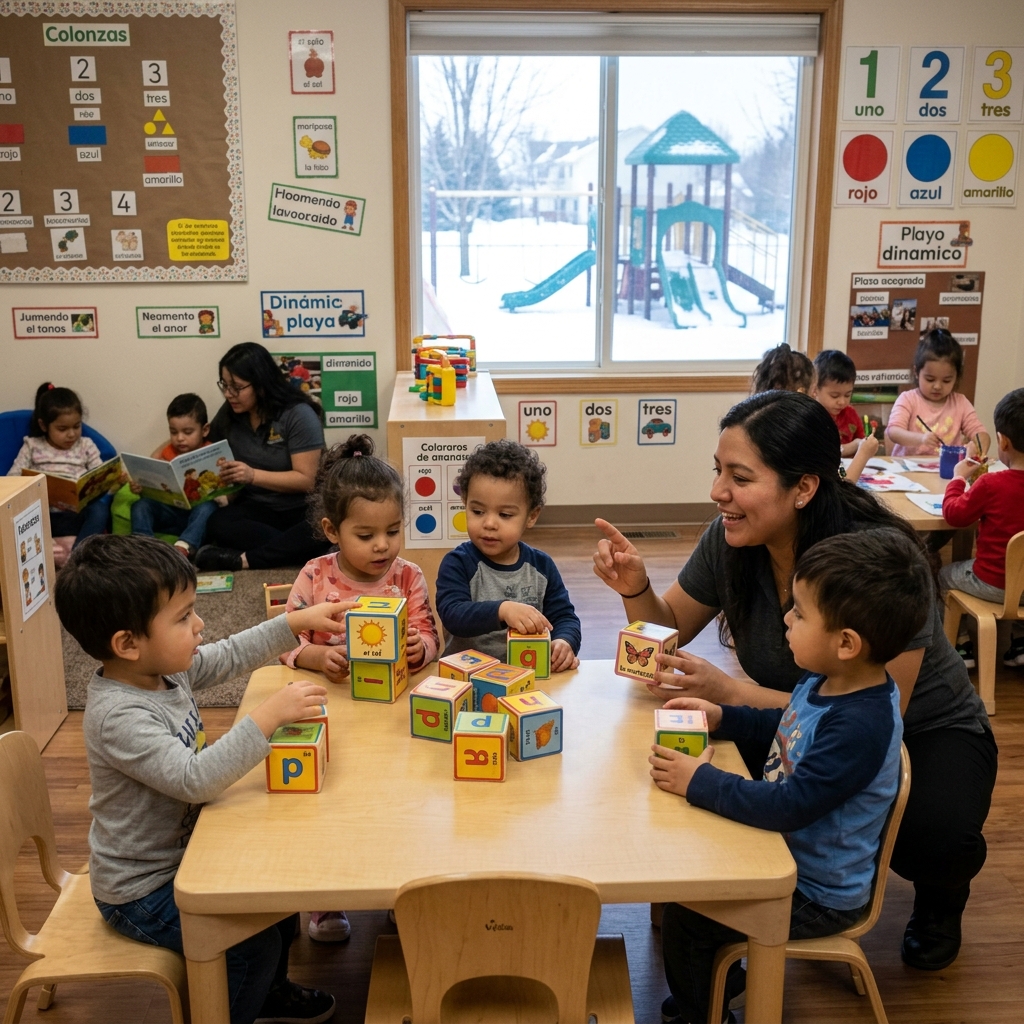
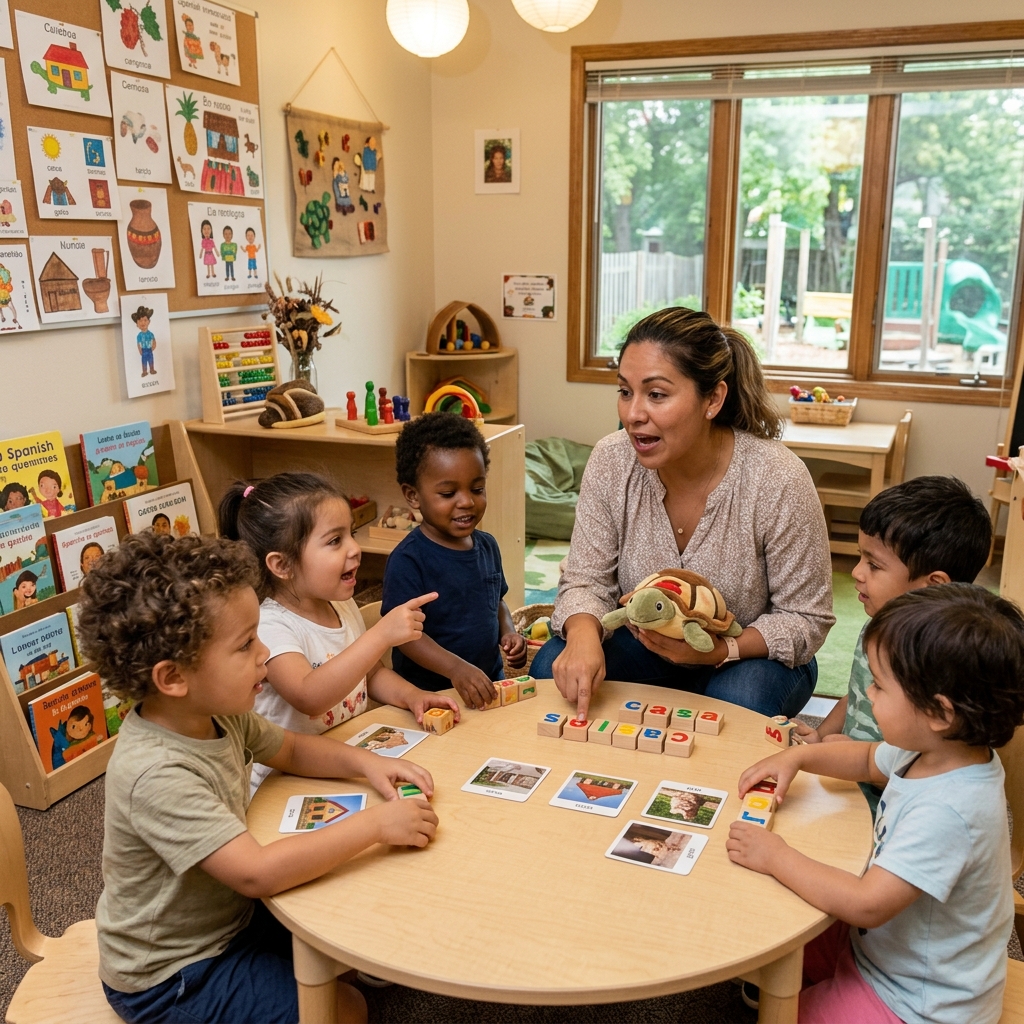
Full immersion is fundamentally different. At our facility, Spanish is the language of instruction throughout the day—during meals, play, learning activities, transitions, and outdoor time. Your child isn’t studying Spanish; they’re living in Spanish. Teachers speak Spanish to each other and to the children. Songs, stories, classroom routines, and problem-solving all happen in Spanish naturally.
Here’s what this means in practice: Your toddler learns that “pan” is bread not through a flashcard, but because a teacher hands them bread at snack time and says, “Aquí está tu pan.” They pick up verb conjugations and conversational patterns through genuine daily use, not memorization. Over months, their brain absorbs Spanish the same way they absorbed English at home.
The difference matters. Children in traditional bilingual programs often don’t develop deep Spanish skills because exposure is limited and fragmented. Children in full immersion programs become genuinely bilingual because the language surrounds them and serves a real purpose in their daily lives.
When you walk through our doors, you’ll hear Spanish spoken with warmth and purpose. This isn’t a performance or a program feature—it’s how we operate every single day.
How Daily Spanish Immersion Builds Cognitive and Language Advantages
Your child’s brain during ages zero to six is like a sponge, absorbing patterns, sounds, and meanings at an astonishing rate. Neuroscience tells us that early exposure to multiple languages strengthens neural pathways in ways that don’t happen as readily in older children.
When your child is immersed in Spanish daily, several things happen cognitively. First, they develop phonological awareness in both Spanish and English. They learn to hear and produce sounds that might not exist in English alone, which actually enhances their ability to hear fine distinctions in both languages. This skill translates directly to reading readiness.
Second, bilingual children often show stronger executive function skills—the mental abilities that help them plan, organize, switch between tasks, and solve problems. Scientists believe this happens because the brain is constantly navigating two language systems, which builds mental flexibility and attention control.
Third, vocabulary and conceptual thinking expand. When a child knows multiple words for the same object or idea, they begin to think more abstractly about language itself. They understand that things can be labeled in different ways, which supports deeper learning across all subjects.
Here’s a concrete example: A child in our toddler program learns colors in Spanish through play. “Rojo,” they say, pointing to a red block. But they also see that the word “red” describes the same color in English at home. By preschool, they’re not just naming colors—they’re beginning to understand that language is a system with patterns and rules. This metalinguistic awareness becomes crucial for reading and writing later.
We see these advantages show up when families tell us their kindergarten teachers are amazed at how quickly their child picks up new concepts and transitions between learning activities. A child who’s spent years navigating two languages approaches new information with curiosity and cognitive confidence.
Next step: Pay attention to how your child responds to Spanish over the first few weeks. You’ll likely notice comprehension growing faster than you expected.
Our Curriculum: Spanish-First Learning for Every Age Group
We’ve designed our Spanish immersion preschool and infant programs around the understanding that language development isn’t separate from play, exploration, and social growth—it’s woven through every moment of the day.
For infants (six weeks to 18 months), language happens through responsive caregiving and sensory experiences. Our caregivers speak to babies constantly in Spanish during diaper changes, feedings, and cuddle time. We sing lullabies, read board books, and narrate daily routines. Infants absorb the melody, rhythm, and sounds of Spanish from day one. They’re building the foundation for comprehension long before they say their first words.
For toddlers (18 months to three years), our curriculum balances structured learning activities with plenty of child-led play. We focus on vocabulary building through hands-on experiences. A cooking activity becomes a Spanish lesson: children handle ingredients, hear the names of foods and tools, and participate in a meaningful task. We sing songs, do finger plays, and read stories together. Toddlers begin forming simple sentences in Spanish, and we celebrate every word they speak with genuine enthusiasm.
For preschoolers (three to six years), learning becomes more intentional while remaining joyful. Our curriculum includes phonological awareness activities, story-based learning, math concepts, science exploration, and social-emotional development—all delivered in Spanish. We incorporate pre-literacy skills like letter recognition, sound-symbol relationships, and early writing. Group projects, dramatic play, and guided discovery keep learning engaging.
Across all age groups, we emphasize school readiness skills: following directions, waiting turns, expressing feelings appropriately, listening to others, and developing independence. These skills are practiced daily in Spanish, so your child arrives at kindergarten not only bilingual but also socially and emotionally prepared.
Small Class Sizes and Bilingual Teaching Staff That Make the Difference
We believe that small class sizes and qualified bilingual teaching staff aren’t luxuries—they’re essentials for high-quality immersion learning.
When class sizes are small, something special happens. Teachers know each child deeply: their learning style, their personality, what motivates them, and how they’re progressing. With fewer children to manage, our staff can have real conversations with your child in Spanish, respond to their interests, and adjust activities based on what they’re curious about that day. There’s room for personalized attention and genuine relationship-building.
Our bilingual teaching staff understand both languages fluently and know how to support children’s development in each. They can answer questions that parents ask, model correct Spanish usage throughout the day, and create activities that deepen language skills intentionally. They recognize when a child is ready to move forward and when they need more time with a concept.
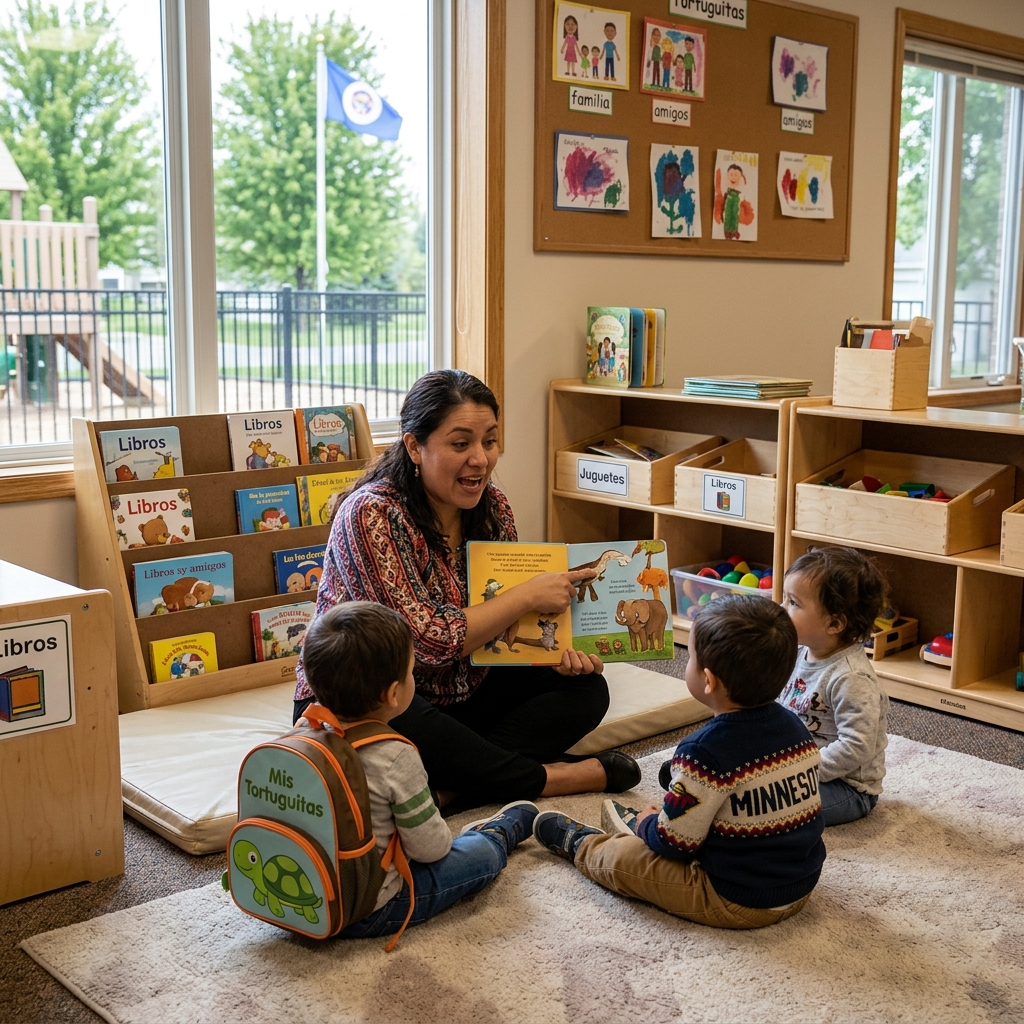
Here’s what this looks like in action: A child struggles with a frustration and starts to cry. A bilingual teacher sits down beside them and helps them name the feeling in Spanish: “Veo que estás triste. Te puedo ayudar?” (I see you’re sad. Can I help?) The teacher validates the emotion, teaches emotional vocabulary, and models problem-solving—all in Spanish, all in the context of real life. That’s not just childcare; that’s teaching.
Your child’s safety is our top priority, which is why every member of our team is licensed, trained, and committed to both exceptional care and exceptional learning. We partner with your family to understand your child’s unique needs, celebrate their milestones, and keep you informed about their progress.
Creating a Warm, Secure Home-Away-From-Home Environment
The first months of daycare can stir up big feelings for both you and your child. We get it. That’s why we work intentionally to create a warm, home-away-from-home where your child feels secure, valued, and ready to explore.
Our facility is thoughtfully designed with quiet spaces, cozy reading nooks, and play areas that invite exploration. We keep class transitions smooth and predictable so children know what to expect. Routines like morning circle time, snack, outdoor play, and quiet rest happen at consistent times. This predictability helps young children feel safe and settled.
We also honor the connection between home and our center. When a child arrives, we greet them warmly in Spanish. We ask about their evening, their family, their interests. We learn from you what routines and comfort items help your child feel secure. If your child has a comfort object or a favorite song, we incorporate those into their day. We stay in close communication with you through daily updates, photos, and conversations so you’re never wondering how your child’s day went.
Our staff approach discipline with patience and teaching in mind. When conflicts happen—and they do—we use them as learning opportunities. A child who grabs a toy learns about taking turns and empathy, all explained in Spanish with warmth, not harshness.
Peace of mind for busy parents starts with knowing your child is genuinely happy and thriving. We’ve heard countless families say their child asks to come to daycare, talks about their teachers with affection, and has grown in confidence and independence. That’s the kind of environment we work to create every single day.
School Readiness Outcomes: What Our Families Experience
We don’t make promises we can’t keep, but we can tell you what our families consistently report when their children transition to kindergarten.
Children who’ve spent time in our Spanish immersion program typically arrive at school with strong language skills in both Spanish and English, better listening comprehension, and confidence in following multi-step directions. Teachers notice they pick up new concepts quickly and aren’t intimidated by academic challenges.
Socially and emotionally, our graduates tend to be adaptable and resilient. They’ve already navigated transitions between home and school, managed group dynamics in small settings, and learned to express their feelings. They’re used to learning through play, which helps them engage with kindergarten instruction more naturally.
One family told us, “Our daughter’s kindergarten teacher pulled us aside and said, ‘I don’t know what you’re doing at that daycare, but your daughter is ahead of her peers. She’s curious, she listens well, and she’s already reading simple words.'” That wasn’t an anomaly—it’s a pattern we see again and again.
Another parent shared, “My son used to be shy, but coming to Mis Tortuguitas for two years completely changed that. He’s confident, he’s bilingual, and he loves learning. I couldn’t have asked for a better start.”
These aren’t guarantees, and every child develops at their own pace. But we see consistently that children thrive in our environment and arrive at kindergarten with a genuine advantage: bilingual skills, academic readiness, social confidence, and a love of learning.
Full-Time and Part-Time Options That Work for Your Family’s Schedule
We understand that families have different work schedules, different needs, and different budgets. That’s why we offer both full-time and part-time enrollment options.
Full-time enrollment works well for families who need consistent childcare while they work full days. Your child attends five days a week and becomes fully integrated into the classroom community, which deepens their Spanish acquisition and relationships with peers and teachers.
Part-time enrollment is perfect if you work part-time, have a flexible schedule, or want to supplement your childcare with other arrangements. Whether your child attends two days a week, three days a week, or follows another pattern, they still benefit from consistent, high-quality Spanish immersion during the time they’re with us.
Some families use part-time care to introduce their child to our program gently. Others use it to give their child enrichment in Spanish while spending other days at home or with family. Both approaches work beautifully.
We also understand that life changes. If you enroll part-time now and need full-time care later—or vice versa—we work with you to adjust. Your family’s needs matter to us.
Rates and availability vary depending on your child’s age and the enrollment option you choose. When you come for a tour, we’ll discuss your family’s specific needs and show you how our programs can work within your schedule and budget.
Enrollment in Farmington, Apple Valley, Lakeville, Eagan, and Rosemount
We’re proud to serve families throughout the greater Farmington area. Our facility in Farmington is convenient for parents in Farmington, Apple Valley, Lakeville, Eagan, and Rosemount who want their children in a licensed Spanish immersion program without a long commute.
We accept children from six weeks through six years old, with programs tailored to each age group. Whether you have an infant you’d like to enroll, a toddler who’s ready for more structured learning, or a preschooler preparing for kindergarten, we have a program for you.
Enrollment typically happens on a rolling basis, but we do fill spots, especially in our infant and toddler rooms. The best way to check current availability is to reach out directly. We can answer questions about ages available right now, class sizes, and openings in the coming weeks or months.
Many families ask whether their child should start immediately or wait until the fall. Our answer: whenever your family is ready and a spot is available, your child is ready to benefit from immersion. Starting in summer or during the school year means more time for Spanish to develop before kindergarten.
Schedule Your Tour and See Our Spanish Immersion in Action
The best way to understand what we do is to see it for yourself. When you visit, you’ll hear Spanish spoken naturally throughout the classroom. You’ll see children engaged in meaningful play and learning. You’ll feel the warmth and care our team brings to every interaction. You’ll know whether this is the right fit for your family.
A tour typically takes 30 to 45 minutes. We’ll show you our classrooms, outdoor spaces, and facilities. We’ll answer your questions about our curriculum, staff, safety protocols, and enrollment. Most importantly, we’ll listen to your hopes for your child and share how we can support your family.
Come see for yourself why families in Farmington, Apple Valley, Lakeville, Eagan, and Rosemount choose Mis Tortuguitas for their child’s early education. Your child deserves a nurturing, secure place where they can thrive, learn, and grow bilingual. We’d love to welcome your family.
To schedule a tour or learn more about availability and enrollment, visit our website at https://mistortuguitas.com/ or reach out directly. We’re here to answer your questions and help you take the next step.