
Why Farmington Parents Face This Choice
If you’re a working parent in the Farmington area, you’re likely juggling multiple questions about your child’s early education. Do I choose a traditional daycare? Wait for a charter school spot? Invest in a specialized program? The stakes feel high because they are—these early years shape how your child learns, grows, and approaches the world.
Many families in our community face a specific fork in the road: full-time daycare with an immersion focus versus waiting for charter school enrollment or choosing a conventional school-prep environment. Both options have merit, but they offer vastly different experiences and outcomes, especially in those critical ages before kindergarten.
We understand this choice intimately because families ask us about it every week. The good news is that you don’t have to choose blindly. By understanding what each path truly offers, you can make a decision that aligns with your family’s values, budget, and your child’s needs.
Understanding Spanish Immersion Daycare Benefits
Spanish immersion daycare isn’t just regular childcare with Spanish songs sprinkled in. It’s a philosophy where Spanish becomes the everyday language of learning, play, and connection—not a subject to study, but the air your child breathes during their days with us.
Here’s what true immersion actually means: your child hears, speaks, and thinks primarily in Spanish during structured learning and play. They don’t translate; they absorb. A toddler doesn’t think “How do I say ‘more’ in Spanish?”—they simply say “más” because that’s the language of their environment.
The cognitive benefits stack up fast:
- Early bilingual exposure creates neural pathways that enhance memory, problem-solving, and cognitive flexibility
- Authentic language acquisition happens naturally through daily conversation, songs, stories, and games—not worksheets
- Cultural foundation builds from age one, not as a later addition to the curriculum
- Brain development gains show that bilingual children often demonstrate stronger executive function skills
- Future academic advantage since literacy in one language supports learning in others
What excites us most is watching toddlers naturally code-switch (moving between languages) or preschoolers confidently leading a visitor through our classroom entirely in Spanish. These aren’t scripted moments—they’re real, joyful proof that immersion works.
What Sets Our Full Immersion Approach Apart
We treat every child like our own, which means we don’t cut corners on immersion or staffing. Our Spanish immersion program starts with licensed bilingual caregivers who are fluent Spanish speakers, not just teachers trying to remember high school Spanish.
Our curriculum weaves immersion throughout every activity. During morning meeting, we sing buenos días (good morning) songs, count the days, and discuss weather—all in Spanish. Snack time? Your child asks for “leche” (milk) or “pan” (bread). Art, science, dramatic play, outdoor time—Spanish is the steady language framework.
We also remain intentional about what immersion isn’t. We don’t expect parents to be fluent Spanish speakers to support learning at home. We don’t isolate Spanish into a special “Spanish class” where someone different comes in once a week. And we never make children or families feel less-than if they’re monolingual at home.
Instead, we send home simple vocab lists, share favorite songs, and celebrate every word your child brings home. Many parents tell us they’ve picked up Spanish alongside their kids—a beautiful side effect.
The difference becomes visible in how our children interact. They’re not shy about language; they’re curious, willing to try, and confident that mistakes are just part of learning. That confidence is as valuable as the vocabulary itself.
The School Readiness Advantage Your Child Gains Early
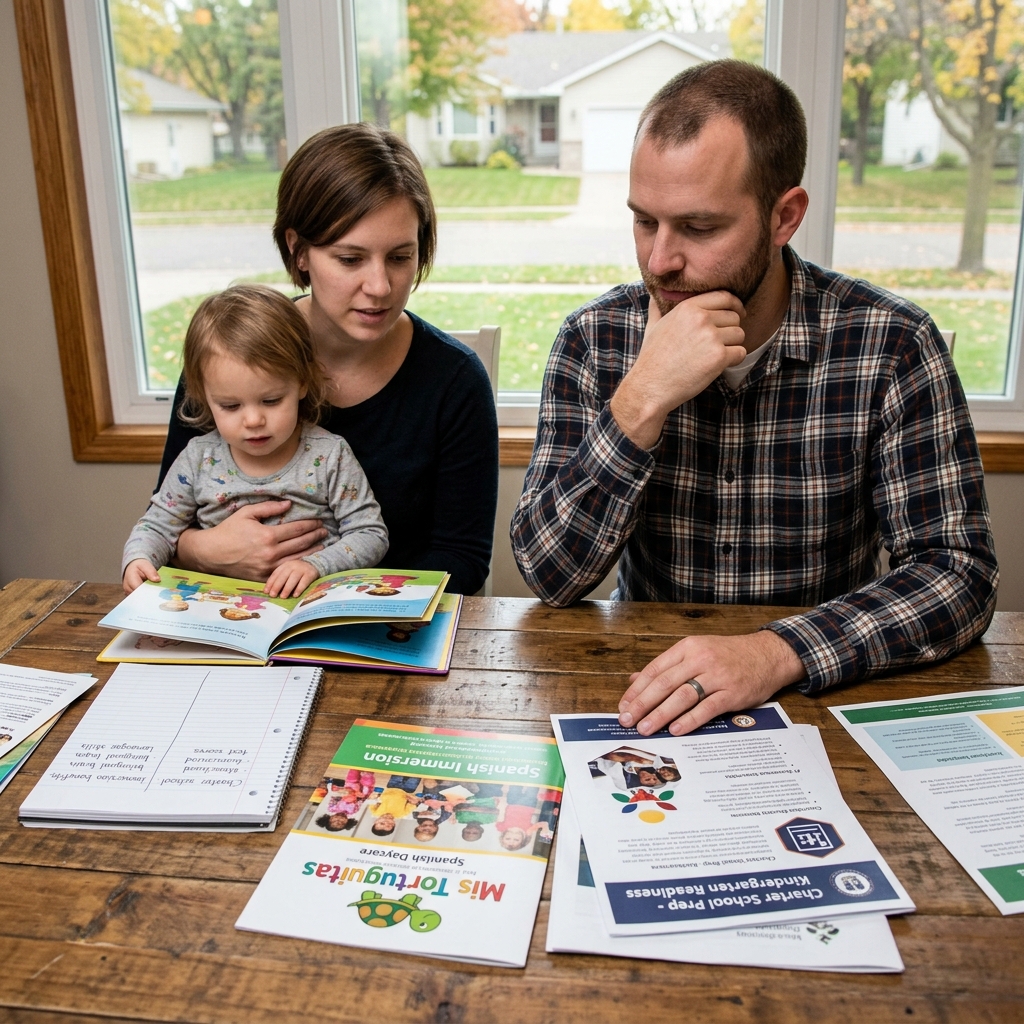
School readiness means more than knowing the alphabet. It’s about self-regulation, social skills, letter recognition, phonemic awareness, following multi-step directions, and the ability to sit and focus.
When your child spends 8, 10, or 12 hours per week in a structured immersion environment from infancy through age five, they’re building these skills alongside language development. They’re not waiting for kindergarten to start learning—they’ve already logged thousands of hours.
Consider a practical example: a three-year-old in our classroom is learning to share blocks while a caregiver narrates in Spanish (“Estamos compartiendo los bloques—we’re sharing the blocks”). The child gains vocabulary, social-emotional skills, and problem-solving practice simultaneously. This integration is exactly what kindergarten teachers look for.
By age four or five, children who’ve had consistent immersion daycare typically arrive at school with:
- Stronger attention spans and ability to follow group directions
- Richer vocabulary in two languages (vocabulary breadth and depth)
- Confidence in group settings and with new people
- Early phonemic awareness in both languages
- Comfort with literacy activities and storytelling
These aren’t guarantees, but they’re consistent advantages we see year after year. When children enter kindergarten with these foundations already solid, they’re ready to learn more, not just ready to sit still and comply.
How Our Bilingual Curriculum Builds Language and Literacy Skills
Language development is at the heart of everything we do. Our curriculum isn’t random—it’s thoughtfully designed around literacy milestones and language acquisition research.
For infants and young toddlers, we focus on language exposure and responsiveness. We narrate diaper changes (“Vamos a cambiar el pañal—we’re changing the diaper”), respond to babbling with enthusiasm, and read board books in Spanish daily. This foundation matters far more than formal lessons.
As children grow, we layer in phonological awareness. Toddlers enjoy Spanish nursery rhymes, songs with rhyming patterns, and playful sound games. They’re developing an ear for Spanish phonemes (sounds) without realizing they’re “learning.”
By preschool age, literacy activities become more explicit:
- Letter recognition and letter sounds in Spanish (a, b, c with their Spanish names and sounds)
- Sight word building and basic word families
- Invented spelling and emergent writing in Spanish
- Read-alouds with comprehension discussions
- Creating class books where children contribute drawings and words
What makes this work is consistency. The same caregiver reads to the same small group of children regularly. They notice which child is starting to recognize the letter “m” or who’s ready for rhyming games. Small class sizes and licensed caregivers mean your child gets individual literacy attention, not one-size-fits-all instruction.
Small Class Sizes and Personalized Attention That Matter
This is where the magic of immersion daycare differs sharply from many charter schools or large institutional programs. Our small class sizes mean your child isn’t one of 25—they’re known deeply.
In a class of 8-10 preschoolers with two caregivers, every child’s learning style, personality, and needs are visible. If Maria is a kinesthetic learner who needs to move to understand concepts, we know that. If Marcus is shy and needs extra time to warm up to new activities, we honor that.
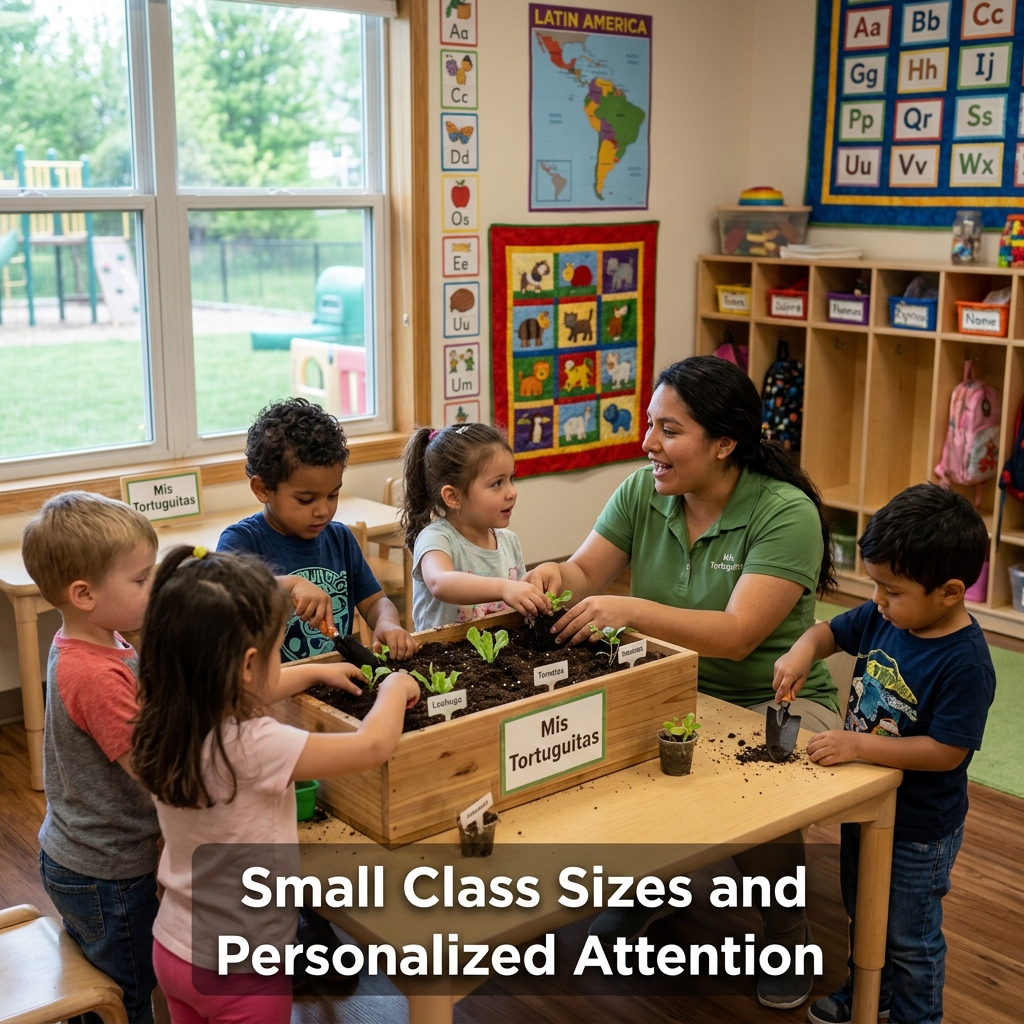
Personalized attention in a small class also means your child receives immediate feedback and encouragement in real time. They’re not waiting for a teacher who’s managing a larger group. When your child tries a new Spanish word or attempts a challenging puzzle, there’s an adult right there, celebrating the effort.
This matters especially in the bilingual context. Language acquisition thrives on interaction, not passivity. Small groups allow for genuine conversations, back-and-forth exchanges, and individual language scaffolding—the exact conditions that accelerate bilingual development.
Parents often tell us they chose us over larger daycares because they wanted their child to be seen as an individual. That’s exactly what we promise: peace of mind knowing your child is not just safe but genuinely known and nurtured.
Peace of Mind With Licensed Caregivers You Can Trust
Your child’s safety is our top priority, and we back that up with licensing, qualifications, and transparency.
Every caregiver on our team holds a current Minnesota childcare license and has completed CPR and first aid certification. We conduct background checks, verify references, and hire only caregivers who share our philosophy: treating every child with warmth, respect, and genuine care.
Beyond credentials, our bilingual caregivers bring something special: cultural fluency and authentic Spanish communication. They’re not just passing information to your child—they’re modeling language naturally and confidently. Children sense that authenticity.
We also maintain open communication with families. You’ll receive daily updates about your child’s day—what they ate, how they played, new words they tried, moments that made us smile. Many parents check in by phone during the day or stop by for a quick visit. Our facility is yours to know and trust.
Licensing and regular inspections ensure we meet state health and safety standards for facility cleanliness, nutrition, supervision ratios, and emergency preparedness. We’re not just following rules; we’re exceeding them because your family deserves more than compliance. You deserve a place where your child truly thrives.
The Cost and Convenience Factor Parents Should Consider
Let’s be honest: cost and schedule matter when you’re a working parent. Daycare is a significant line item in your family budget, and you need care that fits your work hours and commute.
Spanish immersion daycare through a specialized program like ours typically costs more per month than a traditional daycare, but less than full-time charter school tuition plus extended care. You’re investing in bilingual education, qualified staff, smaller classes, and a specialized curriculum.
Here’s the financial reality:
- Full-time immersion daycare (5 days/week): typically more than conventional daycare, but it’s one bill, one facility
- Charter school tuition (often free or subsidized): lower initial cost, but then you need after-school and summer care elsewhere, adding complexity
- Combined cost of traditional daycare plus tutoring for academics: sometimes exceeds specialized immersion daycare when you factor in additional services
Where we save families money is in convenience. One drop-off, one pickup, one place your child spends their days. No coordinating multiple programs, no transportation between locations. If work runs late, your child is already with us in a warm, safe space—not waiting at an after-school program or being rushed out of a school.
We offer full-time and part-time enrollment options to fit different family schedules. Some families choose 3 days a week; others need five. We work with you to create a rhythm that supports your family.
Real Outcomes: Why Immersion Daycare Prepares Children Best
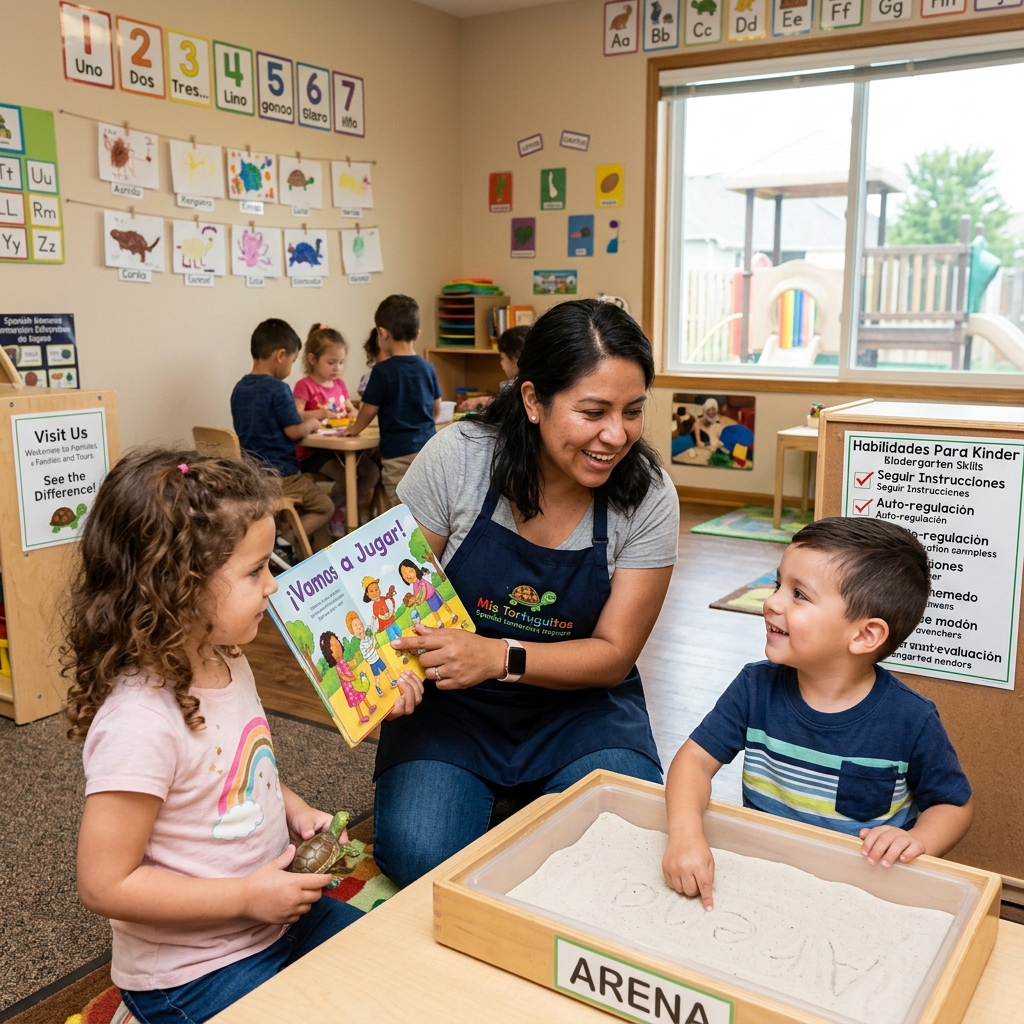
Theory is helpful, but what truly matters is what happens to real children. Families in our Farmington, Apple Valley, Lakeville, Eagan, and Rosemount communities have watched their children grow through immersion, and the outcomes speak for themselves.
Children who’ve completed our full program arrive at kindergarten with Spanish vocabulary that often impresses their teachers. They’re reading or very close to reading in Spanish. They’re confident speakers who aren’t afraid to try new words or make mistakes. They understand that languages are normal, valuable, and learnable.
Elementary teachers consistently tell parents that immersion-graduated children stand out: they have advanced phonemic awareness skills (which transfers to reading), stronger attention spans, and often demonstrate accelerated math reasoning (a cognitive benefit of bilingualism). When these children learn to read in English (often naturally and quickly after mastering Spanish foundations), they’re building on a powerful linguistic base.
Perhaps most importantly, immersion children develop a growth mindset around learning. They’ve internalized that effort and practice lead to understanding. They’re willing to tackle challenges because they’ve already “conquered” a whole language.
We don’t claim perfection or guarantee outcomes—every child develops at their own pace. But we’ve seen hundreds of children graduate from our program with confidence, curiosity, and a bilingual foundation that will benefit them throughout their academic lives and beyond.
How We Partner With Your Family Through Early Years
We don’t view ourselves as babysitters or even just as teachers. We’re partners with your family. Your values, your hopes for your child, your cultural identity—these all matter to us.
Partnership looks like regular conversations about your child’s progress, development, and personality. It means listening when you share concerns and working together to support your child’s growth. It means celebrating wins, whether that’s a child finally trying Spanish words at home or mastering a new social skill.
We also honor the fact that your family may be monolingual English speakers. We don’t expect you to be bilingual to support your child’s immersion experience. Instead, we provide tools: vocab lists, song recommendations, simple phrases you can learn together. Many families tell us that learning alongside their child became a beautiful shared experience.
Your child’s home language and culture are always valued here. If Spanish is spoken at home, wonderful—we celebrate that. If English is your family’s language, equally wonderful—immersion works beautifully in either context. Bilingualism isn’t about rejecting one language; it’s about expanding what your child can do and understand.
We also stay connected throughout transitions. As your child prepares for kindergarten, we share detailed information with schools about their learning style, strengths, and needs. We help your child feel excited about the next chapter, not anxious about change.
Schedule Your Tour and See the Difference
If you’re considering immersion daycare versus other paths for your child’s early education, the best way to know if we’re the right fit is to visit. Come see our warm, home-away-from-home environment. Meet our bilingual caregivers. Watch small groups of children engaged in play and learning.
During a tour, you’ll notice the details that matter: the Spanish-language books in every classroom, the comfortable spaces designed for children to explore safely, the genuine joy on our staff’s faces. You’ll hear Spanish in natural conversation, not forced lessons. You’ll feel the calm, nurturing culture we’ve built.
We’re conveniently located to serve Farmington, Apple Valley, Lakeville, Eagan, and Rosemount families. We accept children from six weeks through six years old, with programs designed for each developmental stage.
Schedule a tour today or call us with questions. We’re happy to discuss your family’s goals, answer questions about our curriculum, and help you understand whether immersion daycare is the right choice for your child. We treat every family inquiry with the same warmth and care we bring to every child—because we know this decision matters deeply to you.
Come see for yourself why so many families in our community have chosen Mis Tortuguitas as their partner in early childhood education and bilingual development.