
Table of Contents
- Why Spanish Immersion Matters for Your Infant's Development
- The Challenge of Finding Quality Bilingual Infant Care
- What Makes Our Spanish Immersion Program Different
- Our Infant Care Standards and Safety Features
- How We Build Language Skills from Six Weeks Old
- Our Qualified Bilingual Teaching Staff and Small Class Sizes
- Full-Time and Part-Time Enrollment Flexibility for Busy Families
- A Home-Away-From-Home Environment Your Baby Deserves
- Real Parent Experiences at Mis Tortuguitas
- Why We're Farmington's Best Choice for Infant Spanish Immersion
- Schedule Your Tour and See the Difference
Why Spanish Immersion Matters for Your Infant’s Development
When you return to work, the idea of leaving your baby with someone else is never easy. You want them safe, loved, and thriving—especially during these crucial early months when their brain is absorbing everything around them. What if your infant could spend those hours not just cared for, but building fluency in a second language at the same time?
That’s the opportunity we offer at Mis Tortuguitas, Farmington’s first licensed Spanish immersion daycare. We understand that finding quality infant care is hard enough. Finding one that creates genuine bilingual foundations from six weeks old? That’s rarer still. Let’s walk through what Spanish immersion infant care really means, why it matters, and how we’ve built a program that gives your little one a profound cognitive and cultural head start.
Your baby’s brain is its own supercomputer right now. Between six weeks and three years, infants absorb language patterns, sounds, and structures at a pace they’ll never match again. Research shows that exposure to a second language during infancy doesn’t slow down first-language development—it actually strengthens overall cognitive flexibility and executive function.
When infants grow up around Spanish daily, they develop what researchers call “dual language networks.” Their brains build pathways for both languages simultaneously, creating stronger neural connections overall. This isn’t just about speaking two languages later; it’s about training the brain to process, organize, and switch between different systems of meaning.
Beyond cognition, there’s cultural richness. Your child will internalize Spanish sounds, rhythms, and social patterns naturally—the same way they absorb English. They’ll grow up seeing Spanish as simply part of how people communicate, not as a “foreign” skill to learn later. This early familiarity also builds confidence and openness to diversity that lasts a lifetime.
For families like yours in the Farmington area, this advantage is real and measurable. Children who begin immersion in infancy tend to reach higher proficiency levels, maintain stronger bilingual skills into school age, and show increased academic flexibility across other subjects.
What to do next: Reflect on your family’s bilingual goals. Are you a Spanish-speaking family wanting to preserve language at home? A non-Spanish family wanting your child to grow up bilingual? Either way, early immersion gives you the strongest foundation.
The Challenge of Finding Quality Bilingual Infant Care
Here’s what many parents discover when they start searching: most infant daycare centers focus on safety and basic care. That’s the baseline, and it matters. But truly bilingual infant care is harder to find than it sounds.
Many daycares claim to offer “Spanish” but might mean a few songs once a week or a bilingual assistant who isn’t the primary caregiver. Others have rotating staff, so your infant hears different accents and speaking styles constantly, which can create confusion instead of clarity. Then there’s the cost factor—genuine Spanish immersion often comes with a premium, and many families worry it’ll stretch an already tight budget.
Finding a program where Spanish is genuinely the working language of the classroom—not an add-on—takes real searching. You need caregivers who are native or near-native speakers, trained in early childhood development, and comfortable speaking Spanish all day with infants who can’t yet talk back. You need consistency so your baby hears the same trusted voices modeling language daily. And you need licensing, safety standards, and small class sizes so your infant gets personal attention while immersed in Spanish.
That’s the gap we saw in Farmington. Quality bilingual infant options just weren’t there.
What to do next: When evaluating any infant daycare, ask directly: “What percentage of the day is actually Spanish? Who speaks it, and are they consistent caregivers?” The answers will tell you everything.
What Makes Our Spanish Immersion Program Different
We designed our infant Spanish immersion program around one core belief: your baby deserves a genuine, consistent immersion experience paired with the warmth and safety of home-based care.
Here’s what that looks like in practice. Spanish is the primary language spoken throughout our facility—not just during designated “Spanish time.” Our caregivers use Spanish naturally during diaper changes, feeding, playtime, and transitions. Your infant hears it in context, attached to real interactions and emotions, which is how babies actually learn language best.
We keep class sizes intentionally small. Your newborn or infant will have the same primary caregiver most days, building the secure attachment that’s essential for development. That consistency means your baby learns one person’s voice patterns deeply, and that trusted adult can respond to your child’s emerging sounds and cues with genuine bilingual feedback.
Our curriculum isn’t academic in the traditional sense—infants don’t need worksheets. Instead, we use sensory play, language-rich interactions, music, movement, and routine care moments as the primary teaching tools. Songs, rhymes, storytelling, and responsive conversation with your baby build phonological awareness and vocabulary in Spanish naturally.
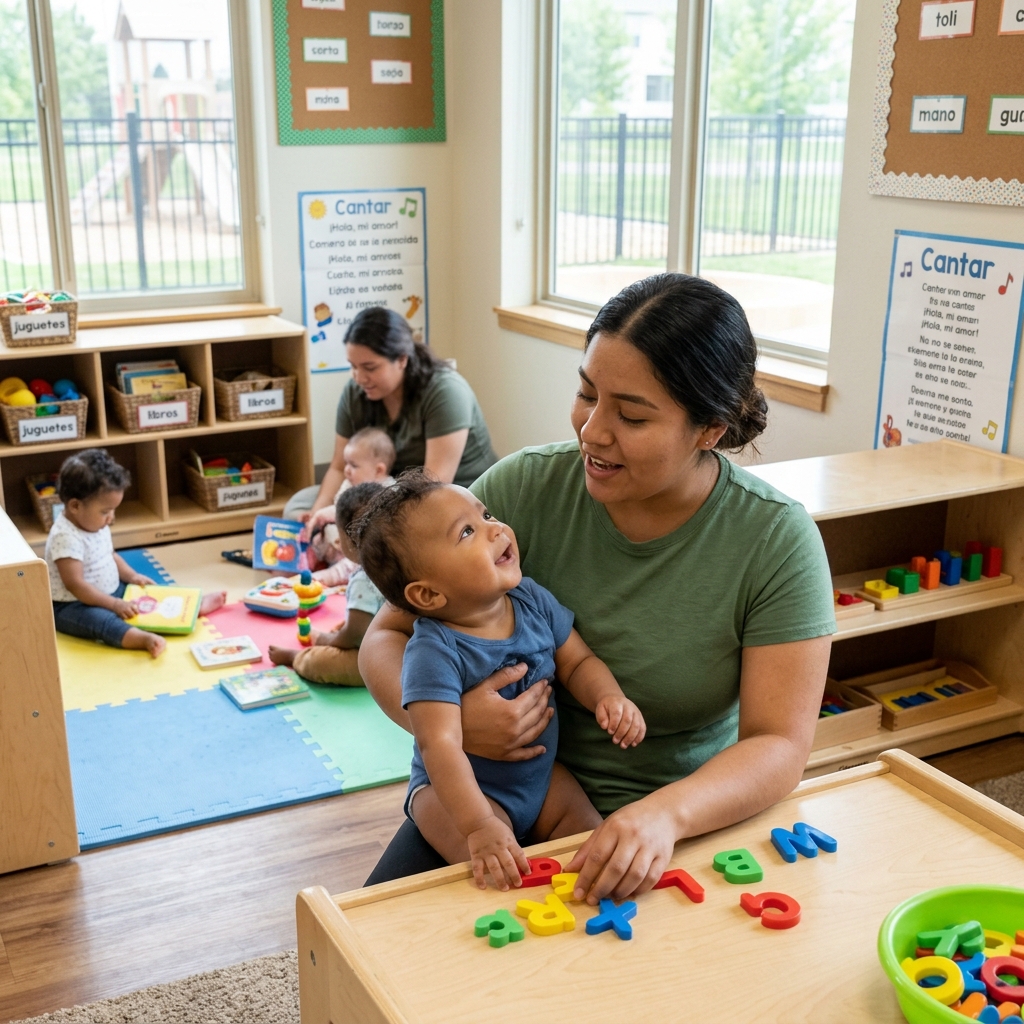
We also partner with your family. If you speak English at home, that’s perfect—your child will hear both languages, and the immersion during care hours provides daily, consistent Spanish input. If Spanish is your family language, we reinforce and expand it. Either way, we treat every child like our own and respect your family’s linguistic goals.
What to do next: When you tour any bilingual program, observe for 10 minutes in the infant room. Do you hear Spanish flowing naturally during care routines? Or is English the default with Spanish sprinkled in? That observation alone tells you the quality.
Our Infant Care Standards and Safety Features
Your child’s safety is our top priority, and that foundation matters before anything else. We’re fully licensed by the Minnesota Department of Human Services, which means we meet rigorous health, sanitation, safety, and staff qualification standards.
Our facility is designed specifically with infants in mind. We maintain appropriate temperature control, use SIDS-safe sleep practices (firm mattresses, no bumpers or loose blankets), and follow current safe sleep guidelines. Our staff is trained in infant CPR and first aid, and we maintain comprehensive health protocols including regular sanitizing, diaper-changing stations that prevent cross-contamination, and clear illness policies.
We staff our infant rooms generously to meet licensing ratios—and we often exceed them. For our youngest babies (six weeks to one year), we maintain a 1:4 caregiver-to-infant ratio, which is better than the state minimum. For older infants and toddlers, we keep similarly low ratios. This means your baby gets responsive, individualized attention throughout the day.
All our caregivers undergo background checks, health screenings, and ongoing training in child development, emergency procedures, and bilingual communication strategies. We have secure entry systems, and we communicate with parents daily via written updates and photos so you stay connected even while you’re focused on work.
What to do next: Ask any daycare for their current licensing status and most recent inspection reports. Request details on their infant sleep practices and emergency procedures. Don’t settle for vague answers—you deserve specific, clear information.
How We Build Language Skills from Six Weeks Old
Newborns and young infants can’t speak, so how does immersion work? The magic is in listening and recognition. Your baby’s brain is mapping language patterns from day one, distinguishing sounds, recognizing voices, and building the foundation for later speech.
In our infant rooms, we use predictable routines and responsive language. During diaper changes, our caregivers narrate: “Vamos a cambiar tu pañal. Levantamos las piernitas. Qué suave.” (We’re going to change your diaper. We lift your little legs. So soft.) Your baby hears Spanish attached to real actions and feelings. Songs and gentle rhymes during transitions reinforce rhythm and phonetic patterns.
As infants grow into the babbling stage (around 4-6 months), our staff responds to every coo and babble as conversation. When your baby says “ba-ba-ba,” we mirror it back in Spanish context: “Sí, muy bien! Ba-ba. Bravo!” (Yes, very good! Ba-ba. Bravo!) This back-and-forth builds confidence and shows your baby that their sounds matter and can be Spanish.
By 9-12 months, many infants begin saying first words. In our immersion environment, those first words often emerge in Spanish first—simple words like “papá,” “mamá,” “perro” (dog), or “agua” (water). We celebrate these moments and reinforce them. If you speak English at home, your child will develop code-switching naturally (switching between languages depending on context), which is a sign of healthy bilingual development, not confusion.
We use picture books, sensory exploration, and music specifically chosen for Spanish phonetics. Lullabies like “Arrorró” and action songs like “Así So Hacemos” become part of your baby’s daily rhythm, embedding Spanish sounds and patterns.
What to do next: Start noticing your own baby’s current sounds and vocalizations. When your infant attends immersion care, ask your caregiver to share examples of how they’re responding to those sounds in Spanish. You’ll see the progression.
Our Qualified Bilingual Teaching Staff and Small Class Sizes
The single biggest factor in your child’s immersion success is the quality and consistency of their caregivers. We’ve built our team carefully.
Every staff member in our infant program is bilingual with Spanish as a native or near-native language. They’re not learning Spanish alongside your baby—they’re fluent and speak it naturally. Many are from Spanish-speaking countries and bring cultural knowledge and authentic accents that matter.
Beyond language, every caregiver holds current CPR/First Aid certification and has completed early childhood education training. Many hold specialized credentials in infant development or bilingual early childhood education. We hire for warmth and patience first—the ability to genuinely connect with an infant and respond to their non-verbal cues—and we invest in ongoing professional development.
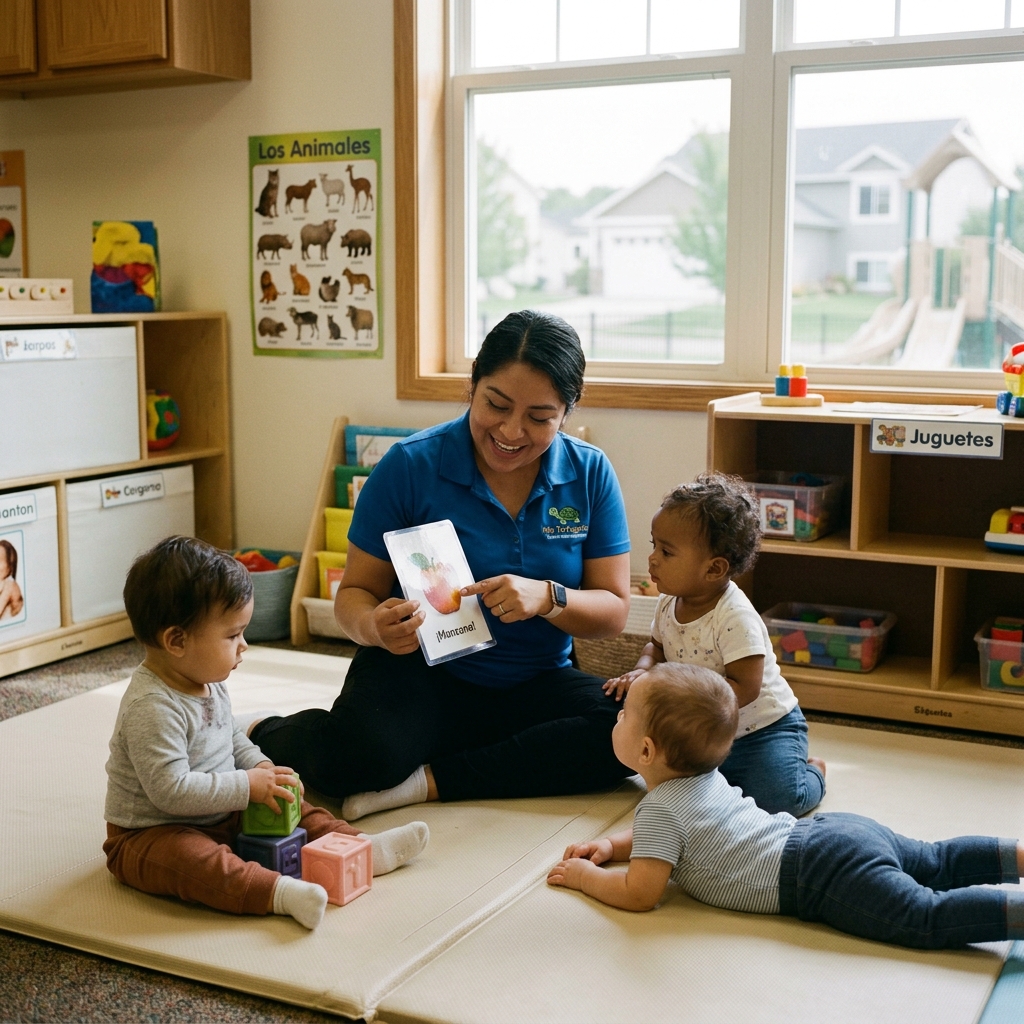
Small class sizes mean your baby isn’t one of eight infants with one caregiver. We typically have 4-5 infants per primary caregiver in our youngest rooms. This ratio allows your child to experience responsive, attachment-based care—the kind where their caregiver knows their hunger cues, sleep patterns, and preferred way of being soothed. A consistent caregiver who speaks Spanish all day becomes a trusted adult model for language and behavior.
Staff consistency is intentional. We don’t rotate caregivers. Your baby will likely have the same primary caregiver throughout their time in our infant room, building deep familiarity and secure attachment. That continuity is powerful for development and for your peace of mind.
What to do next: When interviewing any infant care, ask: “Will my baby have the same primary caregiver most days?” and “What’s the training background of staff?” Listen for specifics, not generalities.
Full-Time and Part-Time Enrollment Flexibility for Busy Families
We know that every family’s schedule looks different. Some parents return to full-time work. Others have flexible schedules, part-time roles, or variable hours. One size doesn’t fit all.
We offer full-time enrollment (five days a week, traditional business hours) and part-time options (2-3 days per week, flexible scheduling). Both options include the same high-quality Spanish immersion experience and small class sizes. Whether your child attends full-time or part-time, they’re part of our community and receive consistent, responsive care.
Part-time enrollment is especially popular with parents who work from home part-time, have a co-parenting arrangement, or want to balance outside care with family time. Your child still benefits from daily Spanish immersion during their attendance days, and you get focused time to work without childcare worries. Full-time enrollment provides consistent peer interaction, routine, and comprehensive language exposure.
Our flexible scheduling also accommodates school holidays and summer breaks. We can discuss your family’s needs when you schedule a tour.
Pricing varies by enrollment level and age, and we’re transparent about costs upfront. We don’t hide fees, and we work with families on billing to reduce stress for busy parents. We’re also happy to discuss how your FSA or other childcare benefits might apply.
What to do next: Calculate your actual weekly childcare need based on your work schedule and family support. Part-time might work if grandparents cover extra days, for instance. Be honest with yourself about what your family actually needs—and we’ll build a plan that fits.
A Home-Away-From-Home Environment Your Baby Deserves
A daycare can meet all the safety boxes and deliver immersion, but if it doesn’t feel warm and nurturing, something essential is missing. We designed our space to be a warm, home-away-from-home where your baby feels secure and loved.
Our infant rooms are soft, calm, and sensory-rich without being overstimulating. Natural light, gentle colors, plants, and age-appropriate toys create an environment where a small baby can rest and explore safely. We play soft Spanish music, including traditional lullabies and modern children’s songs that soothe and engage.
Routines are predictable and unhurried. We follow your baby’s hunger and sleep cues rather than forcing a group schedule. Feeding times are one-on-one, with your baby held and connected to their caregiver. Nap times happen in safe, quiet spaces where we can monitor sleep closely. Diaper changes are moments of connection, not just logistics.
We welcome family members to visit. If a grandparent wants to observe, have lunch with your child, or see their day firsthand, we invite that. Your child’s extended family is part of their village.
Daily communication is warm and specific. You’ll receive photos and written updates—not just “He had a good day” but “Matteo tried squash for the first time and loved it. He kept saying ‘más, más!’ (more, more!). He napped for 90 minutes this afternoon and woke up smiling.” You stay connected.
What to do next: When you visit any childcare facility, pay attention to how the staff interact with babies. Do they seem rushed, or do they pause and respond warmly to vocalizations? Do they speak directly to the infants, or mostly to each other? That warmth—or absence of it—isn’t something you can change. Choose a place where it’s already there.
Real Parent Experiences at Mis Tortuguitas
We could tell you about our program, but what parents actually experience matters most.
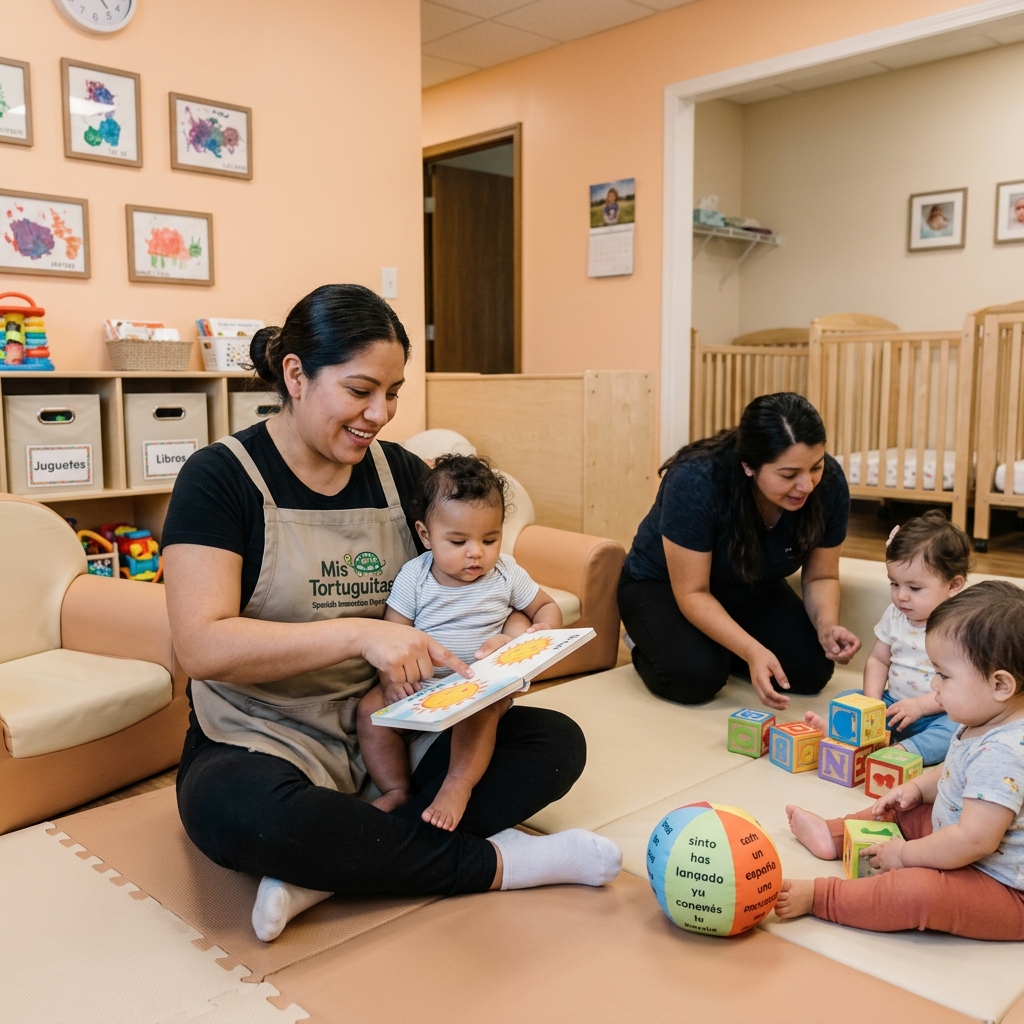
Families who choose us come back with stories. Parents watch their infants go from hearing only English at home to recognizing Spanish, understanding simple commands, and—around 12-18 months—saying their first words in Spanish alongside English. One parent shared that her daughter’s first word was “agua” (water), and now at three years old, she code-switches between languages naturally, speaking Spanish with our staff and English with her parents. The family never expected that fluency and now cherishes their daughter’s bilingual identity.
Other families appreciate the peace of mind. Working parents know their baby isn’t just in a safe facility—they’re in a place where someone genuinely excited about their development is speaking to them in Spanish all day. One father told us: “I had been worried about putting our son in daycare, but knowing he’s getting immersion hours I could never give him at home has made the whole transition easier. I trust these caregivers with my baby AND his future.”
Parents also value the consistency and responsiveness. Because we keep class sizes small and caregivers consistent, families feel known. Our staff learns not just your baby’s name but your family’s preferences, cultural values, and bilingual goals. One mother noted: “Our caregiver texts me photos of little Maria exploring the sensory bin, and every evening she tells me specific things Maria did that day. I feel like I’m part of her day even though I’m at work.”
The sense of community is real too. Families who attend part-time or full-time become part of our Mis Tortuguitas family. Parents connect with each other, share bilingual parenting tips, and feel part of something larger than just a daycare transaction.
What to do next: Ask for references from current families when you tour. Real conversations with real parents will tell you more than any marketing message.
Why We’re Farmington’s Best Choice for Infant Spanish Immersion
You could search for infant care in Apple Valley, Lakeville, Eagan, or Rosemount. You might find safe places, even some claiming bilingual programs. But we’re Farmington’s first licensed Spanish immersion daycare, and that distinction comes from commitment, not marketing.
We specialize in this. Our entire program—from curriculum design to staff hiring to facility setup—exists to deliver genuine Spanish immersion paired with exceptional infant care. We’re not a general childcare center that added Spanish; we’re built on the bilingual mission from the ground up.
Our staff is specifically trained in both infant development and bilingual language acquisition. We understand the neuroscience of how babies learn dual languages, and we apply that knowledge every day. Our curriculum materials, music, books, and activities are selected specifically for Spanish immersion in the birth-to-three age range.
We’re deeply rooted in Farmington and the surrounding communities. We understand the families we serve—working parents balancing career and family, families who value bilingual heritage, parents seeking educational advantages. We’re not a corporate chain; we’re a local, family-owned program that cares about our community.
Our licensed status means you get accountability. We’re inspected, we meet rigorous standards, and we document our practices. Your child isn’t an experiment; they’re in a regulated, professional program that’s transparent and answerable to state oversight.
Most importantly, we treat every child like our own. That phrase means something specific to us. We wouldn’t leave our own infant in rushed conditions, with rotating caregivers, or without genuine engagement. So we don’t ask that of other families either. Your child deserves a Spanish immersion experience that’s both linguistically rich and emotionally secure. That’s what we deliver.
What to do next: Stop comparing generic options. You’ve found a program specifically designed for your goal: high-quality, Spanish-immersion infant care in Farmington where your baby will be genuinely loved and bilingual skills will be nurtured from six weeks old.
Schedule Your Tour and See the Difference
Reading about our program gives you the facts. Visiting changes everything. You’ll see the soft colors of our infant rooms, hear Spanish spoken naturally during daily routines, and watch how our caregivers interact with the babies in our care. You’ll feel the warmth.
Tours are personalized. We don’t rush them. You’ll get to ask questions, observe our spaces, meet our staff, and imagine your baby thriving here. Many parents say that seeing the program in action made their childcare decision easy.
To schedule a tour, contact us through our website at mistortuguitas.com or call to discuss your family’s specific needs and childcare timeline. We also welcome drop-in visits during operating hours if you want to see us in action without an appointment.
We serve families across Farmington, Apple Valley, Lakeville, Eagan, and Rosemount—wherever your commute takes you. Your child deserves a Spanish immersion experience built on genuine expertise, warmth, and safety. We’d love to show you what that looks like.
Come see for yourself. Your baby’s bilingual journey can start today.