Table of Contents
- Why Parents Hesitate: The Fear of No Spanish Background
- The Myth That Your Child Needs Prior Exposure
- Our Zero-Background Approach: How We Make the Transition Smooth
- Approach 1: Waiting Until Kindergarten – What You're Missing
- Approach 2: Starting Spanish Immersion at Mis Tortuguitas – Why It Works Better
- Comparison: Language Retention and School Readiness Outcomes
- The Bilingual Brain Advantage: How Early Exposure Creates Lifelong Benefits
- Our Supportive Environment: Small Classes and Licensed Bilingual Caregivers
- What Real Parents Say About Their Toddler's Transition
- How We Partner With Your Family Through the Process
- Making the Decision: Why We're the Clear Choice for Your Family
- Schedule Your Tour and See Our Warm, Nurturing Community Today
Why Parents Hesitate: The Fear of No Spanish Background
It’s a question we hear almost every week from parents exploring our program: “But we don’t speak Spanish at home. Won’t that confuse our child?” The worry is real, and it comes from a place of love. You want the best for your little one, and the thought of sending them into a Spanish-only classroom without any foundation can feel daunting.
Many parents feel caught between two competing hopes: wanting their child to grow up bilingual while fearing that a full immersion environment might overwhelm them or slow down their English development. It’s natural to wonder if you’re setting your child up for success or creating an unnecessary obstacle. After all, English will come naturally at home and in their everyday world anyway, right?
Here’s what we’ve learned from working with families across Farmington, Apple Valley, Lakeville, Eagan, and Rosemount: that hesitation is actually a sign that you’re thinking seriously about your child’s future. And the good news is that having no Spanish background at home is not a barrier. It’s simply where your family starts.
Your next step: Take a breath. This isn’t something your child needs you to solve before they arrive. We handle the transition with care, and we’ll walk alongside your family every step of the way.
The Myth That Your Child Needs Prior Exposure
Let’s bust this one open: Children absolutely do not need prior Spanish experience to thrive in a Spanish immersion program. In fact, many of the most confident bilinguals we’ve seen started with zero exposure at home.
Here’s the science: Young children are natural language learners. Between six weeks and six years old, your child’s brain is actively building neural pathways for language acquisition. They don’t need to understand Spanish before they arrive. They need an immersive, consistent environment where Spanish is the everyday language. Your daycare provider speaking only Spanish during the day is far more effective than any at-home crash course you could create.
Think about how your child learned English. They didn’t take lessons first. They were surrounded by it, they heard it spoken naturally and repeatedly, and their brain made the connections. Spanish immersion works exactly the same way, except now your child has the cognitive advantage of developing two language systems simultaneously during their peak learning years.
The myth persists because many programs expect families to do the language work at home before enrollment. We don’t believe in that model. We believe in doing the work where it matters most: in a dedicated, professional immersion environment during the hours when your child learns fastest.
What to do: Stop worrying about teaching Spanish at home first. Your job is to provide a loving, curious attitude about the experience. We’ll provide the language expertise.
Our Zero-Background Approach: How We Make the Transition Smooth
We designed our Spanish immersion for toddlers program specifically for families like yours, with no prior Spanish exposure. Every single element is built around a smooth, confident transition.
First, we staff our classrooms with licensed bilingual caregivers who understand the psychology of language introduction. They’re trained to pair Spanish words with actions, gestures, and real objects so meaning becomes clear without translation. When your toddler hears “ponte los zapatos” (put on your shoes) while their teacher points and models the action, they understand through context and repetition, not through a parent translating in English.
Second, we keep class sizes intentionally small. This means your child isn’t one of twenty kids competing for attention during those crucial language exposure moments. Our teachers can respond to individual learning rhythms, repeat key phrases, and build confidence one child at a time. A toddler learning “hola” (hello) with eye contact and warmth internalizes it differently than a child in a large group where the language feels distant.
Third, we use a consistent, predictable daily routine in Spanish. Songs, circle time, snack time, outdoor play, transitions between activities, cleanup, goodbye rituals. Every part of the day follows a pattern so your child begins to predict and then participate in Spanish naturally. Familiarity builds confidence.
We also maintain transparent communication with parents. You’ll know exactly what your child is hearing and learning each day so you can reinforce comfort at home without teaching Spanish yourself. This partnership bridges the gap between our immersion classroom and your family’s English-speaking world.
Action item: Schedule a tour to see our classroom environment and meet our bilingual staff. You’ll see firsthand how naturally our teachers create a Spanish-speaking world that feels safe and inviting.
Approach 1: Waiting Until Kindergarten – What You’re Missing
Let’s be honest about the wait-and-see approach. Many families decide to keep their child in English-only childcare now and introduce Spanish formally when school starts. On the surface, this feels safer. Your child will be older, more verbal in English, and “ready” for something new. But there’s a real cost to this timeline that parents often don’t fully consider.
Between birth and age five, your child’s brain is at its absolute peak for language acquisition. Neural pathways for language learning are being built at a rate that will never happen again. By kindergarten, much of that window has begun to close. This doesn’t mean a kindergartener can’t learn Spanish. They absolutely can. But they’ll work harder, progress more slowly, and may struggle with pronunciation and natural speech patterns that come effortlessly to younger children.
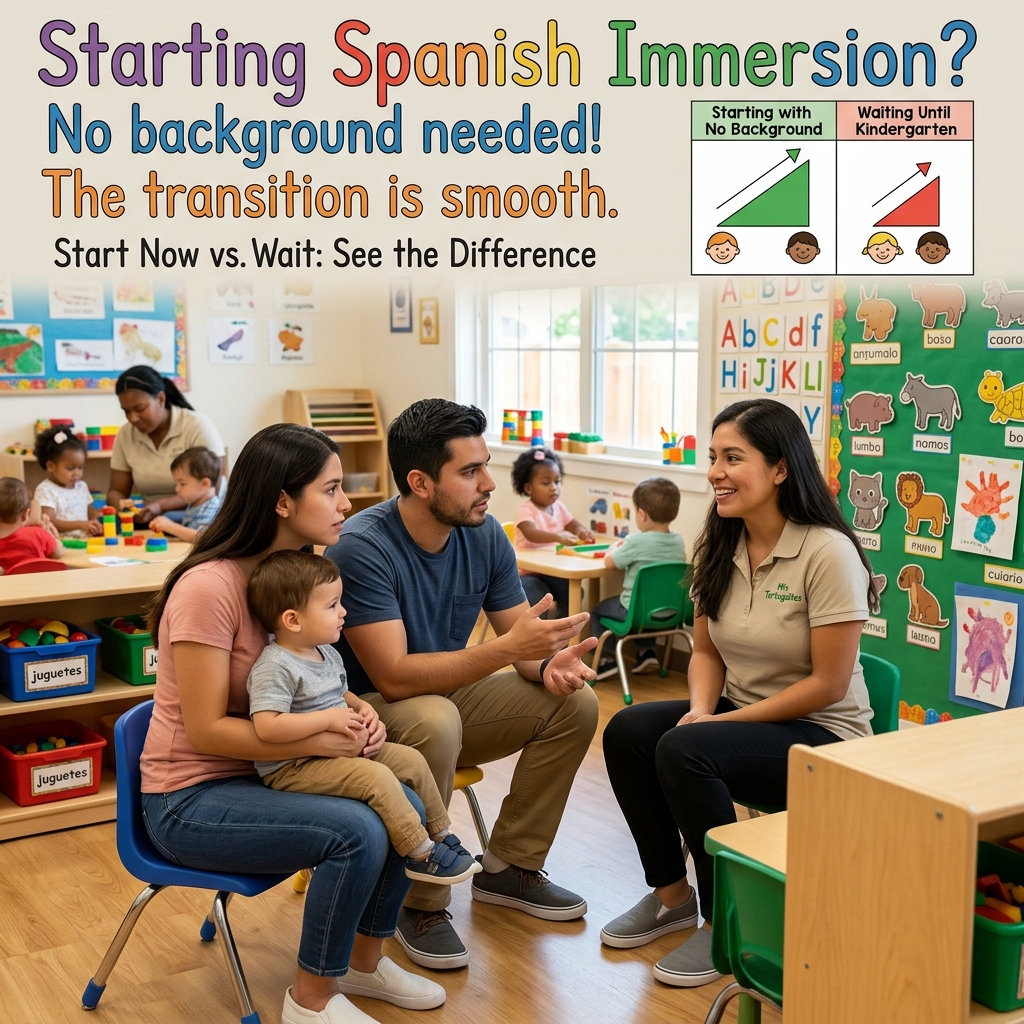
Second, waiting until school age means missing years of cognitive bilingualism. When a young child grows up hearing two languages simultaneously, their brain develops differently in beneficial ways. They build stronger executive function skills, better attention control, and enhanced cognitive flexibility. These aren’t just language benefits; they’re brain-building benefits that support all learning. Kindergarten Spanish classes, even good ones, can’t replicate the neurological advantage of true daily immersion from age two or three onward.
There’s also the transition challenge. Starting Spanish immersion at age five or six means your child is also navigating the social and emotional adjustment of kindergarten itself. They’re meeting new peers, adjusting to more structure, managing separation from parents, and learning classroom expectations, all while trying to decode a new language. That’s a lot of simultaneous adjustment.
Additionally, children who arrive at kindergarten Spanish programs without prior exposure often feel behind their peers who have already spent years in immersion. The confidence gap can be real, and by then, peer dynamics matter more. Early immersion builds that confidence while your child’s social world is still small and focused on their teacher’s support.
The reality: Waiting trades years of optimal learning for a more convenient timeline now. Your child will manage, but they won’t have the full advantage they could have had.
Approach 2: Starting Spanish Immersion at Mis Tortuguitas – Why It Works Better
Starting immersion early with us positions your child for genuine bilingualism, not just basic Spanish skills. Here’s what the research and our years of experience show us:
Children who begin Spanish immersion between ages two and four develop true bilingual proficiency by school age. They’re not translating or studying Spanish; they’re thinking in Spanish during their daycare hours, switching naturally between languages at home and with us. This cognitive flexibility is a gift that becomes more difficult to achieve as children age.
We treat every child like our own, which means we pace the immersion based on what we observe about your child’s comfort and progress, not on a predetermined curriculum timeline. Some children take to the all-Spanish environment immediately; others need a few weeks of quiet listening before they begin speaking. Both paths are completely normal, and our experienced staff knows how to honor each child’s unique entry into the language.
Our Spanish immersion preschool environment is also building school readiness through the medium of Spanish. Your child isn’t just learning a language; they’re learning letters, numbers, problem-solving, social skills, and independence all in Spanish. By the time they enter kindergarten, they’re not just bilingual. They’re cognitively ahead because they’ve had to think more deeply about language to understand it.
You’re also giving your family a gift that lasts a lifetime. A child who grows up bilingual has cognitive advantages throughout their education and career. They have access to another culture, another way of thinking, and frankly, better opportunities in an increasingly global world. This isn’t about perfection or native-level fluency. It’s about opening doors that would otherwise stay closed.
Why we’re different: We don’t treat Spanish immersion as an add-on. It’s woven into every moment of your child’s day, delivered by licensed, passionate bilingual educators in a warm, nurturing setting. This is how genuine bilingualism is built.
Comparison: Language Retention and School Readiness Outcomes
The differences between these two approaches become clearest when we look at actual outcomes. Children who begin Spanish immersion between ages two and four retain language skills long-term because the immersion was deep and early. Research consistently shows that languages learned before age five are processed in the same brain regions as a native language, which means retention is stronger and accent-free pronunciation is more likely.
Children who start Spanish in kindergarten learn more slowly, retain less, and often lose ground during summer breaks because they don’t have the ongoing reinforcement that an immersion environment provides. A once-a-day Spanish class in elementary school, even a good one, can’t match the intensity and consistency of daily immersion.
On school readiness, the comparison is striking. Children from our Spanish immersion program enter kindergarten with:
- Stronger phonemic awareness (understanding how sounds work), which transfers across languages
- Better listening comprehension and attention skills developed through the effort of understanding a new language
- Confidence in learning, having already navigated and mastered a complex cognitive task
- More developed social-emotional skills from small class environments and individualized attention
- A natural understanding that different people speak different languages, which supports cognitive development
Children starting Spanish in kindergarten enter that year at the typical English-language readiness level. They’re not behind, but they’re also not ahead, and they’re splitting cognitive energy between language learning and traditional academics.
The long-term difference is even more pronounced. By high school, students who’ve had years of immersion are functionally bilingual, capable of genuine academic work in Spanish. Students who started in kindergarten may have conversational skills but rarely achieve the depth of bilingual competency. The window closes, and the earlier you start, the wider it opens.
The bottom line: Early immersion isn’t just nice to have. It’s the scientifically supported path to real, lasting bilingualism.
The Bilingual Brain Advantage: How Early Exposure Creates Lifelong Benefits
When your child grows up bilingual from an early age, something remarkable happens in their brain. They’re not just learning two language systems. They’re building a more flexible, resilient cognitive architecture.
Research in neuroscience shows that bilingual children develop stronger executive function. That means better impulse control, superior working memory, and enhanced ability to switch between tasks. These skills, built through the constant cognitive work of managing two language systems, spill over into every area of learning and life.
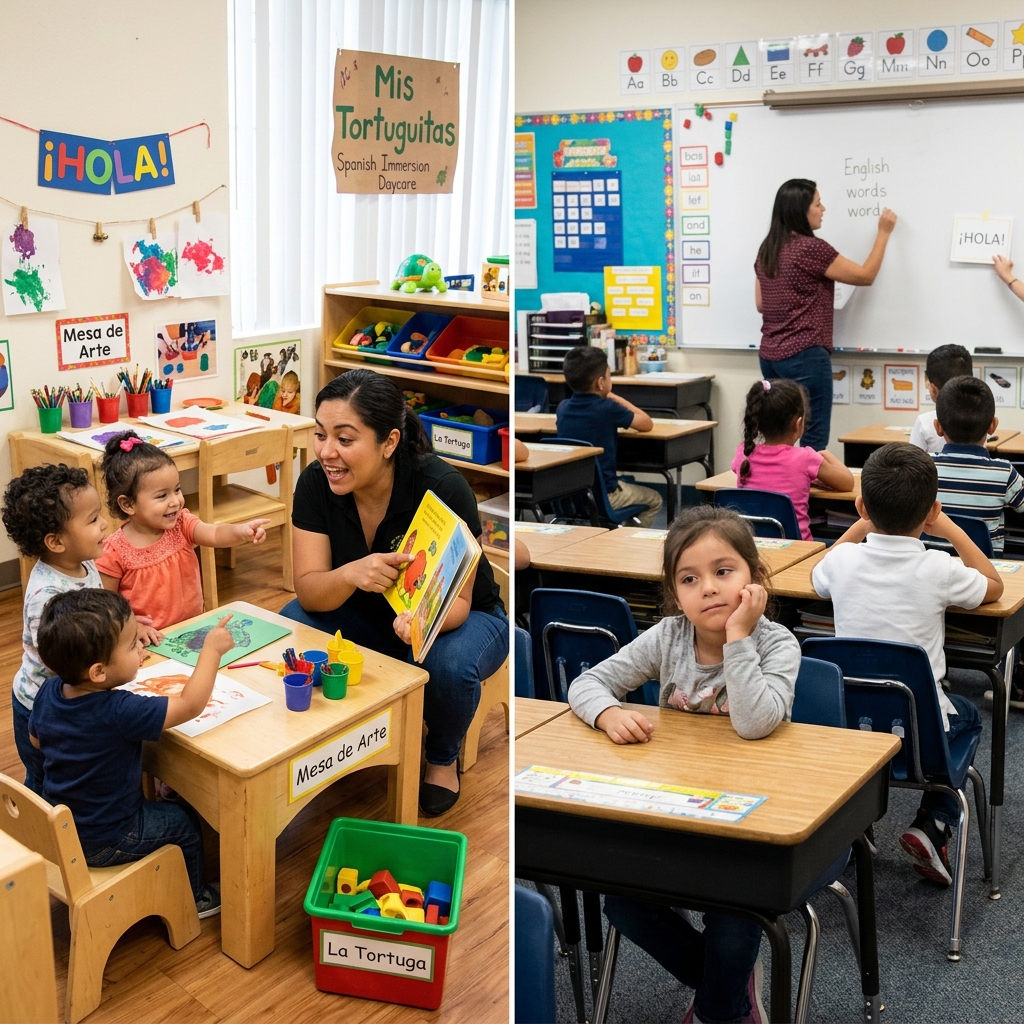
Bilingual children also develop stronger social-emotional intelligence. They’re navigating the complexity of understanding that the same thing has two names, that different people speak different languages, and that communication requires attention to context and audience. These realizations build empathy and perspective-taking earlier than in monolingual peers.
But here’s what often gets overlooked: bilingualism is a confidence builder. Your child will spend years hearing “Muy bien” (very good), being praised for effort, and successfully navigating a complex language environment. That sense of competence doesn’t stay confined to Spanish class. It seeps into their sense of themselves as capable learners.
There’s also the cultural dimension. A child growing up with Spanish, even if they’re not of Hispanic heritage, develops a natural connection to Spanish-speaking cultures and people. This isn’t cultural appropriation; it’s cultural competency and genuine access to another way of being in the world. That opens possibilities your monolingual child might never have.
And practically speaking, in a world where bilingual job candidates earn more and have more opportunities, you’re giving your child a long-term advantage that starts in toddlerhood. This is a gift that compounds over time.
Why it matters: The bilingual brain isn’t a dual English-and-Spanish brain. It’s a fundamentally more capable, adaptable, curious brain. That advantage begins now, in your child’s earliest years.
Our Supportive Environment: Small Classes and Licensed Bilingual Caregivers
Your child’s safety is our top priority, and that safety includes emotional safety and the security of knowing their caregiver. We accomplish this through intentional staffing and class sizes that honor your child’s developmental needs.
Our small classes mean your child isn’t one of a crowd. In our toddler and preschool programs, low student-to-teacher ratios mean every child gets genuine one-on-one interaction, their name is called frequently, their efforts are noticed, and their transition into Spanish immersion happens in a context of warmth and security, not overwhelming stimulation.
Every member of our teaching team holds a bilingual credential and understands child development. They’re not just fluent Spanish speakers. They’re trained educators who know how to make language meaningful to a two-year-old, how to handle the frustration of a child who doesn’t understand, and how to celebrate progress in ways that build confidence. They’ve made this transition with dozens of families, and they’re patient, skilled, and genuinely invested in your child’s success.
We also create a warm, home-away-from-home environment intentionally. You’ll notice the details: familiar classroom routines, consistent caregivers, age-appropriate play materials, and a daily rhythm that feels safe and predictable. Children learn language best when they feel secure, and security is something we build into every design choice.
Our facility is licensed and complies with all child safety regulations. But beyond compliance, we understand that you’re trusting us with the person you love most. That trust is something we earn every single day through consistency, communication, and genuine care.
What to expect: When you visit, you’ll meet the actual teachers who would care for your child. You’ll see the classroom environment. You’ll feel the calm, nurturing atmosphere. That’s not a show. That’s how we operate, day in and day out.
What Real Parents Say About Their Toddler’s Transition
Parents often tell us their biggest fear before enrollment is “What if my child cries every day?” or “What if they don’t understand anything?” These are real concerns, and honest feedback from families who’ve been through it is worth hearing.
One parent shared that her daughter didn’t speak for the first three weeks. She was quiet, observing, listening. Then one morning, she waved at her teacher and said “Buenos días” (good morning) with a huge smile. The parent worried those three weeks were a problem. Our staff reassured her that quiet listening is exactly where confident learners often begin. By month two, her daughter was singing Spanish songs at home and happily chattering in Spanish during pickup. Today, she switches between English and Spanish naturally, without translation.
Another family brought their toddler with zero Spanish exposure and no siblings at home, meaning he was socially cautious. His parents worried he’d be isolated. Instead, the small class size and dedicated caregivers gave him the security he needed to gradually emerge. Within a few months, he was the child initiating songs and games. His parents say he’s more confident overall, not just more bilingual.
What we hear consistently: The transition is easier than parents expect because we’re trained for it, because your child’s brain is built for it, and because the consistent, immersive environment works. There are always adjustment days. Some mornings are harder than others. But the research and real experience both show that children adapt quickly when they feel safe and when the language environment is consistent.
Parents also share something unexpected: their family’s relationship to language and culture changes. Suddenly, parents are asking staff how to pronounce things, learning Spanish themselves, and feeling grateful that their child has access to something they never did. The immersion isn’t just affecting your child. It’s touching your whole family.
Real talk: The transition is normal. Tears and confusion happen sometimes. But the outcomes families see are worth it, and our team has supported dozens of families through this exact journey.
How We Partner With Your Family Through the Process
We don’t believe in handing your child to us and handling the language work in isolation. We partner with your family, which means you’re informed, supported, and actively part of your child’s bilingual journey, even though you may not speak Spanish.
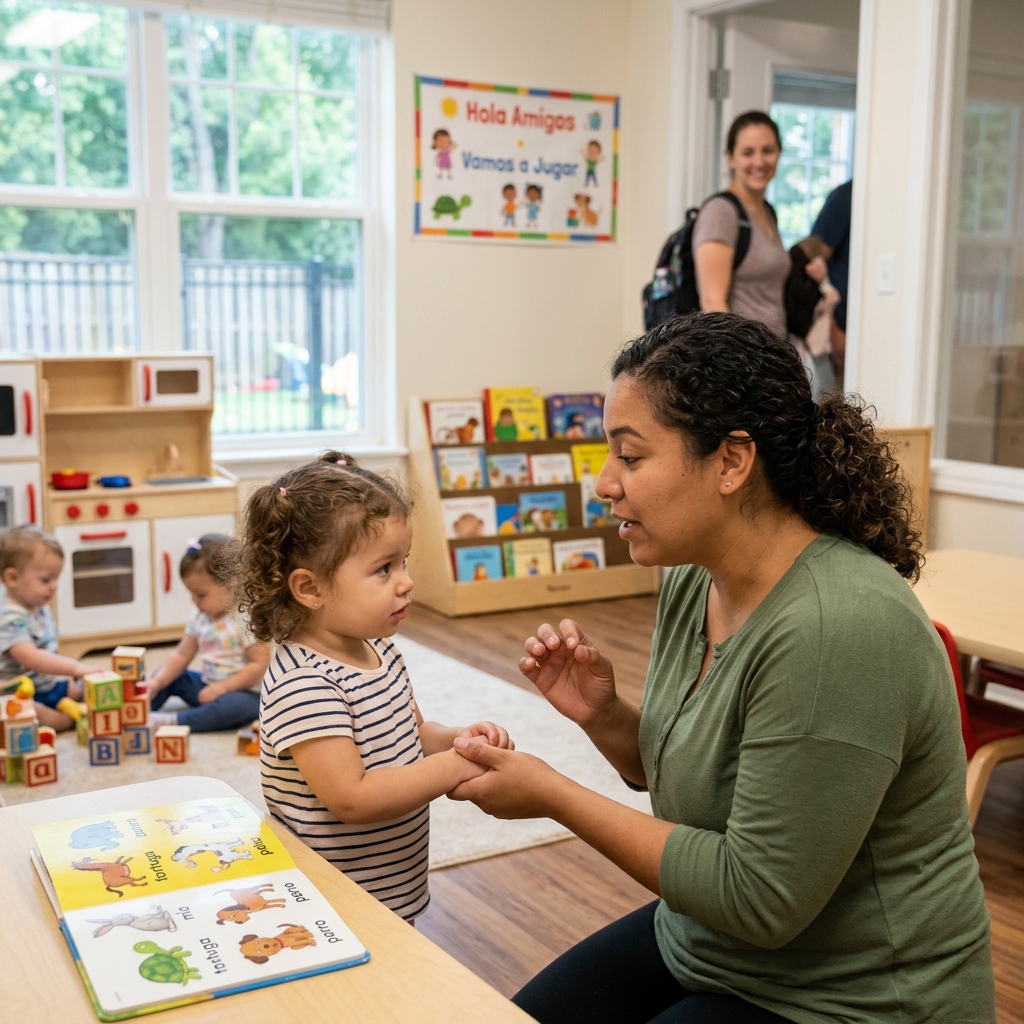
Here’s what partnership looks like in practice: We send daily updates about what your child learned, what songs they sang, what excited them today, and how they’re adjusting. You’ll know your child is safe, happy, and learning. You’ll see specific Spanish phrases your child is picking up so you can recognize and celebrate those moments at home.
We welcome questions. If you’re wondering whether your child understands or worrying about something, we explain what’s happening developmentally and in the classroom. We’re not defensive about the immersion model. We’re collaborative about your child’s wellbeing.
We also provide gentle guidance about supporting bilingual development at home without the pressure of trying to teach Spanish yourself. This might mean greeting your child with “Hola, mi amor” (hello, my love) instead of full sentences, or celebrating when they teach you Spanish words. It means not being alarmed if your child speaks only English to you at first, which is developmentally normal in bilingual families.
We hold family events and offer opportunities to see your child in the immersion environment. You’ll observe circle time, hear the songs, and watch your child interact in Spanish. This isn’t just reassurance. It’s witnessing something beautiful and building your own connection to the language journey.
We also stay in touch about transitions. When your child ages up to a new classroom or approaches the move to preschool or kindergarten, we’re proactive about supporting that change with your family.
How to start: When you come for your tour or enrollment conversation, ask us specific questions about how we communicate with families and what we expect from you. This is a partnership, and clear expectations matter.
Making the Decision: Why We’re the Clear Choice for Your Family
You’re facing a real choice, and we want to be direct about why Mis Tortuguitas is the clear answer for families in Farmington, Apple Valley, Lakeville, Eagan, and Rosemount who want genuine Spanish immersion for their young children.
We’re not just a daycare with Spanish classes. We’re Farmington’s first licensed Spanish immersion daycare, which means we were built from the ground up around this mission. Every policy, every hire, every curriculum choice reflects our commitment to true immersion, not Spanish as an add-on.
We have years of experience with families exactly like yours, including families with no Spanish background. We’ve worked through the transitions, we’ve supported the doubts, and we’ve celebrated when children who arrived speaking no Spanish began thinking, dreaming, and learning in Spanish. We know what works.
Our bilingual, licensed teaching staff aren’t volunteers or paraprofessionals. They’re credentialed educators who chose to work in immersion because they believe in it. They’re trained not just to speak Spanish but to teach children during their most critical learning years.
We offer flexible enrollment options for your family’s actual schedule, whether you need full-time care, part-time programs, or something in between. We also serve ages six weeks through six years, so your family can stay with us through your child’s entire early childhood, meaning consistency and continuity for your child across years.
We treat every child like our own. That’s not a marketing phrase for us. It’s a core value that shows in how we respond to your child’s individual needs, how we communicate with you, and how we create a warm, secure environment where your child thrives.
Starting Spanish immersion early isn’t a luxury or a nice educational extra. It’s a decision to give your child a cognitive, cultural, and practical advantage that will unfold across their entire life. Waiting costs years of optimal learning. Starting now, with us, builds genuine bilingualism in a warm, expert environment.
The decision is clear: Your child deserves Spanish immersion from qualified, passionate educators in a small, nurturing setting. That’s exactly what we provide.
Schedule Your Tour and See Our Warm, Nurturing Community Today
The best way to understand whether Mis Tortuguitas is right for your family is to come see for yourself. A tour isn’t just logistics. It’s an experience. You’ll meet our staff, see our classrooms, feel the calm energy in our facility, and get a genuine sense of the warm, home-away-from-home environment we create.
During your visit, you’ll see our small class sizes in action. You’ll observe how our bilingual teachers interact with children, how naturally Spanish flows through the day, and how secure and engaged children look. You’ll also have time to ask questions specific to your family’s situation, timeline, and concerns.
We’re currently enrolling for our infant, toddler, and preschool programs. We have spots available, and we’d love to talk with you about how we can support your family.
To schedule your tour, contact us through our website at https://mistortuguitas.com/ or reach out directly. We’re located in Farmington and serve families from Farmington, Apple Valley, Lakeville, Eagan, and Rosemount.
Your child is ready for this. You don’t need Spanish background knowledge. You just need to trust that your child’s brain is built for language learning, that our team knows how to support that learning, and that starting now is one of the best decisions you can make for your child’s future.
Come see us. We can’t wait to meet your family and welcome your child into our warm, bilingual community. Bienvenido (welcome).