Table of Contents
- Why Bilingual Foundations Matter More Than Ever for Your Child's Future
- The School Readiness Gap: What Traditional Daycare Misses
- How Spanish Immersion Creates Dual Literacy Skills Naturally
- Our Daily Immersion Approach: Language Learning Through Play and Real Experience
- Building Strong Readers in Two Languages at Once
- The Cognitive Boost Your Child Gets from Bilingual Learning
- Age-Appropriate Programs That Grow With Your Child From Infants to Preschoolers
- What Parents Notice: Real Progress in Speech, Reading, and Cultural Confidence
- Your Peace of Mind: Safety, Small Classes, and Licensed Bilingual Teachers
- Schedule Your Tour and See the Difference Immersion Makes
Why Bilingual Foundations Matter More Than Ever for Your Child’s Future
Think about the moment your child walks into kindergarten. You want them confident, curious, and ready to learn. What if they arrived with not just one language foundation, but two? That’s not just an academic advantage—it’s a gift that keeps growing.
Research shows that bilingual children develop stronger cognitive flexibility, better problem-solving skills, and a deeper understanding of how language works. When your child learns to read and communicate in two languages from the start, their brain builds neural pathways that benefit every skill they’ll learn later. We’re not talking about confusion or delay; we’re talking about richness. Your child’s brain literally learns to switch between two language systems, building mental agility that shows up in math, science, and creative thinking.
In a world where bilingualism is increasingly valued—both culturally and professionally—starting early gives your child a genuine head start. By the time they’re six, they won’t just speak Spanish and English; they’ll understand how language itself works. That foundation shapes readers, writers, and thinkers for life.
Here’s your first action: Consider whether a bilingual foundation aligns with your family’s values and long-term goals for your child. If it does, immersion during the early childhood years (when children’s brains are most plastic and absorbent) is the most natural time to build it.
The School Readiness Gap: What Traditional Daycare Misses
Many daycare programs focus on keeping children safe, fed, and entertained. Those things matter, absolutely. But school readiness goes deeper. It’s about phonemic awareness, letter recognition, vocabulary depth, listening comprehension, and the confidence to engage with new ideas.
Traditional childcare often operates in English only. Children hear English all day, learn English routines, and develop English literacy skills—which is fine, but it leaves a gap. When children arrive at kindergarten, they have one language foundation instead of two. They’ve had fewer opportunities to practice the cognitive skill of switching between language systems, and they’re starting from a single linguistic perspective.
Real school readiness means your child can:
- Recognize letters and understand they represent sounds (in both languages)
- Listen carefully and follow multi-step directions
- Express thoughts and ideas with confidence
- Ask questions and seek help when confused
- Understand that words have meaning and stories have structure
We design our program around these skills from day one. Instead of treating bilingual learning as an add-on, we build it into every song, story, snack time, and circle conversation. Your child isn’t learning Spanish as a separate subject; they’re learning life, literacy, and culture through Spanish. That’s the gap traditional daycare misses—and it’s enormous for your child’s future success.
Action step: Ask any program you’re considering how they specifically build school readiness skills. Don’t settle for “we read books.” Ask how they develop phonemic awareness, letter knowledge, and language-rich conversations in their curriculum.
How Spanish Immersion Creates Dual Literacy Skills Naturally
Literacy doesn’t start with a workbook. It starts with language-rich experiences where children hear stories, sing songs, play with rhymes, and see adults modeling reading and writing naturally throughout the day.
In a true immersion environment, your child experiences language the same way they learned it at home: through real communication, play, and relationships. When our teachers narrate daily routines in Spanish (“Vamos a lavar las manos”—we’re going to wash our hands), children connect words directly to experiences. When we read a story aloud with enthusiasm and repetition, children learn vocabulary, story structure, and the pure joy of books.
Here’s the magic: when children develop strong literacy skills in one language, those skills transfer to the second language. If your child understands that print carries meaning, recognizes the letter ‘M’, and knows that words rhyme, those understandings work in Spanish and English. They’re not learning literacy twice; they’re learning it deeply in one language and applying it flexibly to the other.
Our approach builds phonemic awareness (the ability to hear and manipulate sounds) through songs, rhyming games, and playful sound exploration—all in Spanish. Children learn letter names and sounds in Spanish first, then discover those same letters carry meaning in English. By the time they’re ready for formal reading instruction in elementary school, they’ve already internalized how language works at a fundamental level.
The result? Children who become strong, confident readers in both languages because they understand reading at its core, not just as a set of rules in one language.
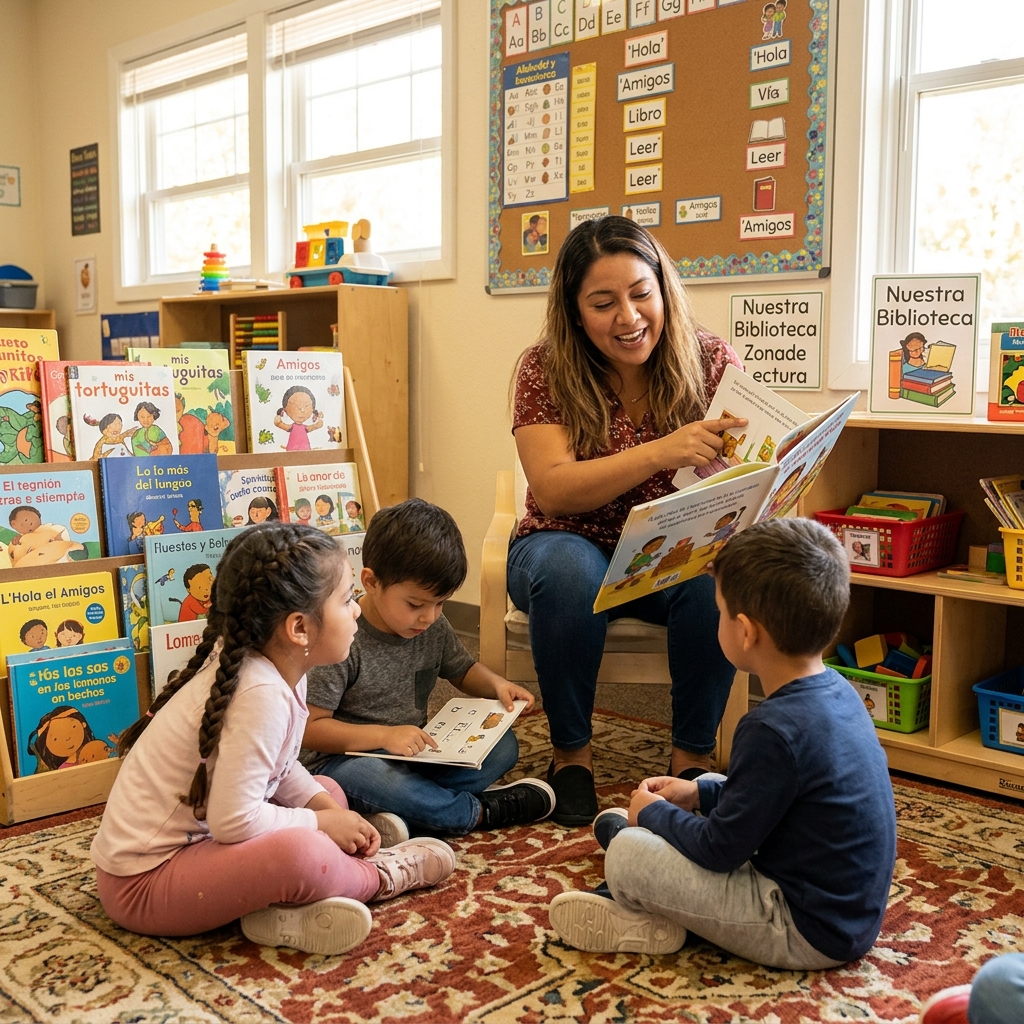
What to do next: Look for immersion programs that integrate literacy into daily routines rather than isolating it into lesson time. The best bilingual school readiness comes from language-rich moments throughout the day.
Our Daily Immersion Approach: Language Learning Through Play and Real Experience
We don’t use worksheets or flash cards to teach Spanish. Instead, every moment of the day is a language learning moment.
Picture morning meeting in our classroom: children sit in a circle while our bilingual teacher greets each child by name in Spanish, sings a welcome song, and talks about the weather, the day of the week, and what’s happening outside. Not a single English word. Children see pictures, hear repetition, watch our teacher’s face and gestures, and gradually understand through context and warmth. By the third week, toddlers are chiming in with “buenos días”—not because they’re memorizing, but because they’re participating in something real and joyful.
Our days flow like this:
- Morning: Bilingual greeting, songs, and conversation to start engaged brains
- Learning centers: Children play with language naturally through blocks, dramatic play, art, and science exploration—all narrated and guided in Spanish
- Story time: We read aloud with expression, ask questions, and let children predict what happens next
- Outdoor play: Teachers use Spanish to narrate movement, name plants and animals, and build vocabulary through hands-on exploration
- Snack and meals: Real conversations at the table in Spanish, where children learn food vocabulary and social language
- Transition times: Songs, rhymes, and gentle direction-giving in Spanish keep the day flowing smoothly
Children learn Spanish not as a separate subject but as the language of relationship, play, and discovery. That’s why it sticks. Your child isn’t translating in their head; they’re thinking in Spanish because it’s the language of their safe, fun, trusted space.
Action to take: When you visit a program, observe a full morning. Do you see Spanish woven throughout, or is it confined to a “Spanish lesson”? Immersion should feel as natural as the air your child breathes, not like a lesson being taught.
Building Strong Readers in Two Languages at Once
Strong readers need three foundational skills: they must understand that words carry meaning, recognize letters and sounds, and be able to blend those sounds into words. Bilingual children develop these skills in a unique way.
When we teach a child to recognize the letter ‘A’ and hear its sound in Spanish (“A de araña”—A of spider), they’re building the same neural network they’ll use when they encounter ‘A’ in English. The letter doesn’t change; the language does. This actually makes the learning more robust because your child understands the fundamental concept at a deeper level.
We support early literacy through:
- Phonemic awareness activities: Songs and games that isolate sounds within words (Spanish songs naturally have rhyme and rhythm that support this)
- Letter recognition: Letters introduced through words children care about (their own names, favorite animals, family words)
- Print concepts: Seeing teachers write, reading labels around the classroom, understanding that words have a direction and sequence
- Vocabulary richness: Children hear 30-50% more unique vocabulary in immersion settings because teachers narrate, explain, and repeat constantly
- Motivation to read: When children see adults reading for joy and purpose in Spanish, they develop curiosity about what those squiggles mean
By age four or five, immersion-educated children often begin decoding—not because they’re forced, but because they’re curious and ready. And because they’ve built literacy skills in Spanish, they transfer that confidence and competence to English when they encounter it. English doesn’t feel mysterious; it feels like another way to access the reading skill they already possess.
Consider this: a child who reads in two languages has twice the access to stories, knowledge, and ideas. That’s a genuine advantage that compounds over a lifetime.
Next step: Look for a program where literacy development is intentional but play-based. Your child should be reading because they’re curious, supported, and surrounded by language-rich experiences—not because they’re in “reading class.”
The Cognitive Boost Your Child Gets from Bilingual Learning
Bilingual children’s brains work differently—in measurably positive ways. Research in developmental neuroscience shows that managing two languages strengthens executive function, which is basically the brain’s ability to focus, plan, switch between tasks, and solve problems.
Think about what your brain does every time you encounter language: it recognizes which language is being spoken, activates the right vocabulary and grammar system, and suppresses the other language so you don’t get confused. When your child does this dozens of times per day in an immersion setting, they’re literally strengthening their brain’s ability to manage complexity and shift focus.
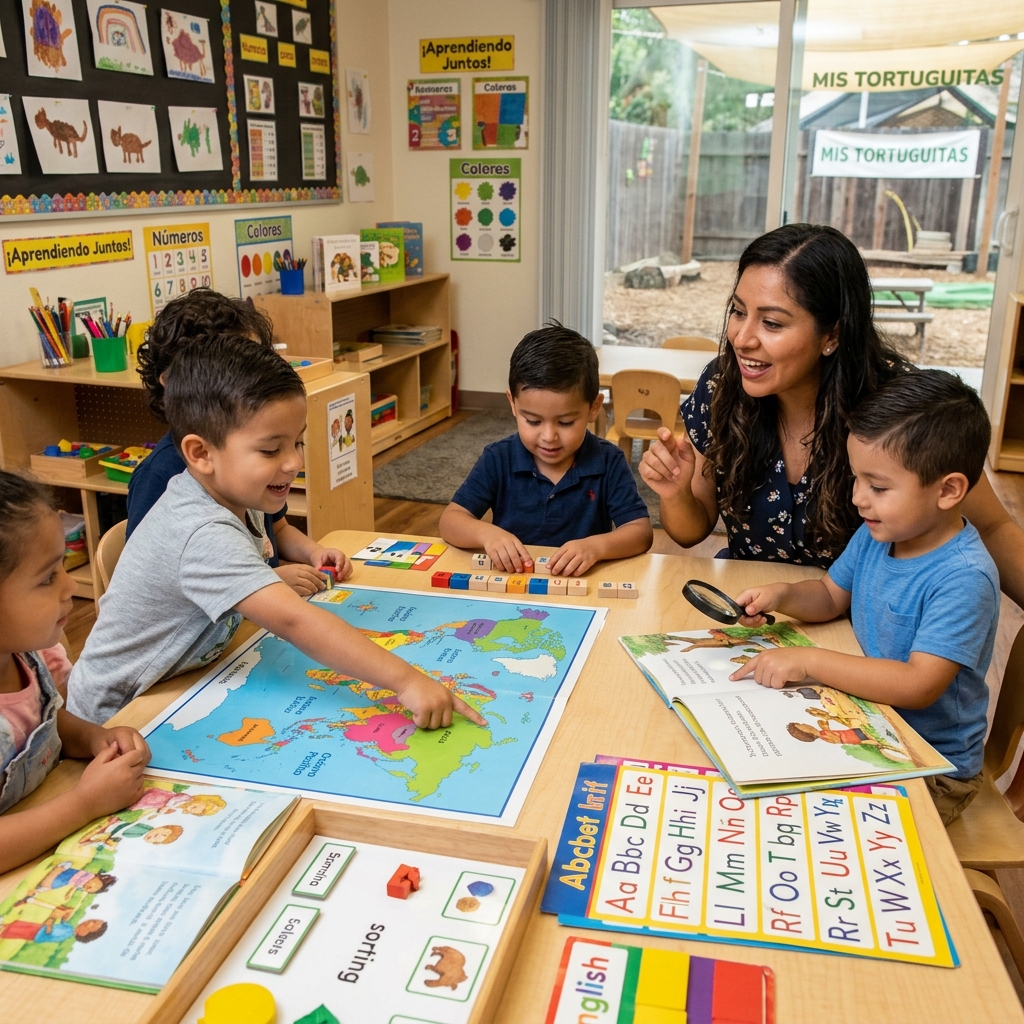
This shows up in real ways:
- Better attention control: Bilingual children often excel at focusing on relevant information and ignoring distractions
- Enhanced cognitive flexibility: They find it easier to shift perspectives, adapt to new situations, and see problems from multiple angles
- Stronger working memory: The ability to hold and manipulate information in their mind improves
- Better impulse control: The executive function boost extends to self-regulation and patience
- Deeper language awareness: Bilingual children understand how language works at an abstract level earlier than monolingual peers
You’ll notice these benefits in subtle ways. Your child might organize toys into categories more creatively, adapt more easily when plans change, or show impressive patience when learning something new. These aren’t just nice traits; they’re foundational skills that support success in school and life.
The bilingual advantage is real, and it starts in early childhood. The immersion setting provides the daily cognitive workout that makes these benefits possible.
What to do: Don’t pressure your child to perform or demonstrate bilingualism. The cognitive benefits happen naturally through living in the immersion environment. Trust the process, and notice the growth over time.
Age-Appropriate Programs That Grow With Your Child From Infants to Preschoolers
Your child changes dramatically from six weeks to six years old. Their brains, bodies, social needs, and language abilities all transform. A program that’s right for infants isn’t right for preschoolers, and a great program recognizes those differences.
We offer our infant program for the littlest learners, starting at six weeks. Infants learn Spanish through responsive caregiving—soft songs, gentle narration, and the secure attachment relationships that language learning depends on. We talk to them constantly (in Spanish), read board books together, and create the warm, language-rich foundation that sets them up for future learning.
Our toddler program (12 months to 2.5 years) picks up that foundation and adds more. Toddlers are discovering words explode in growth. We support this through songs, rhyming games, picture books, and dramatic play where language comes alive. Toddlers learn Spanish because their world is full of Spanish speakers who love them and respond to their needs.
Our preschool immersion program (2.5 to 6 years) builds on that and adds intentional school readiness skills. Preschoolers are ready for more structure, more complex stories, more opportunities to write and draw and express ideas. We introduce letter sounds, support emerging phonemic awareness, and create the kind of language-rich environment where reading readiness naturally develops.
What ties it all together? Consistent immersion, small class sizes, and teachers who understand child development. Your child doesn’t experience Spanish as a separate curriculum at each stage; they experience it as the living language of their relationships, their play, and their learning. That continuity is powerful.
Action: If you have a younger child starting our infant or toddler program, know that you’re building a foundation that will carry them through preschool and beyond. Consistency matters.
What Parents Notice: Real Progress in Speech, Reading, and Cultural Confidence
We hear from parents constantly, and what they notice often surprises them in the best way.
“My daughter came home singing Spanish songs I’d never taught her. Now she asks me what words mean in Spanish and tries to teach me.” That’s a parent whose child has moved from passively hearing Spanish to actively engaging with it.
“My son started recognizing letters on signs. In Spanish first, but then in English too. He’s not even three.” That’s a child whose brain is making the connections we hope for—understanding that letters carry meaning across languages.
“We don’t speak Spanish at home, but our child is maintaining it. She uses it at the grocery store when she sees a Spanish sign, and she code-switches between languages naturally.” That’s immersion working exactly as it should.
“He’s more confident overall. Not just in language, but in trying new things. He takes risks in play because he’s used to navigating an environment where everything isn’t in English.” That’s the cognitive flexibility and resilience that develops in bilingual children.
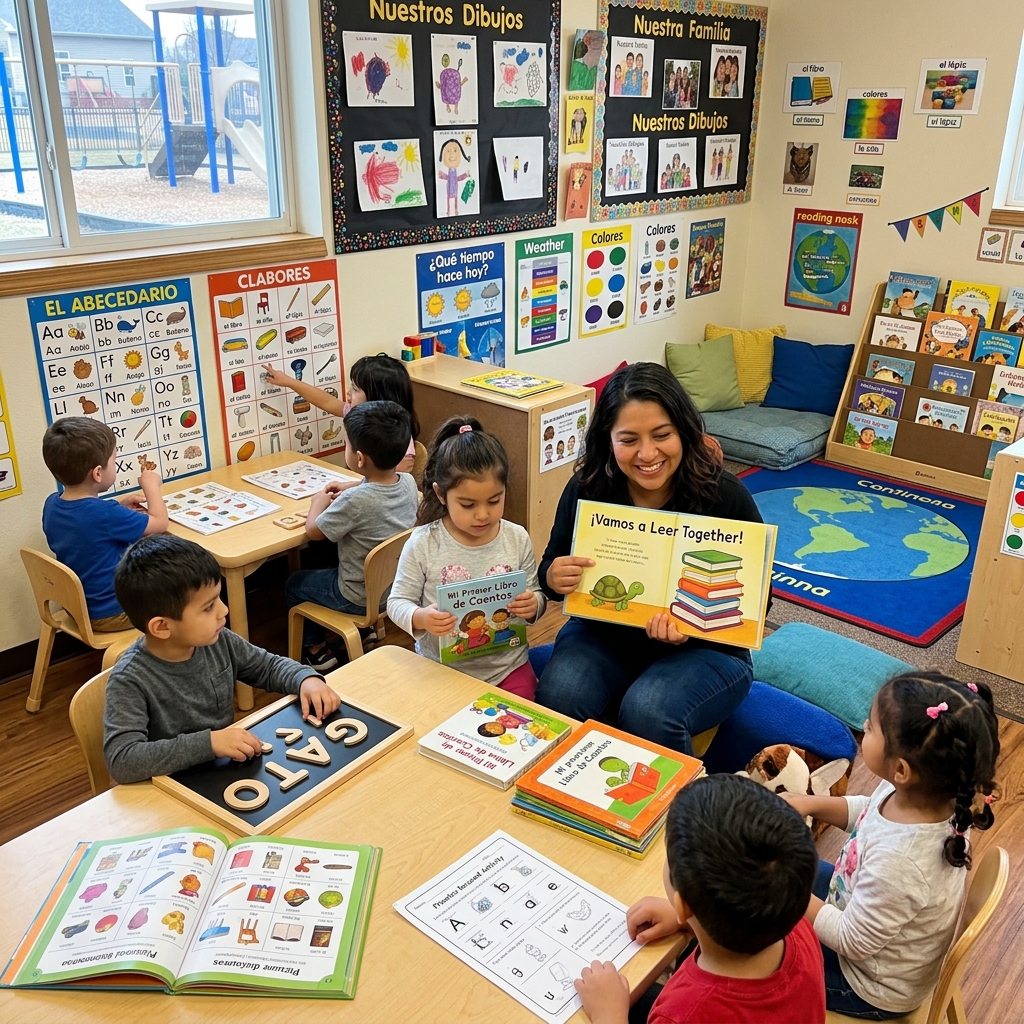
Parents also notice:
- Vocabulary growth that happens visibly—sometimes a new word every day
- Confidence in Spanish that extends to cultural pride and curiosity about their heritage
- Comfort switching between languages without frustration or confusion
- Early reading skills that develop naturally, without pressure
- Social skills that include code-switching and cultural awareness
The changes aren’t overnight, but they’re real and sustained. By the time a child reaches kindergarten after immersion in our program, they arrive not just bilingual but with a stronger foundation in literacy, confidence, and cognitive skill than they would have otherwise.
What to expect: Growth looks different for every child. Some children are verbal early; others are quiet observers who understand everything before they speak. Both are completely normal and both benefit enormously from immersion.
Your Peace of Mind: Safety, Small Classes, and Licensed Bilingual Teachers
When you choose a daycare, the most important thing isn’t the curriculum or the bilingual component. It’s knowing your child is safe, loved, and in the hands of people who are qualified to care for them.
We treat every child like our own. That means our facility is clean, secure, and designed for the age groups we serve. Our staff is fully licensed, trained in CPR and first aid, and undergoes background checks. We maintain small class sizes so that every child gets the attention and individual care they need. Your child’s safety is our top priority, always.
Beyond basic care, our bilingual teaching staff brings specific expertise. They’re not just fluent in Spanish; they’re trained in early childhood education and understand child development. They know how to support a bilingual toddler’s speech development, how to notice when a child needs extra support, and how to communicate with families about their child’s growth.
We partner with your family, not just as a service provider but as genuine partners in your child’s development. We share observations about your child’s progress, listen to your goals and concerns, and work together to support their growth. We send home information about what your child is learning in Spanish, suggest ways you can support their bilingualism at home (even if you don’t speak Spanish), and celebrate milestones together.
Our small class sizes mean:
- Your child has consistent relationships with the same teachers
- Teachers know your child’s needs, preferences, and personality deeply
- Transitions are smooth and secure
- Communication between home and school is frequent and personal
- Your child gets one-on-one attention when they need it
You’ll have peace of mind knowing your child is in a warm, home-away-from-home where they’re known, safe, and thriving.
Action step: When you visit a program, pay attention to how staff interact with children. Do they seem genuinely present and connected? Do they speak warmly about individual children? That warmth and attentiveness is what builds both safety and language development.
Schedule Your Tour and See the Difference Immersion Makes
Reading about immersion is one thing. Seeing it in action is entirely different.
When you visit Mis Tortuguitas, you’ll walk into classrooms where Spanish is alive and natural. You’ll hear children singing, teachers narrating, and conversations flowing in a language that supports both learning and belonging. You’ll see small groups of children engaged with materials, with each other, and with adults who clearly love what they do. You’ll feel the difference—that warmth, that safety, that sense of a place where your child will belong.
You’ll be able to ask questions about our approach to school readiness, see our classrooms, and meet the teachers who would care for your child. You’ll understand not just what we do, but why we do it. And you’ll leave knowing whether immersion is the right choice for your family.
Your child’s early years are precious and fleeting. The foundation you build now—in language, literacy, confidence, and cognitive skill—shapes their entire future. We’re honored to be part of that journey with families in Farmington, Apple Valley, Lakeville, Eagan, and Rosemount.
Come see for yourself. Schedule a tour today and experience the difference immersion makes.