Table of Contents
- Why Spanish Learning Starts at Home: The Missing Piece Most Parents Don't Know About
- Your Child's Spanish Foundation: What We're Building During the Day at Our Facility
- The Challenge: How Working Parents Can Extend Learning Beyond Our Classroom
- Simple Strategies We Recommend: Daily Spanish Practices That Fit Your Family's Routine
- Creating a Spanish-Friendly Home Environment: Our Expert Tips for Busy Families
- Music, Games, and Stories: Making Spanish Learning Fun at Home
- Partnering With Our Teachers: How We Keep Parents Informed and Supported
- Managing Code-Switching Without Confusion: What Parents Often Worry About
- Celebrating Small Wins: Tracking Your Child's Bilingual Progress Together
- Preparing Your Child for Kindergarten: The Long-Term Benefits of Your Home Support
- Ready to Give Your Child This Gift: Schedule Your Tour and Learn More
Why Spanish Learning Starts at Home: The Missing Piece Most Parents Don’t Know About
Here’s what we’ve learned from years of working with families in Farmington and the surrounding areas: the most successful bilingual children aren’t those who only hear Spanish during daycare hours. They’re the ones whose families reinforce and celebrate Spanish at home, even in small, everyday moments.
You might think that dropping your child off at our Spanish immersion program means we’re handling all the heavy lifting. The truth is gentler and more empowering than that. Language development is a partnership between your child’s school environment and their home life. When both places speak the same language—literally and figuratively—something magical happens. Your child absorbs Spanish not as a “subject” to learn, but as a natural, living part of their world.
Research in early childhood bilingualism shows that children who hear a language consistently across multiple settings develop stronger vocabulary, better retention, and deeper confidence in that language. Your home is one of the most powerful learning environments your child will ever have. The conversations at the dinner table, the songs in the car, the books before bedtime—these moments are just as important as anything we teach during the day.
The key insight many parents miss: you don’t need to be fluent in Spanish to support your child’s learning. You need to be present, curious, and willing to stumble along with them. That’s what builds a truly bilingual child and creates a home where both languages feel valued and safe.
Your Child’s Spanish Foundation: What We’re Building During the Day at Our Facility
During a typical day at Mis Tortuguitas, your child is immersed in Spanish from arrival to departure. Our licensed bilingual teachers model language naturally through songs, stories, snack time, outdoor play, and everyday routines. We’re not drilling vocabulary lists; we’re creating a warm, nurturing environment where Spanish is simply the language we use to live together.
Our preschool program focuses on developing both academic foundations and conversational confidence. Children learn colors, numbers, and shapes, but more importantly, they learn how to ask for help, express their feelings, and connect with their peers—all in Spanish. We build in repetition and rhythm because young brains love patterns. We sing the same songs, follow the same routines, and use the same phrases week after week. That consistency is what cements language into long-term memory.
For younger learners in our toddler program, the focus is on receptive language (understanding) before expressive language (speaking). We’re building neural pathways, expanding listening skills, and planting the seeds for future fluency. Your toddler may not repeat every word, but they’re absorbing sounds, rhythm, and meaning at a pace that might astonish you.
We also weave cultural elements throughout our day. Stories, celebrations, and traditions help children understand that Spanish is more than a code—it’s a living, breathing way of connecting with the world and with each other. By the time your child is ready for kindergarten, they’ve had thousands of hours of exposure to Spanish in a safe, joyful environment. But that foundation only solidifies when you extend it at home.
The Challenge: How Working Parents Can Extend Learning Beyond Our Classroom
Let’s be honest: you’re busy. Between work, commuting, household responsibilities, and everything else on your plate, adding “Spanish practice” to your evening routine might feel like one more thing you don’t have time for. That’s a real concern, and we hear it from parents all the time.
The good news is that extending your child’s Spanish learning doesn’t require carved-out “study time” or complicated lesson plans. It means weaving Spanish into the activities and routines you’re already doing. Instead of adding something new, you’re shifting how you engage with what already exists in your family’s day.
Many working parents feel guilty that they can’t be fluent conversation partners with their children in Spanish. Some worry they’ll confuse their child by mixing languages or getting the grammar wrong. These concerns are understandable and common. The reality is simpler: your effort and presence matter infinitely more than perfection. Your child watches you try, celebrates your small victories, and learns that languages are meant to be played with, not feared.
The challenge isn’t really about time or fluency. It’s about permission—permission to be a learner alongside your child, to embrace imperfection, and to trust that small, consistent efforts add up over months and years.
Simple Strategies We Recommend: Daily Spanish Practices That Fit Your Family’s Routine
Think of your day as a series of windows where Spanish can naturally appear. You don’t need to open all of them at once.
Morning transitions: As you’re getting ready, narrate what you’re doing. “Nos ponemos los zapatos” (we’re putting on our shoes). “Desayunamos” (we’re eating breakfast). Your child hears Spanish paired with real-world context, which is how language sticks.
Car time: This is golden. During the drive to daycare or to the grocery store, play Spanish music, sing along, or ask simple questions in Spanish. “What color is that car?” becomes “Qué color es ese auto?” Your child is captured in the moment, unburdened by distractions, and actively listening.
Mealtime: Point to foods by their Spanish names. Taste and describe together. “Delicioso” (delicious). “Dulce” (sweet). “Sabroso” (tasty). Mealtimes are relaxed, repetitive, and packed with vocabulary opportunities.
Bedtime routines: This is when language feels tender and bonding. A Spanish lullaby, a simple story, or just five minutes of chat before sleep—this creates positive associations with the language and winds down the day gently.
Bath time: Water play is joyful and low-pressure. Name body parts, toys, and actions. “Splash” is “¡Chapotear!” Your child is already playful; language becomes part of the fun.
The real strategy isn’t about which activity you choose. It’s about consistency and repetition in spaces that already feel comfortable. Pick two or three of these windows and commit to them for a few weeks. Once they feel natural, add another. You’ll be surprised how quickly a few small practices become automatic.
Creating a Spanish-Friendly Home Environment: Our Expert Tips for Busy Families
Your home doesn’t need to look like a Spanish classroom to support bilingual development. Small, intentional touches make a big difference.
Label common items: Post-it notes with Spanish words on the refrigerator, light switch, door, and toy bin cost nothing and work constantly. Every time your child grabs a toy or opens the fridge, they’re reinforcing vocabulary. Seeing the word paired with the object helps bridge the gap between hearing and reading.
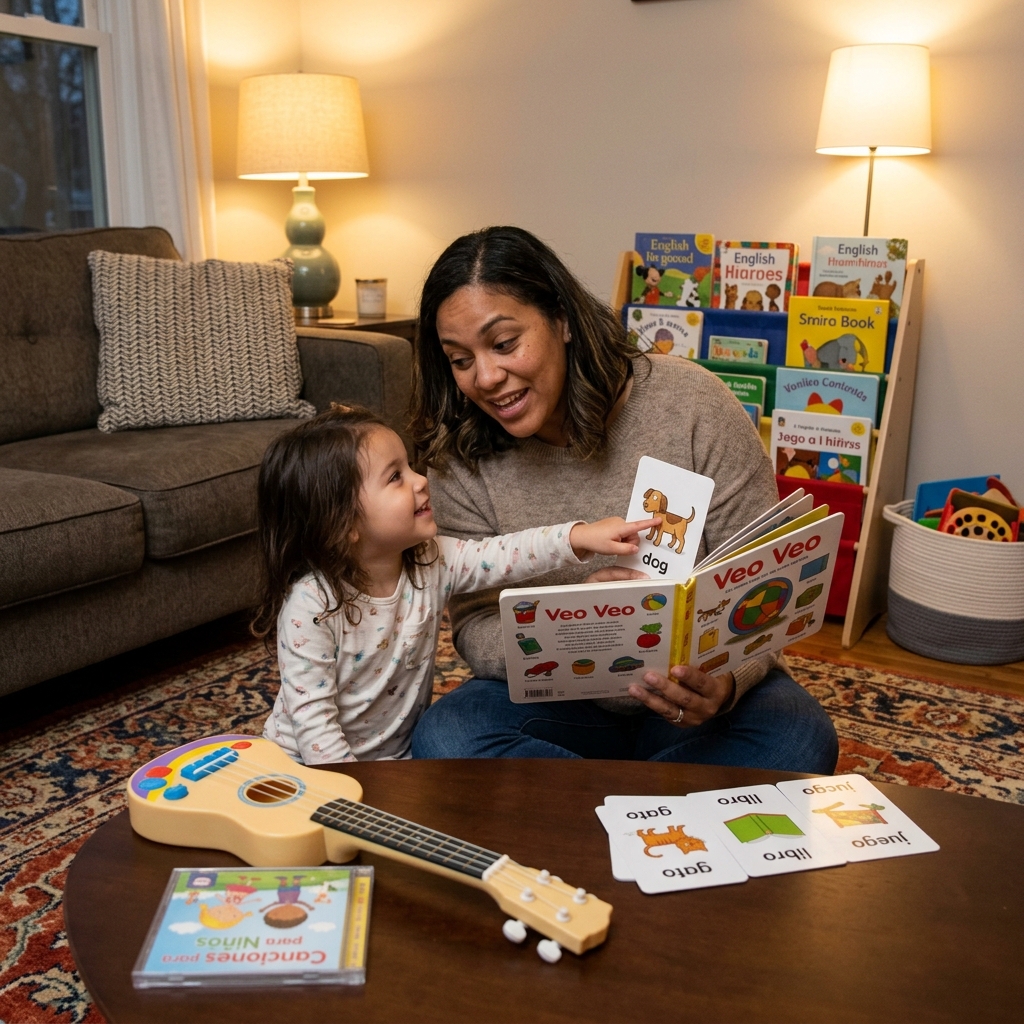
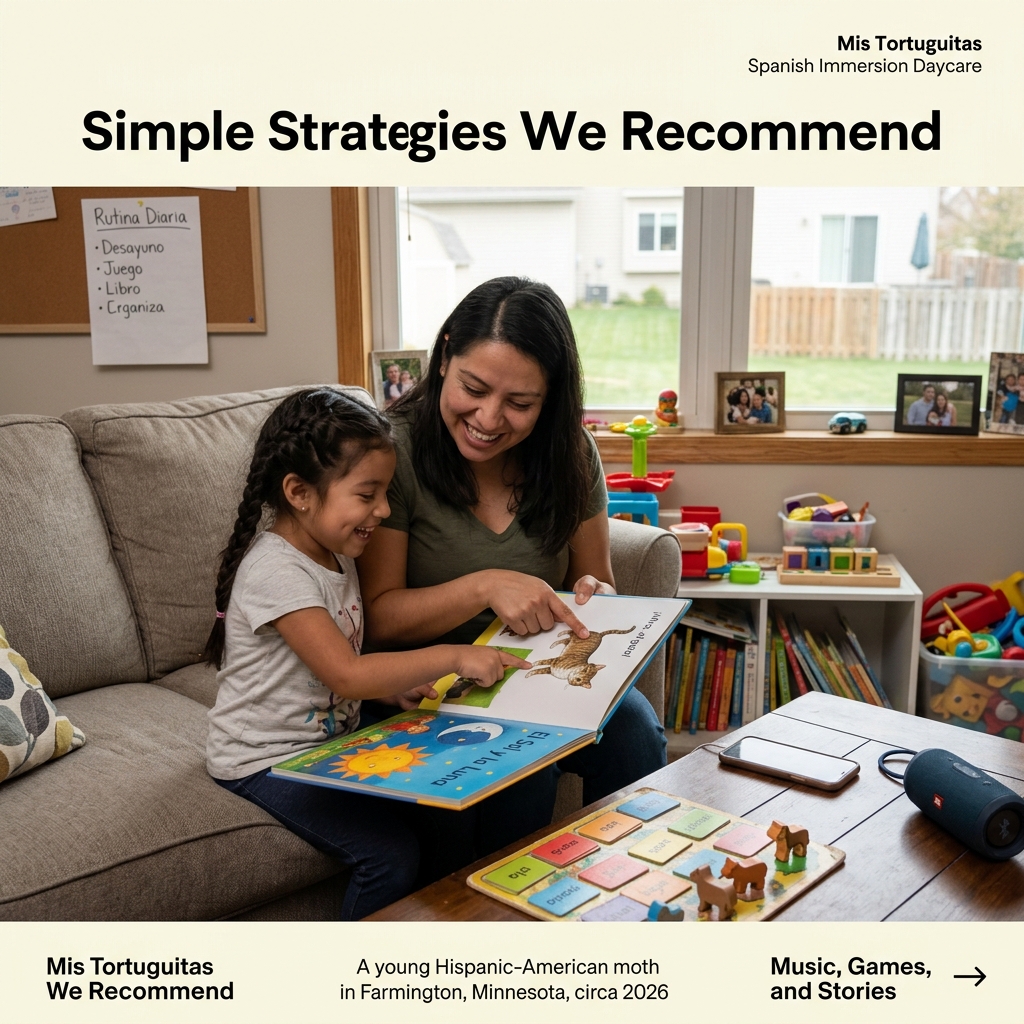
Choose bilingual books wisely: You don’t need an enormous library. Three or four high-quality bilingual picture books that your child loves will be read dozens of times. Repetition is how children learn. We recommend books with rhythmic, simple text and bright illustrations. When you read together, point to pictures and ask questions in Spanish: “Dónde está el gato?” (Where is the cat?)
Use Spanish in play: Dolls, toy food, action figures—these are language-rich toys. As your child plays, describe what they’re doing in Spanish. “El muñeco está durmiendo” (The doll is sleeping). “La comida es sabrosa” (The food is yummy). You’re not interrupting play; you’re narrating it in Spanish.
Normalize both languages: It’s okay if your child responds in English sometimes. You model Spanish, and they’ll choose the language they need. Bilingual children are smart navigators of language. Let them lead while you gently model Spanish responses.
Create a cozy language corner: A small basket of books, soft pillows, and a blanket becomes a inviting space for language exploration. Sit together, read, and talk. This signals to your child that stories and learning are valued and joyful in your home.
The environment does the teaching for you. When Spanish is visible, playful, and woven into the space where your child lives, they absorb it naturally. You’re not forcing it; you’re creating conditions where curiosity grows.
Music, Games, and Stories: Making Spanish Learning Fun at Home
Your child’s brain learns fastest through joy and play. Music, games, and storytelling are some of the most powerful language tools available to you, and they require nothing but your presence.
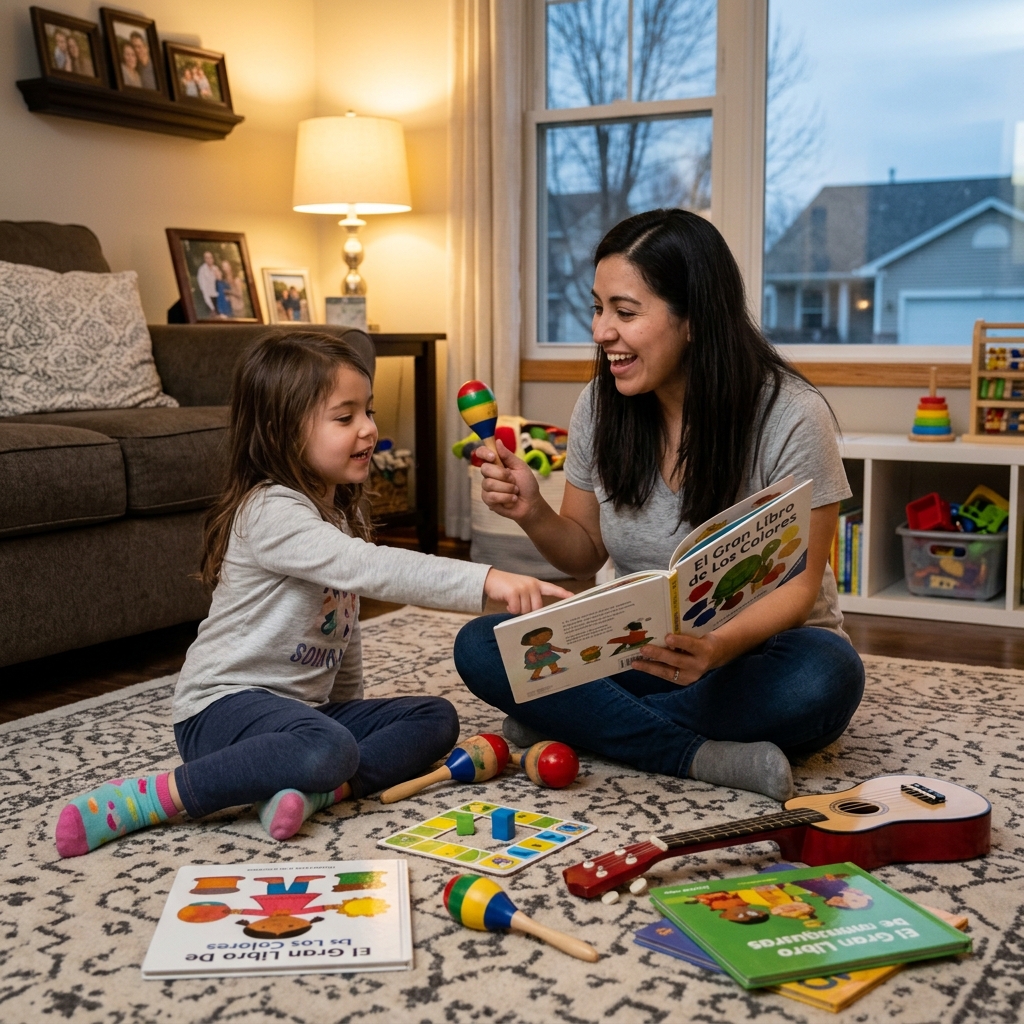
Music and movement: Spanish children’s songs (canciones infantiles) are treasures. Songs like “Twinkle, Twinkle, Little Star” (“Brilla, Brilla Estrellita”), “If You’re Happy and You Know It” (“Si Eres Feliz”), and “Wheels on the Bus” (“Las Ruedas del Autobús”) embed language through melody and repetition. Your child learns words, rhythm, and intonation together. Dance, clap, stomp—add movement and the learning deepens.
Simple games: “I Spy” becomes “Veo, veo, qué ves?” Name body parts with a silly game: point to your nose and say “nariz,” touch your ears and say “orejas.” Play counting games with toys: “Uno, dos, tres…” The game is the reward; language is the vehicle.
Storytelling and imaginative play: Even if you’re reading from a picture book, you’re building narrative skills and vocabulary simultaneously. Pause and ask questions. Let your child fill in words or finish sentences. Create silly stories together. This interactive style turns reading into a conversation and keeps your child engaged.
Color and shape hunts: “Find something red” becomes “Busca algo rojo.” Your child moves through the house, spots objects, and practices colors. This combines physical activity, exploration, and vocabulary practice in one simple game.
The secret ingredient in all of these is playfulness. Children whose parents laugh, experiment, and embrace mistakes develop confidence and curiosity in language. That confidence matters more than perfect pronunciation. Your enthusiasm models to your child that Spanish is fun, not a chore.
Partnering With Our Teachers: How We Keep Parents Informed and Supported
We treat every family like our own, which means communication and partnership are at the heart of everything we do. Your child’s language development is a conversation we’re having together.
Our teachers document progress and share insights regularly. You’ll know which Spanish words your child is using, what stories they’re drawn to, which songs they’re singing, and what they’re struggling with. This information helps you extend learning at home with intention. If your child is learning about animals this week, you know to visit the zoo or read animal stories at home.
We also welcome your questions and concerns. Are you worried about code-switching? Unsure if your child is progressing normally? Curious about how to handle a specific situation? Our bilingual teachers have years of experience and are here to partner with you. There’s no such thing as a silly question when it comes to your child’s development.
Beyond daily updates, we host occasional parent workshops and provide resources (like book recommendations, song lists, and activity ideas) that you can use immediately at home. We want to make your job easier, not harder. Think of us as your Spanish immersion coaches—you’re the expert on your child, and we’re the experts on bilingual language development. Together, we create a seamless learning experience.
Managing Code-Switching Without Confusion: What Parents Often Worry About
One of the biggest worries parents express is this: “Will my child get confused if we mix English and Spanish at home?”
The short answer is no. Code-switching—moving between languages—is a sign of bilingual intelligence, not confusion. Your child’s brain is perfectly capable of keeping languages organized, even when they’re hearing both. Research actually shows that children raised in multilingual homes develop stronger executive function skills because their brains are constantly managing multiple linguistic systems.
Here’s what typically happens: your child might understand Spanish perfectly but prefer to respond in English, especially if English is the dominant language outside the home. This is normal and temporary. If you consistently respond to them in Spanish while accepting their English answer, they gradually begin to match your language choice. This isn’t forcing them; it’s gentle, natural modeling.
Some families use a one-person, one-language approach—one parent always speaks Spanish, the other speaks English. This works beautifully if it fits your family’s comfort level. Others mix languages more fluidly. Neither approach is wrong. The key is consistency and comfort. Your child learns best when everyone involved is relaxed and genuine.
If one parent isn’t fluent in Spanish, that’s completely fine. You can still support your child by using the Spanish words you know, playing Spanish music, reading Spanish books together, and celebrating when your child teaches you new words. Your child becomes your teacher sometimes, which strengthens their own grasp of the language and makes learning feel like a team sport.
The confusion parents worry about is far less common than the success bilingual children experience when their family calmly supports both languages.
Celebrating Small Wins: Tracking Your Child’s Bilingual Progress Together
Bilingual development doesn’t always look like dramatic breakthroughs. Often it’s quiet, incremental progress that’s easy to miss if you’re not looking for it.
Keep a simple notebook or use your phone to jot down Spanish words your child uses, jokes they make, songs they sing, or concepts they grasp. “Today she counted to ten in Spanish,” or “He asked for ‘agua’ instead of water,” or “She noticed the word ‘gato’ on a label and said it out loud.” These small moments are huge. They’re proof that learning is happening.
Share these wins with our teachers. They’ll celebrate alongside you. Over time, your notebook becomes a beautiful record of your child’s bilingual journey. Months from now, you’ll flip back and be astonished at how far they’ve come. That astonishment is important—it keeps your perspective grounded in hope and progress, not pressure or comparison.
Avoid the trap of comparing your child’s bilingual development to monolingual peers’ English development. Bilingual children aren’t behind in either language; they’re ahead in both, just with a different timeline. By kindergarten and beyond, bilingual children typically catch up and surpass monolingual peers in vocabulary and cognitive flexibility.
Celebrate with your child too. When they use a Spanish word or understand something new, name it: “You said ‘gato!’ That’s wonderful!” This positive reinforcement is brain food. Your child learns that their bilingual efforts are noticed and valued. That encouragement compounds over time into intrinsic motivation and confidence.
Preparing Your Child for Kindergarten: The Long-Term Benefits of Your Home Support
The work you’re doing now—the labels on the fridge, the songs in the car, the bedtime stories in Spanish—is building something that will serve your child for a lifetime.
By the time your child enters kindergarten, hours of consistent home support, paired with our immersion curriculum, will have created a truly bilingual foundation. Your child won’t just know Spanish; they’ll be comfortable thinking in Spanish, problem-solving in Spanish, and expressing themselves creatively in Spanish. That opens doors.
Bilingual children show advantages in executive function, creativity, and cognitive flexibility. They find it easier to learn additional languages later. They have richer cultural understanding and stronger connections to family heritage. Schools and future employers increasingly value bilingual skills. But beyond all that, your child will have access to stories, relationships, and worlds that monolingual peers might never reach. That’s the real gift.
Kindergarten teachers consistently notice which children had strong early language support at home. Those children transition more smoothly, follow instructions with greater clarity, and engage in peer interactions with more ease. The groundwork you’re laying now ripples through your child’s entire educational journey.
More importantly, you’re modeling to your child that learning is a family value. You’re showing them that education happens everywhere, that imperfection is acceptable, and that effort matters. These lessons are invisible at first, but they’re the deepest kind of learning.
Ready to Give Your Child This Gift: Schedule Your Tour and Learn More
If you’re reading this, you already sense that bilingual education is a gift worth giving your child. We believe it too. At Mis Tortuguitas, we’ve created an environment where Spanish is alive, joyful, and woven into every moment of your child’s day. Our licensed bilingual teachers care deeply about each child, and we partner with families who are committed to supporting language development at home.
Come see for yourself. Schedule a tour of our Farmington facility. Walk through our classrooms, meet our teachers, and feel the warm, nurturing environment we’ve built. Watch children learning, playing, and growing in Spanish. Ask us questions about curriculum, routines, enrollment options, and how we support families like yours.
We serve Farmington, Apple Valley, Lakeville, Eagan, and Rosemount with full-time and part-time enrollment for infants, toddlers, and preschoolers. Your child’s safety and growth are our top priority. We treat every child like our own.
The partnership starts with a conversation. Reach out to us today—let’s talk about how we can support your family’s bilingual journey together.