Table of Contents
- Why Parents Choose Spanish Immersion for Their Preschoolers
- The Benefits of Bilingual Learning During Early Childhood
- What Makes a Quality Spanish Preschool Program
- How Our Spanish Immersion Curriculum Works
- Why Our Farmington Daycare Stands Apart
- What to Expect in Our Daily Spanish Immersion Environment
- Safety, Security, and Licensed Care You Can Trust
- Enrollment Options That Fit Your Family's Schedule
- How Spanish Preschool Prepares Children for School Success
- Meet Our Bilingual Teaching Staff
- Real Families, Real Results at Mis Tortuguitas
- Schedule Your Tour and See Our Difference
Why Parents Choose Spanish Immersion for Their Preschoolers
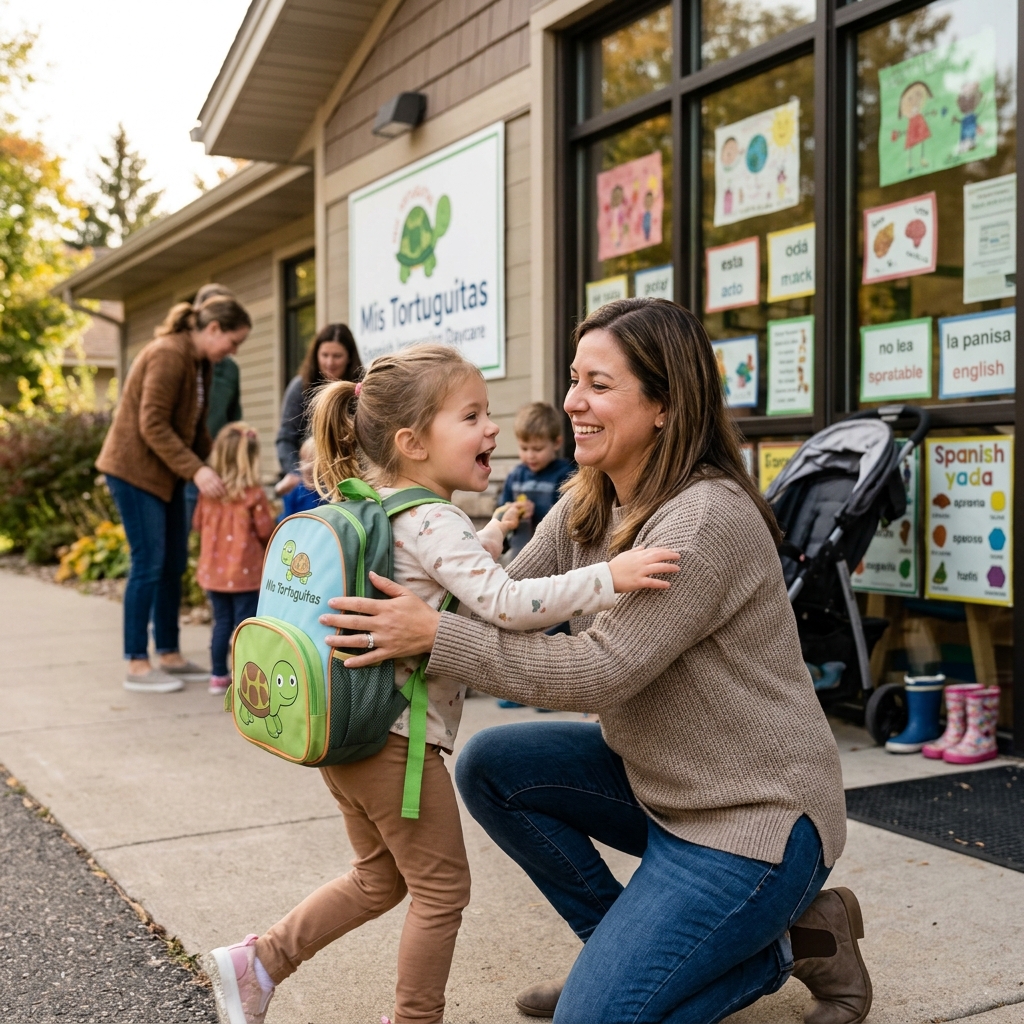
You’re standing at school pickup, and your child comes running toward you chattering in Spanish and English—switching between languages naturally, the way kids do when both are woven into their daily lives. That moment is why so many families in the Farmington area are choosing Spanish immersion preschools.
Parents today understand something research has been showing us for years: early childhood is the golden window for language learning. A young brain absorbs language through immersion—through play, conversation, songs, and daily interaction—far more easily than an older one ever will. When families choose a Spanish preschool program, they’re giving their child access to that window while they’re still wide open.
Beyond the language itself, families tell us they’re drawn to Spanish immersion because they want something more. They want their children to grow up appreciating another culture. They want bilingual confidence as a life skill. And they want their kids to have fun learning alongside children from different backgrounds. Spanish immersion preschool makes that possible while your child is playing with blocks, singing, and making friends.
Starting your child in a quality Spanish preschool program early means they’re building language skills naturally, without the pressure or struggle of learning Spanish later in school. That head start becomes a gift that keeps on giving.
What to do next: Think about your family’s values around language and culture. If bilingualism matters to you, early childhood is absolutely the right time to invest in it.
The Benefits of Bilingual Learning During Early Childhood
Children who grow up in bilingual environments don’t just learn two languages—their brains develop differently in ways that benefit them across the board. Research consistently shows that bilingual children often display stronger cognitive flexibility, better problem-solving skills, and enhanced ability to switch between tasks. Their brains get a natural workout.
Beyond the cognitive gains, bilingual preschoolers gain real social and emotional advantages. They’re more aware that different people communicate differently, which builds empathy and cultural awareness early. When your child hears Spanish all day and English at home, they naturally understand that languages are tools—and that adapting communication to fit the person in front of you is normal and valuable.
There’s also a practical advantage many families overlook: bilingual children often become confident code-switchers. They learn when to use Spanish and when to use English, understanding context intuitively. That kind of linguistic awareness serves them in every setting, from classrooms to workplaces later on.
Here’s what parents notice most: their children become more curious about the world. Learning Spanish at a young age opens doors to stories, songs, foods, and traditions from Spanish-speaking cultures around the globe. It’s not just language—it’s culture, creativity, and connection all rolled into one.
The window for absorbing language naturally stays widest between ages zero and five. After that, learning a second language becomes a more deliberate academic exercise. That’s why early immersion matters so much.
What to do next: If bilingualism aligns with your family’s goals, starting in preschool removes the pressure of “catching up” later and makes the journey feel natural and playful.
What Makes a Quality Spanish Preschool Program
Not every program calling itself “Spanish preschool” delivers the same experience. A truly quality Spanish immersion program has a few non-negotiable elements.
First, the staff must be genuinely bilingual and trained in early childhood education. These aren’t two separate skills—they go hand in hand. Your child’s teacher needs to speak fluent, native-level Spanish and also understand how young children develop, learn, and thrive. Without that combination, you might get language exposure, but you won’t get thoughtful, developmentally appropriate immersion.
Second, a strong program uses Spanish as the primary language throughout the day—not as a subject tacked onto an English-heavy day. True immersion means instruction, play, storytelling, and problem-solving all happen in Spanish. English might be understood and occasionally used, but the learning environment is Spanish-first. That’s the difference between a program that teaches Spanish and a program that teaches through Spanish.
Third, quality matters in curriculum and classroom design. The best Spanish preschools aren’t just playing music and coloring. They’re following intentional curricula that build literacy, math concepts, science curiosity, and social-emotional skills—all through the lens of Spanish language and culture. Your child should see Spanish books, labels, songs, and activities that feel purposeful, not random.
Fourth, look for small class sizes and individualized attention. You want to know your child’s teacher sees your child as an individual, knows their personality and learning style, and adjusts support accordingly. Large, impersonal classrooms don’t support the kind of language immersion that works best.
Finally, a quality program treats families as partners. The best preschools communicate with you regularly, welcome your questions, and help you support bilingualism at home too. They understand that immersion works best when there’s alignment between school and family.
What to do next: When evaluating Spanish preschool programs, ask directly: What’s the language breakdown in your classroom? Are all staff native Spanish speakers? Can I see the curriculum? What’s your typical class size?
How Our Spanish Immersion Curriculum Works
We’ve designed our program with the understanding that young children learn best when they’re safe, engaged, and having fun. Our Spanish immersion curriculum weaves language development throughout everything we do—it’s not separate from learning, it is the learning.
Our day starts with buenos días (good morning) routines where children and teachers gather to sing, share, and talk about the day ahead—all in Spanish. Circle time builds listening comprehension, vocabulary, and community. Children hear language modeled naturally while becoming comfortable as speakers and listeners themselves.
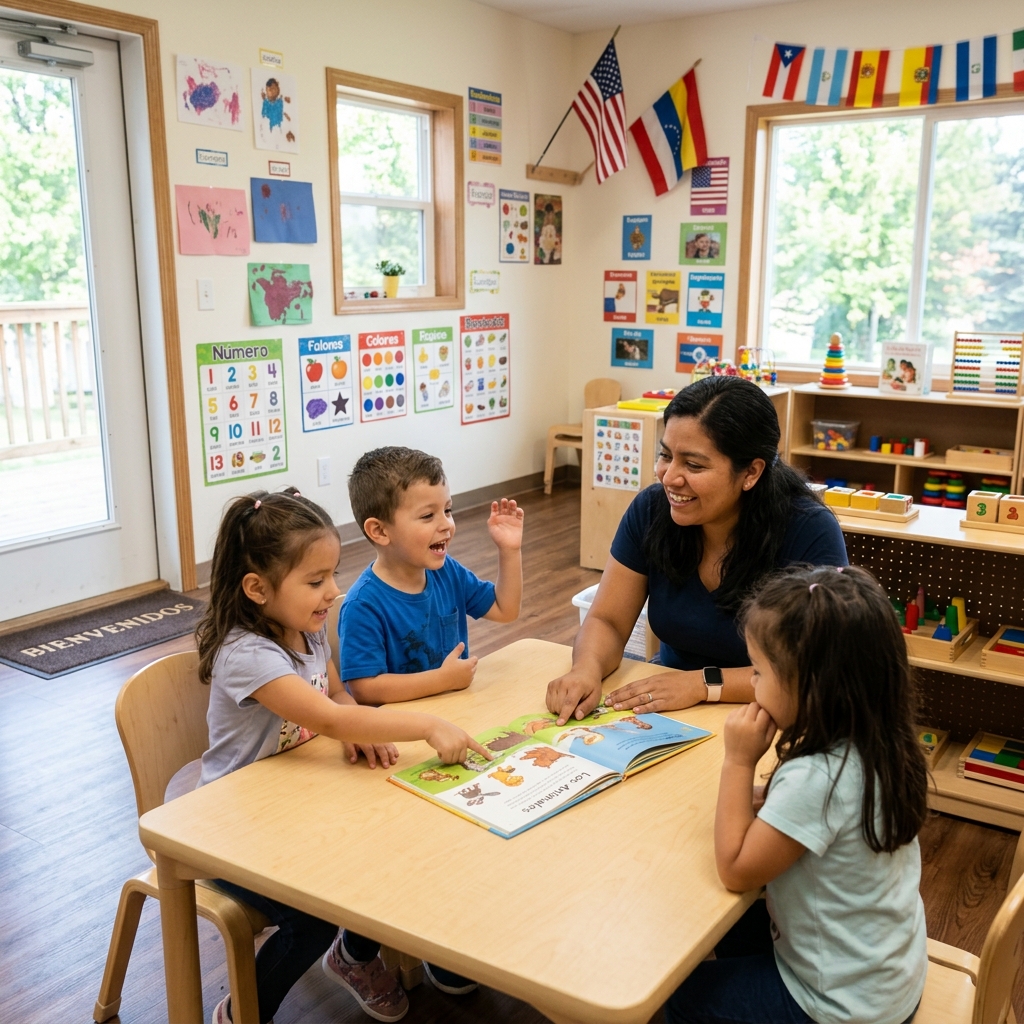
Throughout the day, learning centers become language-rich spaces. In our kitchen area, children learn food vocabulary, cooking concepts, and math through measuring—all naturally in Spanish. Our reading corner is stocked with beautifully illustrated Spanish books. Art projects, block building, and dramatic play all happen within Spanish conversation. Your child isn’t sitting at a desk conjugating verbs; they’re living language through play.
We integrate literacy intentionally. Even our youngest learners see Spanish words and letters in their environment. Preschoolers begin recognizing letters, understanding that print carries meaning, and sometimes start decoding simple words. That early literacy foundation supports reading success once they enter elementary school.
Our curriculum also celebrates the cultures connected to Spanish. We explore music, holidays, traditions, foods, and stories from Mexico, Spain, Central America, South America, and Spanish-speaking communities right here in our neighborhoods. Your child learns that Spanish isn’t just a language—it’s a doorway to rich, diverse cultures.
We build in time for English as well. We’re not trying to erase English; we’re building bilingualism. Some structured time may include English books or conversation, but Spanish remains the dominant language of instruction and daily interaction.
What to do next: Come observe a class in action to see how our immersion curriculum looks and feels in practice.
Why Our Farmington Daycare Stands Apart
We’re Farmington’s first licensed Spanish immersion daycare, and we didn’t rush into this. We built Mis Tortuguitas because we saw a gap in what our community needed and a chance to do something meaningful for local families.
What sets us apart starts with our team. We’ve recruited bilingual educators who are trained in early childhood development and genuinely passionate about both Spanish language and nurturing young children. Our teachers aren’t just staff—they’re the heart of what we do. We invest in their ongoing training, competitive compensation, and a culture where they feel valued. When our teachers feel supported, your child feels that warmth and stability.
Our facility is designed specifically for immersion and child development. Every corner has been thoughtfully set up to encourage language exploration and learning through play. Our classrooms are organized by age group—infants, toddlers, and preschoolers—so each program respects developmental stages while providing appropriate Spanish immersion.
We keep class sizes intentionally small. We’re not trying to maximize enrollment; we’re trying to maximize relationships and individual attention. When your child’s teacher knows them deeply, that teacher can respond to their unique learning style, celebrate their progress, and support them when they need extra encouragement.
We also treat every child like our own. That’s not just a phrase—it shapes how we show up every day. We’re calm under pressure, responsive to your child’s needs, and genuinely delighted by their growth. Parents tell us repeatedly that they feel peace of mind dropping their child off here because they trust us completely.
Finally, we partner with your family. We communicate regularly about what your child is learning, celebrate milestones together, and support you in continuing bilingualism at home. Immersion works best when school and home are aligned, and we take that seriously.
What to do next: Schedule a tour and spend time with our team. You’ll feel the difference immediately.
What to Expect in Our Daily Spanish Immersion Environment
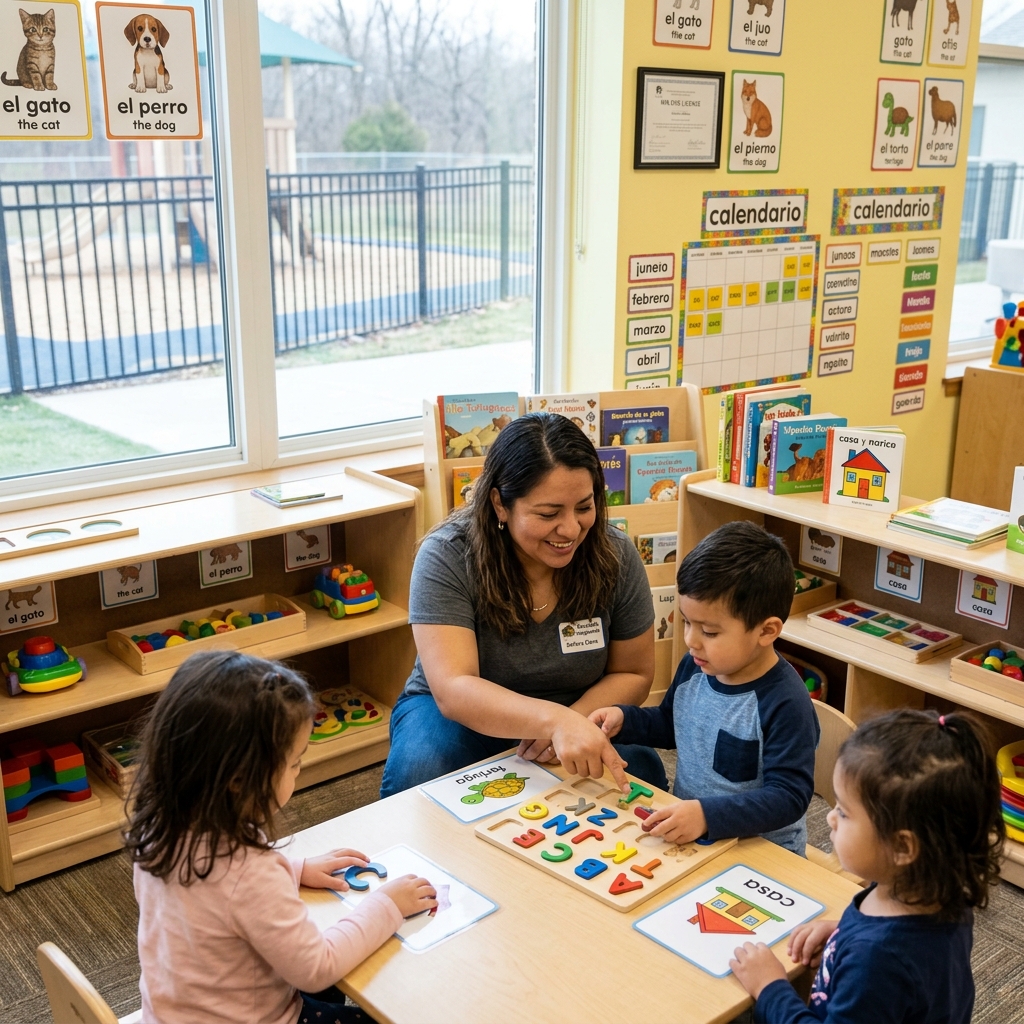
Walking into our classrooms, you’ll notice Spanish everywhere. Names of classroom areas are labeled in Spanish. Songs playing throughout the day are in Spanish. Conversations between teachers and children, children and children—Spanish. And yet it never feels forced or overwhelming. It’s warm, natural, and joyful.
A typical preschool day at Mis Tortuguitas flows like this: children arrive and transition into the classroom with a warm greeting. Teachers and children chat about the morning, talk about what they’ll do today, and sing welcome songs. That first half hour of unhurried transition helps children settle and gets their ears tuned to Spanish.
Structured learning blocks happen next. This might be a guided activity like learning numbers through a counting game, exploring shapes through art, or listening to a story. Teachers model language, ask questions, and encourage participation. Children aren’t expected to respond in perfect Spanish—approximations, gestures, and emerging attempts are celebrated. The focus is on comprehension and confidence, not perfection.
Free play and learning centers take up a significant portion of the day. Children choose where they want to play—building with blocks, pretending in our dramatic play kitchen, painting, reading, doing puzzles. Teachers circulate, play alongside children, model language, and gently expand on what children are exploring. This is where real language absorption happens.
Snack and meal times are language-rich too. Teachers and children talk about the food, practice vocabulary, and use mealtimes to build community. We also respect children’s individual needs and preferences, always with warmth.
Outdoor time is essential. Children run, play, explore, and yes, speak Spanish on the playground too. Fresh air and physical activity support language learning and overall wellbeing.
The day includes transitions and quieter moments. Before pickup, we have settling-down time with calmer activities, books, or soft music. Children leave our care calm and ready to transition home.
Throughout all of this, we’re tracking each child’s progress, celebrating small wins, and communicating with families about what we’re seeing and learning.
What to do next: Ask us for a typical daily schedule when you call or visit. Seeing the flow helps you understand how language is woven throughout the day.
Safety, Security, and Licensed Care You Can Trust
Your child’s safety is our top priority—everything else flows from that foundation. We’re a fully licensed daycare facility in Minnesota, which means we meet and exceed state regulations for safety, sanitation, staff training, and child-to-teacher ratios.
Our physical space is secure. We control access to our building, maintain up-to-date safety equipment, and conduct regular safety drills. Parents pick up and drop off in person, and we keep careful records of who’s in our care and when. There’s no guesswork or casual oversight.
Our staff is thoroughly vetted. All our teachers have background checks, are trained in CPR and first aid, and bring early childhood credentials. We invest in ongoing professional development because best practices in child care are always evolving, and we want to stay at the leading edge.
Health and hygiene are built into our routines. We follow handwashing protocols, maintain clean environments, and coordinate with families about illness policies to keep all children healthy. We’re also experienced in caring for children with a wide range of needs and happy to discuss any specific health considerations.
We maintain detailed documentation of each child’s care, activities, and development. You’ll know what your child ate, how long they napped, what they played, and what progress we’re celebrating. That transparency builds trust and helps us partner with you effectively.
We also prioritize emotional safety. Our caregiving approach is responsive and warm. Children feel secure enough to explore, take small social risks, and develop confidence. That emotional foundation supports both language learning and healthy development.
What to do next: Ask to see our licensing documentation and safety protocols. We’re proud of our standards and happy to walk you through them.
Enrollment Options That Fit Your Family’s Schedule
We know every family’s needs are different, and we’ve designed our enrollment options to be flexible and accessible.
We offer enrollment options at Mis Tortuguitas for both full-time and part-time care. Full-time enrollment typically works best if you’re working and need consistent, predictable childcare. Part-time enrollment might be perfect if you work part-time, stay home, or want your child in an immersion program just a few days weekly.
We serve children from six weeks through six years, so we can support your child across multiple years and stages. Many families stay with us from infancy through preschool, building relationships and maintaining continuity.
Our hours are designed around working families’ needs. We open early enough for morning commutes and stay open long enough for standard work days. We also understand that every family is unique, and we’re happy to discuss your specific situation.
Tuition is competitive with other quality childcare in the area, and we’re transparent about pricing. We don’t have surprise fees or hidden costs. When you talk with us, we’ll walk through exactly what enrollment includes and what investment looks like for your family.
We recognize that cost matters, and we’re happy to discuss what’s realistic for your family. Many families find that the value of bilingual immersion, combined with the peace of mind our care provides, makes the investment meaningful.
Enrollment does have a process—we typically meet with families, tour the facility, and talk through how to make sure Mis Tortuguitas is the right fit for your child and family. We’re selective because we care deeply about building a strong community and ensuring every child thrives in our environment.
What to do next: Contact us to learn about current availability and discuss enrollment options that fit your family’s needs and schedule.
How Spanish Preschool Prepares Children for School Success
Children who’ve attended quality Spanish immersion preschools don’t just speak Spanish—they arrive at kindergarten with advantages that ripple throughout their education. Understanding how immersion supports school readiness helps explain why this investment matters so much.
First, literacy skills. Children in immersion preschools typically develop strong phonological awareness and early decoding skills. They’ve been hearing Spanish language patterns, seeing print in their environment, and understanding that words carry meaning. That foundation transfers to reading in any language. When your child starts elementary school and transitions to English reading instruction, they already understand how language works.
Second, cognitive development. The cognitive flexibility that comes from bilingualism—the ability to switch between language systems, understand multiple perspectives, and problem-solve creatively—directly supports academic thinking. Studies show bilingual students often outperform monolingual peers on tests of executive function and abstract reasoning.
Third, social-emotional readiness. Children who’ve spent years in a warm, attentive preschool environment have developed confidence, resilience, and healthy social skills. They know how to separate from a caregiver, navigate group dynamics, follow routines, and ask for help. Those capacities are essential for kindergarten success.
Fourth, cultural awareness and openness. Children who grow up learning Spanish and celebrating diverse cultures develop a natural curiosity and respect for difference. They’re more likely to be kind to classmates from different backgrounds and flexible when facing new or unfamiliar situations.
Finally, the motivation piece. Children who’ve had positive, playful learning experiences tend to approach school with enthusiasm rather than anxiety. They see learning as something enjoyable and natural. That attitude toward learning is one of the strongest predictors of long-term academic success.
What to do next: Think about what matters most to you in your child’s early education journey. School readiness is about so much more than academics—it’s about the whole child.
Meet Our Bilingual Teaching Staff
Our team is the heart of Mis Tortuguitas, and they’re what makes immersion real and meaningful.
Each member of our teaching staff brings fluent Spanish language skills and deep training in early childhood education. We’ve been intentional about recruiting educators who are genuinely passionate about bilingualism and who love working with young children. It’s the combination that matters—language skill alone isn’t enough, and early childhood training without Spanish fluency wouldn’t serve our mission.
Our teachers are warm, patient, and creatively energetic. They know how to get down on the floor and play, how to guide without controlling, and how to celebrate each child’s unique way of learning. Parents tell us repeatedly that they feel their children are genuinely loved and seen by our team.
We invest in ongoing professional development. Our teachers attend workshops, stay current on best practices in early childhood development and language immersion, and are part of a learning community. We know that great teaching isn’t something you do once—it’s something you continually improve.
We also support our team with competitive compensation, benefits, and a culture where they feel valued. When your child’s teachers feel respected and secure, they show up fully for the children in their care. It matters.
Each teacher brings their own personality and strengths. Some are naturally musical; others excel at art or storytelling. Some are calm and steady; others are playfully energetic. That diversity means different children connect with different teachers, and it also means our program benefits from multiple perspectives and approaches.
Our team is also bilingual, bicultural, and intentionally diverse. We want our staff to reflect the beautiful diversity of the Spanish-speaking world. Children see teachers who look like them, speak with different Spanish accents, and bring varied cultural backgrounds. That representation matters.
What to do next: When you visit, ask our teachers about their background, their approach to immersion, and what brings them joy in working with children.
Real Families, Real Results at Mis Tortuguitas
The families we serve come from different backgrounds, work in different professions, and have different reasons for choosing Spanish immersion. What they share is a desire for quality childcare and a commitment to bilingualism.
We’ve watched children arrive at six weeks old and grow into confident preschoolers. We’ve seen toddlers go from shy to chatty, from uncertain to willing to try new things. We’ve supported families through transitions and celebrated achievements big and small. Every child’s journey is unique, and we’re honored to be part of it.
Parents tell us they choose us because they feel their children are thriving—not just academically, but emotionally and socially. They notice their kids becoming more curious, more confident, more willing to take risks. They’re amazed at how naturally their children speak Spanish, how they code-switch appropriately, and how they talk about the cultural activities and celebrations we do together.
Working parents tell us they experience genuine peace of mind. They know their child is safe, engaged, and learning. They know their teacher cares. They’re not constantly worried or wondering if their child is okay. That peace of mind is priceless.
Families who plan to move to other regions often tell us they’re sad to leave but grateful for the head start their child received in immersion. Children moving to Spanish-speaking countries or to bilingual communities elsewhere often thrive because of the foundation built here.
We also see sibling patterns. Families whose first child attended Mis Tortuguitas almost always enroll their younger children too. That speaks volumes about the experience families have with us.
What to do next: Connect with us and ask if you can speak with a current family. Hearing directly from parents who know our program will give you real insight into what it’s actually like.
Schedule Your Tour and See Our Difference
The best way to understand what Mis Tortuguitas offers is to experience it. A tour isn’t just logistical—it’s a chance to feel the warmth of our environment, watch our teachers interact with children, and ask the questions that matter to your family.
When you tour our facility, you’ll walk through classrooms and see Spanish language and culture woven throughout. You’ll watch how our team interacts with children. You’ll notice the calm, playful energy. You’ll get a sense of whether this feels like a place where your child would thrive.
During a tour, we’re happy to answer any question: How do we handle transitions for anxious children? What’s our approach to behavior guidance? How do we support children learning English? How often do you communicate with families? What if my child speaks very little Spanish? All of these questions are valid, and we have thoughtful answers.
We’ll also talk about logistics—your schedule, your child’s needs, what enrollment looks like. We’ll be honest about whether we think we’re a good fit for your family, and we’ll help you understand your options.
Scheduling a tour is simple. Reach out through our website or give us a call. We’ll find a time that works for you, and we’ll give you our full attention. You’ll leave with a clear sense of who we are and whether Mis Tortuguitas is right for your family.
What to do next: Schedule your tour today. Come see for yourself why families choose Mis Tortuguitas for their child’s early education and bilingual journey.