
Table of Contents
- The Peace of Mind Every Working Parent Deserves
- What Sets Licensed Daycares Apart From Unlicensed Options
- How Spanish Immersion Gives Your Child a Cognitive Head Start
- Safety Standards and Qualifications: Our Commitment to Your Child
- Building a Strong Foundation for School Readiness
- Creating a Warm, Home-Away-From-Home Environment
- Small Class Sizes and Personalized Care That Make a Difference
- Why Bilingual Education Matters in Today's World
- We Partner With Your Family, Not Just Care for Your Child
- Schedule a Tour and Experience Our Difference Firsthand
The Peace of Mind Every Working Parent Deserves
When you’re juggling work, family, and a hundred other responsibilities, choosing the right daycare feels like one of the biggest decisions you’ll make. You’re not just looking for someone to watch your child. You’re looking for a safe space where they’ll grow, learn, and thrive while you focus on your career with confidence.
That’s where the difference between a licensed daycare and other options becomes crystal clear.
Let’s be honest: dropping off your child in the morning is hard, even when you know they’re in good hands. You replay it in your head during meetings. You wonder if they’re happy, safe, and being cared for with the same love you’d give them.
At Mis Tortuguitas, we understand that peace of mind isn’t a luxury, it’s a necessity. When you choose a licensed daycare in Farmington, you’re choosing accountability, standards, and people who’ve been vetted and trained to care for your child.
We treat every child like our own. That means we’ve invested in licensing, ongoing training, and daily practices that keep your little one secure and supported. Your child’s safety is our top priority, and that commitment starts the moment you decide to work with us.
The simple truth? Peace of mind lets you be present at work and present at home. No second-guessing. No stress about whether corners are being cut. Just the assurance that your child is in a warm, nurturing place with qualified caregivers who share your values.
What to do next: Think about what matters most to you in a daycare. Is it safety certifications? Bilingual learning? A small, intimate setting? Write those down and bring them with you when you visit potential providers.
What Sets Licensed Daycares Apart From Unlicensed Options
Not all childcare is created equal. Here’s what licensing actually means and why it matters for your family.
A licensed daycare in Minnesota operates under strict state regulations. We maintain background checks, health screenings, first aid and CPR certification, and regular inspections. We follow specific child-to-staff ratios that ensure your child gets enough individual attention. We document our curriculum, track developmental progress, and stay current with early childhood education best practices.
Unlicensed options? They operate without these guardrails. No mandatory inspections. No training requirements. No accountability structure.
Let’s put it plainly: licensing isn’t paperwork for paperwork’s sake. It’s a framework designed to protect children and give families transparency.
At Mis Tortuguitas, licensing means:
- Trained, background-checked staff who know how to recognize and respond to children’s developmental needs
- Facility standards for safety, sanitation, and security that are regularly checked by the state
- Clear policies on communication, discipline, nutrition, and illness protocols
- Access to resources and professional development so our team stays current
- Accountability to you and to regulatory agencies
When you choose a licensed provider, you’re choosing a partner who’s committed to doing things right, even when no one’s watching.
What to do next: Ask any daycare you’re considering for proof of their license, recent inspection reports, and staff qualifications. A quality provider will share these details openly.
How Spanish Immersion Gives Your Child a Cognitive Head Start
There’s something remarkable that happens in a child’s brain when they’re exposed to a second language daily. New neural pathways light up. Cognitive flexibility increases. They start developing a mental framework for how language works, which strengthens their ability to learn any language later.
Spanish immersion isn’t about forcing your child to speak Spanish fluently by age five. It’s about creating an environment where language develops naturally, the way it would if your family lived in a Spanish-speaking community.
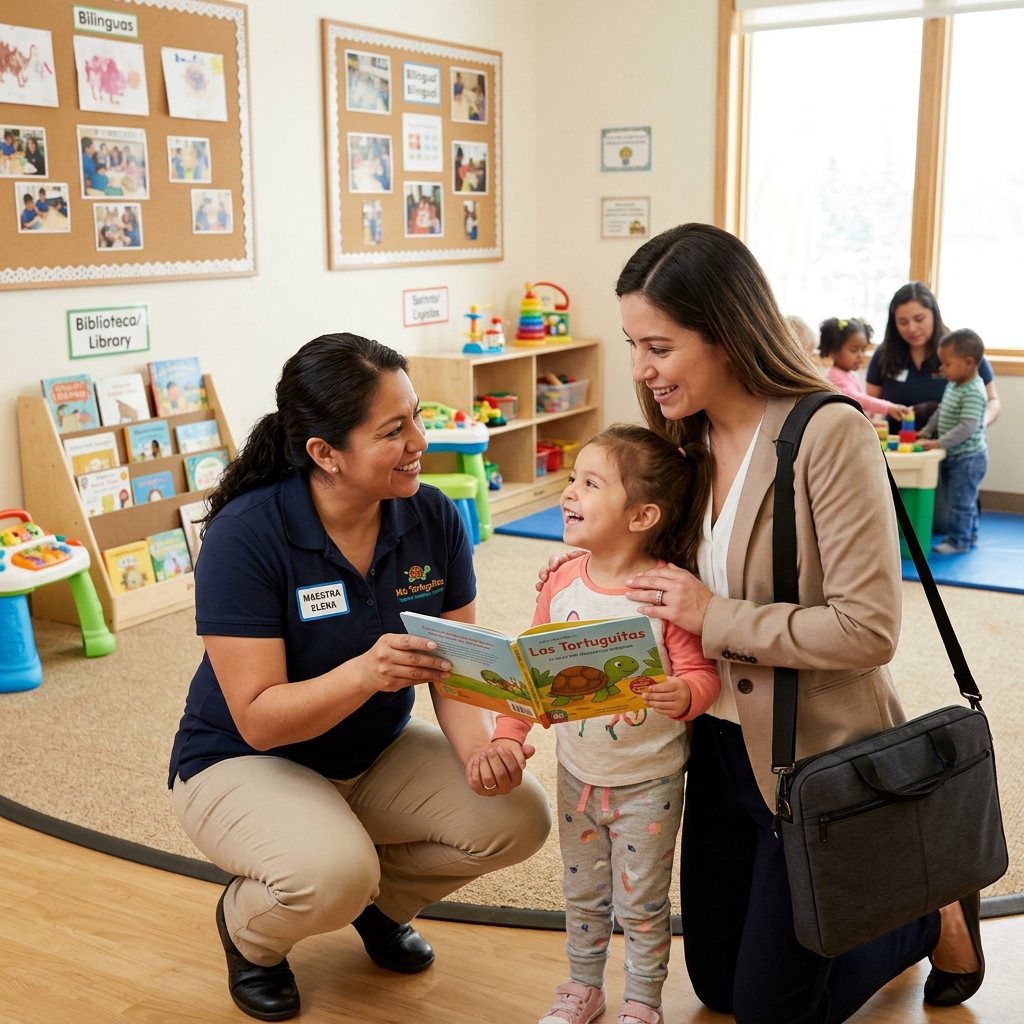
In our Spanish immersion preschool, children aren’t sitting in a classroom with flashcards. They’re playing, singing, building, eating snacks, and doing everything a four-year-old does, except it’s all happening in Spanish. They learn the word for “water” because they’re asking for it. They hear “buenos días (good morning)” every single day. They absorb rhythm, intonation, and vocabulary naturally, the way language is meant to be learned.
Research shows that children in immersion settings develop stronger executive function skills, better problem-solving abilities, and increased cognitive flexibility compared to peers in single-language environments. They’re literally building bigger, more capable brains.
And here’s the bonus: bilingual children often show earlier literacy skills and have an easier time learning additional languages as they grow.
What to do next: Think about whether bilingual learning aligns with your family’s goals. Even if Spanish isn’t spoken at home, immersion creates an incredible gift for your child’s future.
Safety Standards and Qualifications: Our Commitment to Your Child
Safety isn’t something we approach casually. It’s woven into every decision we make, every day.
Our staff members aren’t just caregivers; they’re trained professionals. Every member of our team holds current CPR and first aid certification. All staff complete background checks, health screenings, and fingerprinting through the Minnesota Department of Human Services. We provide ongoing training in child development, recognizing signs of abuse, mental health awareness, and safety protocols.
Our facility meets strict state standards for physical safety: secure entry and exit, clean and well-maintained spaces, age-appropriate equipment, and organized routines that keep children safe during transitions, meals, outdoor play, and rest time.
We maintain detailed health and safety policies covering illness, medication administration, allergy management, and emergency procedures. Every parent receives a handbook outlining these policies, and we communicate openly about any changes.
Beyond the rules and certifications, safety is also about relationships. When your child feels secure with their caregivers, when they know their environment is predictable and responsive to their needs, they feel safe. That emotional safety is just as important as the physical infrastructure.
What to do next: During a tour, ask about staff training schedules, emergency procedures, and how the facility handles illness or allergies. Observe how caregivers interact with children. Do they seem warm, attentive, and patient?
Building a Strong Foundation for School Readiness
By age five or six, children are walking into a classroom where they’re expected to listen, follow directions, cooperate with peers, manage their emotions, and engage with academic concepts. School readiness isn’t about knowing letters and numbers; it’s about the skills and confidence that make learning possible.
In our bilingual childcare programs, we intentionally build these foundations. Through play-based learning, we develop social skills, self-regulation, and curiosity. We introduce early literacy and numeracy concepts naturally, embedded in songs, stories, and games. We create routines that teach children how to listen, transition between activities, and work alongside peers.
A child who’s spent two years in a nurturing, structured daycare arrives at kindergarten with advantages:
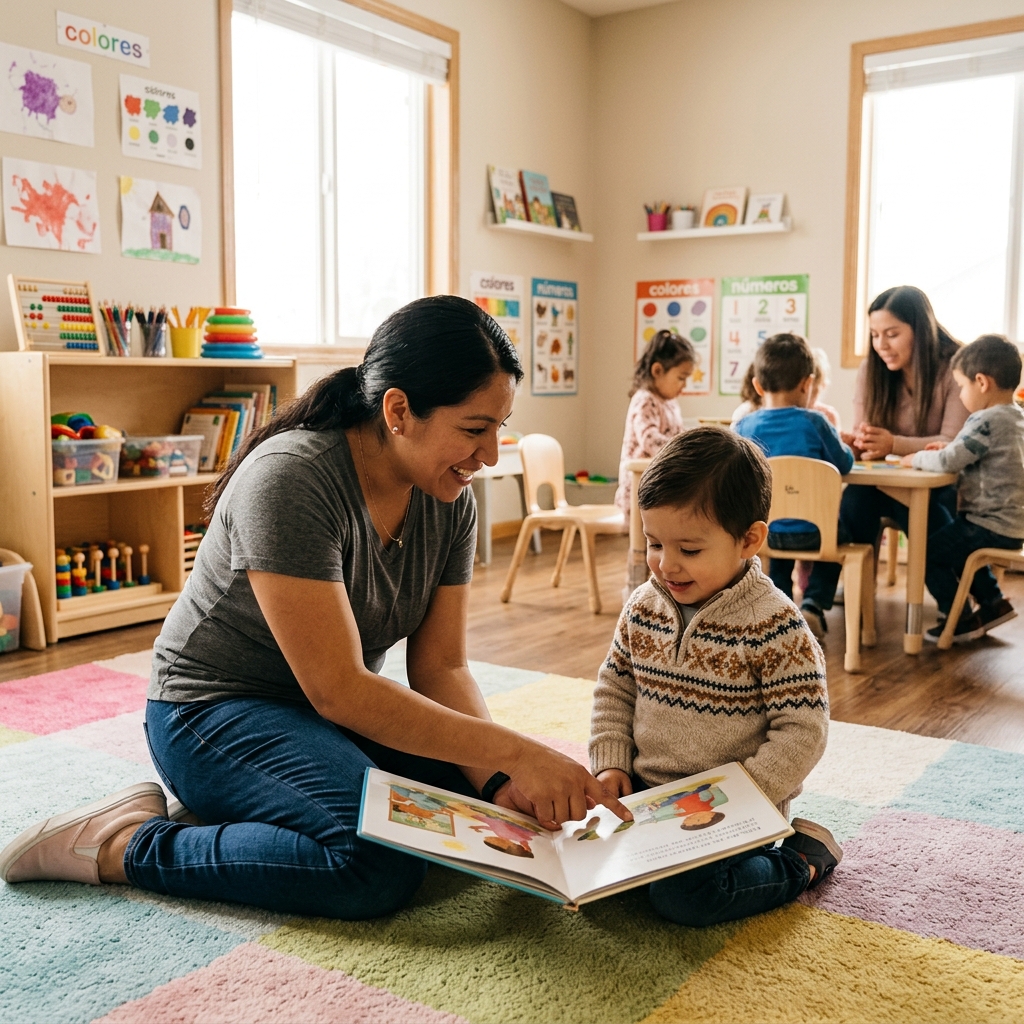
- They’ve practiced separation and reunion, so transitions feel manageable
- They’ve learned to share attention with a teacher and peers
- They understand routines and expectations
- They’ve been encouraged to explore, ask questions, and solve problems
- They’re comfortable speaking and expressing their ideas
We don’t teach academic content in isolation. We help your child develop the resilience, confidence, and social awareness that let them thrive in any learning environment.
What to do next: Ask prospective daycare providers how they approach school readiness. Look for providers who balance play-based learning with intentional skill-building and communication with families.
Creating a Warm, Home-Away-From-Home Environment
Walking into a daycare should feel welcoming, not institutional. Your child spends hours here each week. It should be a place where they feel known, safe, and happy.
We design our space with warmth in mind. Soft lighting, child-sized furniture, cozy reading corners, and art displays created by the children make our facility feel like a place where children belong. We keep class sizes small so every child knows their caregivers well and gets individual attention.
Routines matter, too. We greet each child by name as they arrive. We share stories about their day when you pick them up. We sing the same songs throughout the week so children can anticipate and enjoy them. We celebrate small victories: first time trying a new food, building a tall tower, helping a friend.
The little things create belonging. A child who feels seen and valued in their daycare develops confidence that carries into every other area of their life.
What to do next: Visit a few daycares and pay attention to how the space feels. Does it feel warm and alive? Do caregivers smile and engage with children? Can you imagine your child being happy there?
Small Class Sizes and Personalized Care That Make a Difference
Big does not mean better when it comes to daycare. A classroom with 20 four-year-olds and one teacher is chaos. A classroom with eight children and two caregivers is a learning community where each child is known.
In small classes, caregivers can:
- Notice when a child is hungry, tired, or needing extra support
- Have meaningful conversations with each child daily
- Track individual developmental progress and adjust activities accordingly
- Respond to each child’s unique personality, learning style, and interests
- Build real relationships that help children feel secure
When your child is one of eight instead of one of 20, they get more lap time, more conversation, more individual problem-solving support, and more genuine connection.
This personalized approach is especially important in immersion settings, where each child picks up language at their own pace. Some children will speak Spanish right away. Others will observe and understand for weeks before they speak. Small class sizes let us honor that natural progression without pressure.
What to do next: Ask about class sizes and teacher-to-child ratios. Request to see a classroom during activity time so you can observe the pace and feel of the environment.
Why Bilingual Education Matters in Today’s World
Your child is growing up in a world where bilingualism isn’t exotic; it’s practical. More than 40 percent of Americans speak a language other than English at home. Bilingual employees command higher salaries. Global communication and business are seamlessly multilingual.
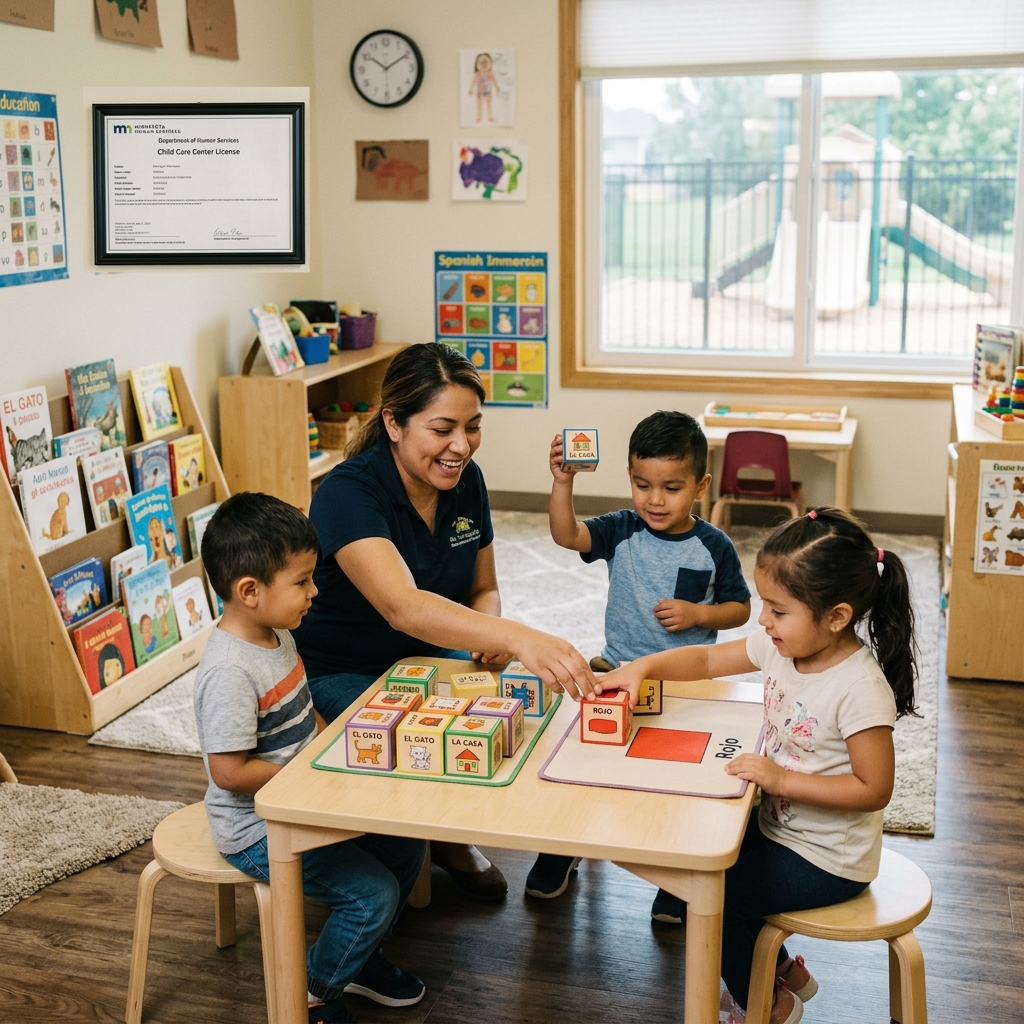
But the deeper reason goes beyond economics. Bilingualism opens your child’s mind to different ways of thinking and expressing ideas. It connects them to diverse cultures and communities. It gives them access to literature, music, relationships, and perspectives they wouldn’t have otherwise.
Learning Spanish in early childhood has particular advantages. Children under six acquire language naturally through immersion, without the self-consciousness or effort it takes older children and adults. Early exposure creates neural pathways that make future language learning easier.
And here’s something beautiful: bilingual children grow up understanding, at a deep level, that there are many ways to express the same idea. That flexibility is a gift.
Farmington’s diversity and proximity to communities with strong Spanish-speaking populations make this an especially meaningful time to give your child this advantage.
What to do next: Consider your family’s long-term goals. How important is bilingualism to you? What languages might benefit your child’s future?
We Partner With Your Family, Not Just Care for Your Child
You know your child better than anyone. You see their fears, their joys, their quirks, and their strengths. We want to build on that knowledge, not replace it.
Partnership means we communicate regularly about what’s happening at home and at school. If your child is going through a transition (a new sibling, a move, family stress), we know about it and adjust our approach. If something is working beautifully in our classroom, we share it so you can do the same at home. If we notice a developmental concern, we talk about it together and figure out next steps.
Partnership also means respecting your family’s values and priorities. You choose how much Spanish to use at home. You decide what matters most for your child’s development. We listen, honor those choices, and work together toward shared goals.
We send updates home through photos and notes. We hold parent conferences where we discuss your child’s progress honestly and celebrate their growth. We’re available when you need to talk. We’re not a service you purchase; we’re an extension of your parenting team.
What to do next: When you visit or call a daycare, pay attention to how they talk about families. Do they seem genuinely interested in your child’s life at home? Do they ask questions and listen?
Schedule a Tour and Experience Our Difference Firsthand
Reading about our approach is one thing. Experiencing it is another.
We invite you to come see for yourself. Walk through our facility. Watch children playing and learning. Feel the warm, purposeful energy that defines Mis Tortuguitas. Talk with our staff and ask the questions that matter most to your family.
A tour takes about 30 minutes and answers most of your questions. You’ll see our classrooms, meet team members, and get a real sense of whether we’re the right fit for your child.
We serve families in Farmington, Apple Valley, Lakeville, Eagan, and Rosemount, and we have openings for infants, toddlers, and preschoolers in both full-time and part-time programs.
Ready to experience the difference? Contact us to schedule your tour. We’re excited to meet your family and talk about how we can support your child’s growth, safety, and bilingual journey.
Your child deserves exceptional care. You deserve peace of mind. We’re here to provide both.