Table of Contents
- Why Early Spanish Immersion Matters for Your Child's Future
- The Science Behind Bilingual Brain Development in Infants and Toddlers
- How We Create a Safe, Spanish-Rich Environment from Day One
- Our Curriculum: Daily Spanish Immersion That Feels Natural and Nurturing
- Small Class Sizes and Licensed Bilingual Caregivers You Can Trust
- From Six Weeks Through Preschool: Programs Designed for Every Stage
- What Parents in Farmington, Apple Valley, and Lakeville Are Saying
- Flexible Enrollment Options That Work With Your Family's Schedule
- Your Peace of Mind: Safety, Security, and Home-Away-From-Home Care
- Schedule Your Tour and See the Mis Tortuguitas Difference Today
Why Early Spanish Immersion Matters for Your Child’s Future
You want your child to have every advantage. Language is one of the most powerful gifts you can give them, and starting early makes all the difference. When children are exposed to Spanish from infancy, they don’t learn it as a separate subject to memorize later—they absorb it naturally, the way they absorb their first language at home.
We’ve watched countless children in our Farmington community grow up speaking Spanish and English fluently, without either language feeling like a chore. These bilingual kids have something special: cognitive flexibility, cultural awareness, and doors that open wider as they grow. In today’s job market, bilingualism is a genuine asset. But more than that, it’s a gift that keeps unfolding throughout their entire lives.
When your child spends their days in a warm, Spanish-rich environment, they’re not just learning vocabulary. They’re building neural pathways that support problem-solving, creativity, and adaptability. Studies show that bilingual children often score higher on tests measuring executive function—their ability to think through problems and switch between tasks. Your child gets all of this while playing, laughing, and building friendships.
Starting in infancy or toddlerhood is ideal because young children are language sponges. Their brains are literally wired to pick up the sounds, patterns, and cadence of every language around them. By the time they reach preschool, they’re already thinking in both languages naturally.
What to do next: Reflect on your family’s goals for your child’s education and cultural identity. If bilingualism matters to you, the earlier you start, the more natural it becomes.
The Science Behind Bilingual Brain Development in Infants and Toddlers
You might wonder: won’t two languages confuse a baby or slow down their speech development? This is one of the most common questions we hear from Farmington parents, and the research is reassuring.
Young children’s brains don’t experience languages as competition. Instead, each language creates its own neural network. Brain imaging studies show that bilingual infants actually develop richer, more densely connected brain regions related to language processing. They’re not confused—they’re building dual language systems simultaneously.
Here’s what happens developmentally. From birth to about six months, babies hear all the sounds in all languages. Around six to twelve months, their brains begin filtering out sounds that aren’t in their home language. But when a child is regularly exposed to two languages during this critical window, both sets of sounds remain “active” in their brain. This is why children immersed in Spanish from infancy pick up pronunciation that native speakers recognize immediately.
Between 12 and 24 months, toddlers start pairing sounds with meaning. A bilingual toddler may have a slightly smaller vocabulary in each individual language compared to a monolingual peer, but their total vocabulary across both languages is typically equal or greater. Within a few years, bilingual children naturally separate the two languages and use them independently and fluidly.
The magic happens because children this young don’t overthink language—they simply absorb it through daily interaction, play, and relationships with caring adults. Their brains are primed for this kind of learning, and when they’re in a safe, nurturing environment where Spanish is spoken naturally throughout the day, language acquisition feels effortless.
What to do next: Trust that your child’s brain is designed for this. If you’re considering bilingual childcare, know that early immersion actually optimizes your child’s language potential.
How We Create a Safe, Spanish-Rich Environment from Day One
Your child’s safety is our top priority, and we weave Spanish immersion seamlessly into every part of that secure foundation. When you walk into Mis Tortuguitas, you feel it immediately: a calm, warm space where children are genuinely cared for and language flows naturally.
Our facility is designed with infants and toddlers in mind. Small class sizes mean each caregiver knows your child’s rhythms, preferences, and developmental stage intimately. We’re talking about five infants per licensed caregiver, or similar ratios for older toddlers. That level of attention creates the emotional safety every young child needs, and it’s the platform on which all learning happens.
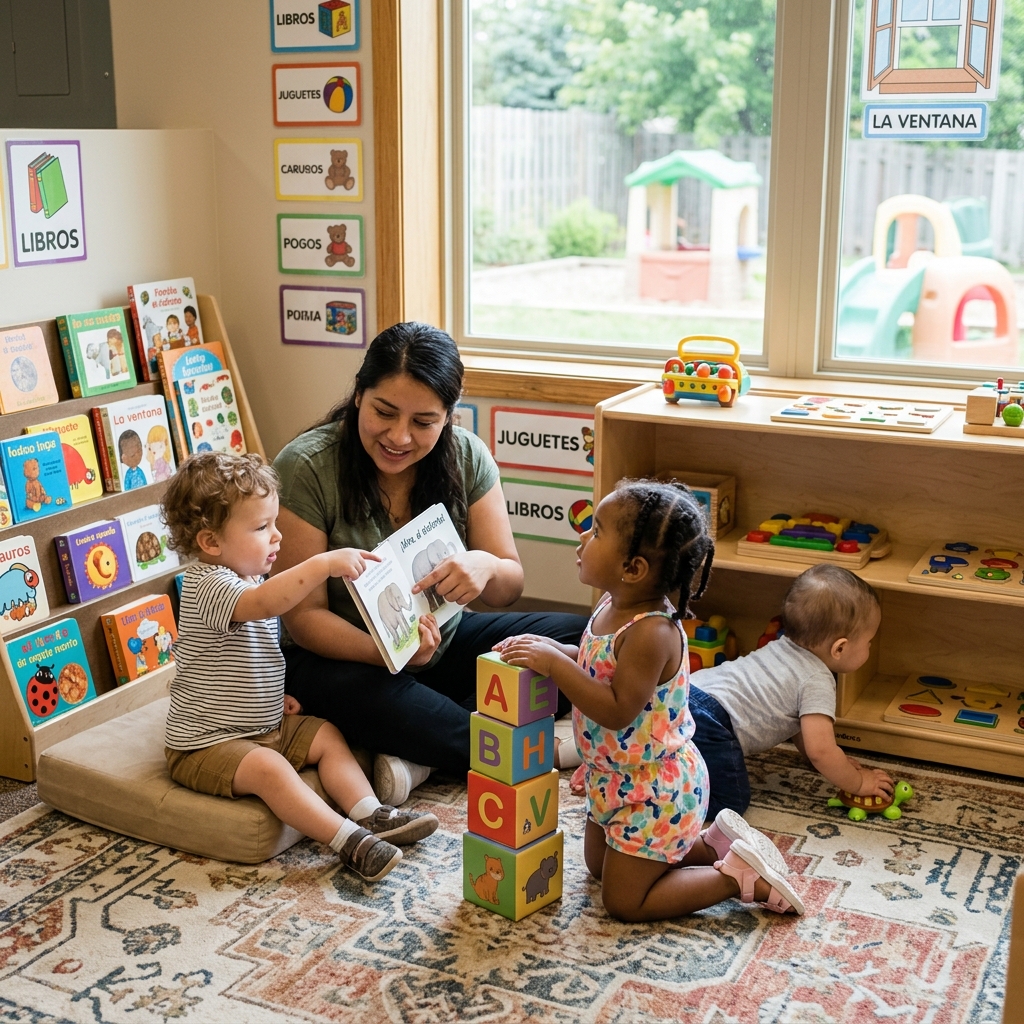
Spanish isn’t introduced as lessons or flashcards. It’s the language we use to comfort, guide, and celebrate with your child all day long. “Buenos días (good morning), mi amor. Let’s change your diaper and get ready for playtime.” “Vamos a leer (let’s read) this book together.” This natural, constant exposure is what makes immersion work.
We staff our classrooms with bilingual caregivers who are fluent in Spanish and hold current Minnesota licensure in early childhood education. They’ve trained in infant and toddler development, CPR, and our specific curriculum approach. Your child isn’t just hearing Spanish—they’re hearing it from adults who speak it authentically and can respond thoughtfully to their needs.
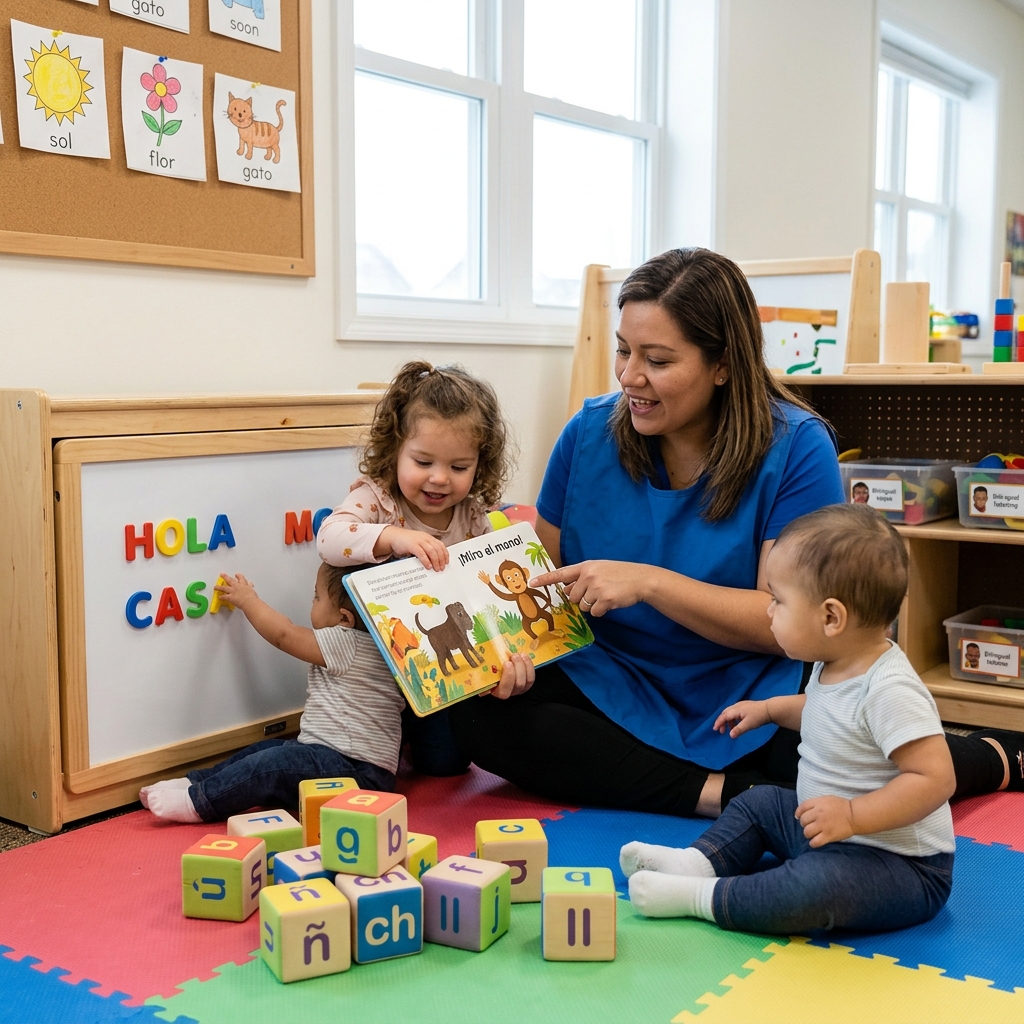
Our classrooms are organized to support exploration and learning. We have soft play areas for crawlers, safe climbing structures, sensory stations, and cozy reading nooks. Every toy, book, and activity is chosen with both Spanish language exposure and developmental appropriateness in mind.
What to do next: Schedule a tour of our facility. You’ll see firsthand how safety, warmth, and Spanish immersion work together to create the ideal environment for your child.
Our Curriculum: Daily Spanish Immersion That Feels Natural and Nurturing
We don’t follow a rigid, academic curriculum with worksheets or drills. Instead, our approach is playful, responsive, and rooted in how young children actually learn. Every activity, song, snack, and transition is an opportunity for language building and joy.
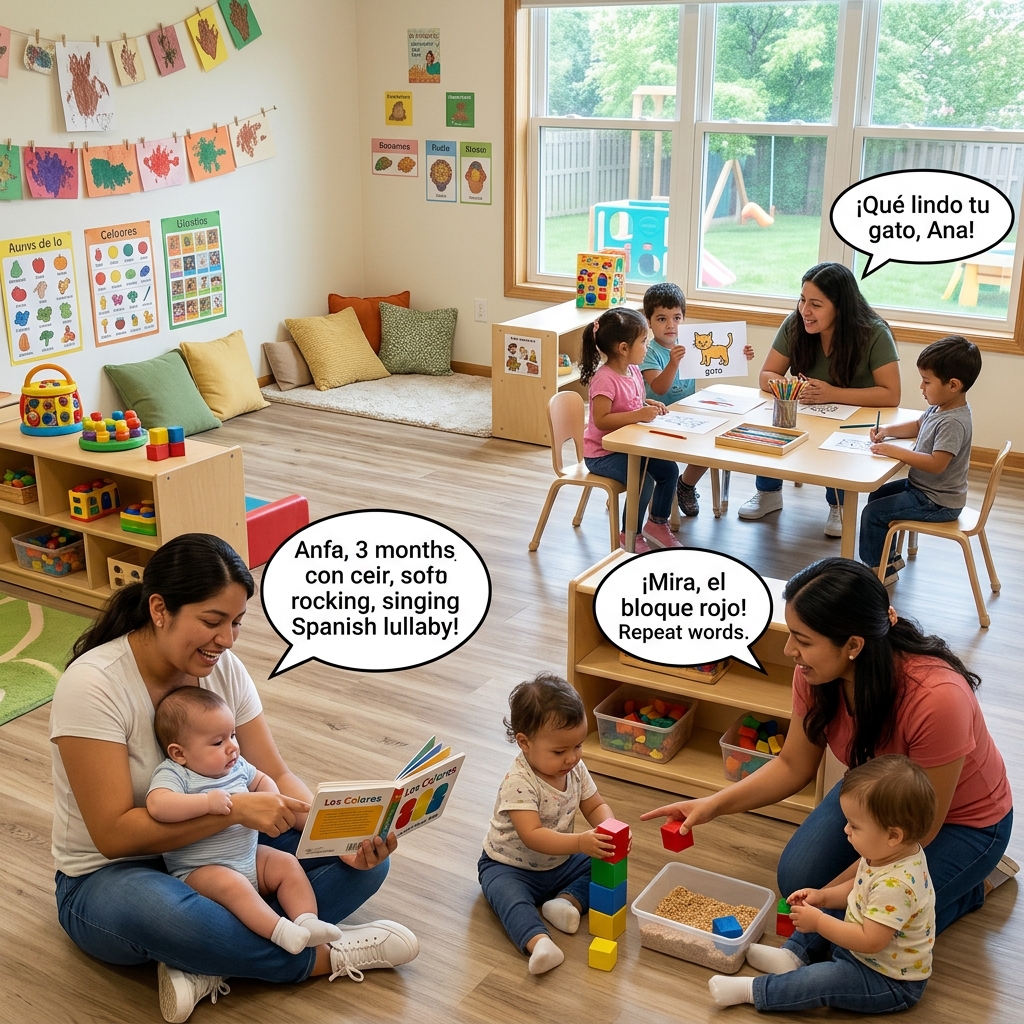
For our infant program, the focus is on bonding, sensory exploration, and emerging language. Your six-week-old hears Spanish lullabies during nap time. They feel the rhythm of Spanish in your caregiver’s voice during feeding. By four months, they’re tracking faces and beginning to recognize familiar voices speaking the language. Songs, rhymes, and simple games all happen in Spanish—not because we’re teaching lessons, but because it’s how we naturally interact.
As toddlers develop, our curriculum layers in more intentional learning while keeping it playful. We build vocabulary around daily routines, animals, colors, and actions. A caregiver might point to a bird outside and say, “Mira, el pajarito (look, the little bird). El pajarito canta (sings). Can you sing like the bird?” The toddler hears the word, sees the connection, and practices the new vocabulary without even realizing it’s “learning.”
We incorporate music, movement, storytelling, and hands-on play daily. Spanish immersion for young children thrives on repetition and real-world context. We read books in Spanish, sing traditional songs, and celebrate culturally significant days. Children experience Spanish language and culture as joyful, present, and integral—not as something separate or special.
Literacy foundations begin early too. Even infants and young toddlers benefit from seeing books, hearing stories, and developing a love of reading in both languages. We use Spanish children’s books with beautiful illustrations and age-appropriate stories that spark curiosity and conversation.
What to do next: Ask about our curriculum philosophy and see sample daily schedules when you visit. You’ll understand how much learning happens through play and relationships, not formal instruction.
Small Class Sizes and Licensed Bilingual Caregivers You Can Trust
This is where trust truly begins. We treat every child like our own, and that’s more than a slogan—it’s reflected in our staffing model and caregiver training.
Each classroom has limited enrollment specifically so your child gets individualized attention. Our infant rooms cap at five babies per licensed caregiver. Toddler rooms maintain similarly low ratios. This isn’t just better for bonding; it’s essential for responsive early education. Your caregiver knows when your child is hungry or tired before they cry. They notice developmental milestones and can tailor activities to your child’s interests.
All our caregivers are bilingual and hold current Minnesota childcare licenses. Many have studied early childhood education, and all complete ongoing professional development in child development, behavior, nutrition, and bilingual learning strategies. We invest in our team because they’re the heartbeat of what we do.
Beyond credentials, we choose caregivers who genuinely love spending time with infants and toddlers. You’ll meet teachers who remember every child’s favorite song, who know which children are teething or learning to walk, and who celebrate small victories with authentic joy. That combination of training and heart is what makes a facility feel like a true extension of your family.
We also maintain stability in our classroom assignments. Your child isn’t moving to a new caregiver every few months. Consistency builds trust and deepens learning. A familiar adult who speaks Spanish daily becomes a language model and a secure base for your child’s growth.
What to do next: When you visit or call, ask to meet some of our caregivers and ask them about their experience with bilingual infants and toddlers. You’ll get a genuine sense of their dedication and warmth.
From Six Weeks Through Preschool: Programs Designed for Every Stage
We welcome children from six weeks old through six years, and we’ve designed our infant Spanish immersion program and toddler and preschool programs with each developmental stage in mind.
Infant program (six weeks to 12 months). Our youngest learners are in a calm, sensory-rich environment. Daily routines are narrated in Spanish. Babies hear responsive, warm language during diaper changes, feeding, and playtime. We use songs, gentle movement, and visual stimulation. The goal is secure attachment and early exposure to Spanish sounds and patterns.
Toddler program (12 months to three years). This is explosive language growth time. Toddlers move around more, have expanding vocabularies, and engage in simple pretend play. Our curriculum incorporates more structured activities while keeping everything playful. We do circle time with songs and stories, outdoor exploration, art, music, and small-group activities. Caregivers model language constantly, expand on toddler communication, and celebrate every word.
Preschool program (three to six years). Children become increasingly social, curious, and capable. Our preschool program balances free play with more intentional learning in literacy, numeracy, and social skills—all in Spanish. We incorporate early writing, phonemic awareness, numbers and shapes, science exploration, and collaborative projects. Children develop friendships, learn to navigate social situations, and build confidence as learners.
Throughout all programs, we offer both full-time and part-time enrollment options. Whether you need us five days a week or two days, we’ve got a flexible solution that works for your family.
What to do next: Review our bilingual childcare programs page to see which age group matches your child, then schedule a tour to see the classroom environment in action.
What Parents in Farmington, Apple Valley, and Lakeville Are Saying
We’re proud to serve families across the greater Farmington area, including Apple Valley, Lakeville, Eagan, and Rosemount. Parents choose us for the Spanish immersion, but they stay because of the relationships and the care.
One parent shared, “I was nervous about enrolling my six-month-old in daycare, but Mis Tortuguitas felt like a safe, loving extension of our home from day one. My daughter is now two and speaks Spanish fluently. Hearing her count to ten and sing songs in Spanish has been incredible.” Another family mentioned, “The staff truly cares about each child. They know exactly what my son needs and celebrate every milestone with genuine enthusiasm. Plus, knowing he’s getting quality bilingual education while I’m at work gives me so much peace of mind.”
What we hear repeatedly is that parents appreciate the combination of rigorous care standards and genuine warmth. They notice their children coming home excited about what they learned, singing new songs in Spanish, and genuinely happy to be here. And they feel supported—we partner with your family, sharing updates about your child’s day, growth, and what you can reinforce at home.
Parents also value the cultural exposure. Children learn not just the language but also traditions, holidays, and ways of being that enrich their worldview. Bilingual children often show greater empathy and flexibility—qualities that serve them well throughout life.
What to do next: Ask for parent references when you connect with us. Hearing directly from families who’ve walked this journey is invaluable.
Flexible Enrollment Options That Work With Your Family’s Schedule
Life with young children is unpredictable. We get it. That’s why we offer flexible enrollment that adapts to your family’s real needs.
Full-time enrollment works for families who need consistent, daily childcare. Your child attends five days a week, giving you reliable care and your child continuity that supports learning and bonding.
Part-time enrollment is perfect if you work part-time, freelance, or want your child to attend several days a week. Some families use part-time care while a grandparent or nanny handles other days. Others are ramping back into work after parental leave and need flexible hours.
We also work with families on scheduling. If you need early drop-off or later pick-up, we accommodate when possible. Our goal is to be a practical partner in your family’s life, not another source of stress.
Pricing is transparent and straightforward. There are no surprise fees or confusing add-ons. We offer competitive rates for the quality of care and Spanish immersion we provide. Many families find that the investment in early bilingual education pays dividends in their child’s confidence, cognitive development, and future opportunities.
What to do next: Call us to discuss your family’s schedule and ask about enrollment options and current availability. We’ll find a solution that works for everyone.
Your Peace of Mind: Safety, Security, and Home-Away-From-Home Care
When you entrust us with your child, you’re handing us your most precious person. We honor that trust every single day through our commitment to safety, security, and nurturing care.
Our facility meets all Minnesota licensing requirements for early childhood settings. We maintain current certifications in CPR and first aid for all staff. We have rigorous cleaning and hygiene protocols, health screening procedures, and secure drop-off and pick-up processes. You’ll never wonder if your child is in safe hands—they are.
But safety goes beyond compliance. It’s about creating an emotionally secure environment where your child feels truly seen and cared for. When your child trusts their caregivers, when they know their needs will be met with warmth, they’re free to explore, learn, and grow. That emotional safety is the foundation for everything else.
We communicate with you daily. You’ll receive updates about your child’s mood, eating, sleeping, milestones, and special moments. Photos and notes keep you connected even when you’re at work. If something comes up—a fall, a feeding issue, a new word—we let you know. Transparency builds confidence.
Many parents tell us that Mis Tortuguitas feels like a warm, home-away-from-home for their child. That’s exactly what we aim for: a place where your child is comfortable, happy, and thriving. A place where Spanish is woven into the fabric of daily life so naturally that by the time your child moves on to kindergarten, bilingualism feels like their superpower.
What to do next: Ask about our safety protocols, communication systems, and how we handle transitions when you tour. Seeing our commitment to security and transparency will ease your mind.
Schedule Your Tour and See the Mis Tortuguitas Difference Today
You’ve read about our approach, our philosophy, and what makes us different. But the real magic happens when you walk through our doors. You’ll see the calm, colorful classrooms. You’ll hear Spanish spoken naturally and joyfully. You’ll meet caregivers who light up talking about the children. And you’ll feel the warmth that makes Mis Tortuguitas truly special.
If you’re a parent in Farmington, Apple Valley, Lakeville, Eagan, or Rosemount considering Spanish immersion for your child, we’d love to meet you and your family. A tour takes about 30 minutes, and we can answer all your questions in person. You’ll see classrooms in action, meet staff, and get a real sense of whether we’re the right fit for your child.
Come see for yourself—schedule a tour today. Call us, visit our website, or send a message with your preferred times. We’ll find a moment that works for your busy schedule. Your child’s future is worth exploring every option, and we believe that once you spend time at Mis Tortuguitas, you’ll see why so many Farmington-area families trust us with their most precious people.
We’re ready to welcome your child and partner with your family. Let’s give your child the gift of bilingualism and the security of exceptional care. We’ll see you soon.