

Table of Contents
- 1. Traditional Full-Time Daycare Centers: Why They Don't Fit Busy Schedules
- 2. Drop-In Childcare Services: Convenience Without Consistency or Quality Assurance
- 3. In-Home Daycare Providers: Limited Curriculum and Inconsistent Licensing Standards
- 4. Our Spanish Immersion Part-Time Programs: Flexibility Meets Educational Excellence
- 5. School-Based Before and After Care: Why It's Too Limited for Working Parents
- 6. Nanny Shares: High Cost and Coordination Challenges for Farmington Families
- 7. Part-Time Preschool with Spanish Immersion: The Best of Both Worlds
1. Traditional Full-Time Daycare Centers: Why They Don’t Fit Busy Schedules
Finding the right childcare fit is one of the biggest decisions you’ll make as a working parent. You need something reliable, affordable, and safe, but you also want your child to learn and grow while you’re away. The problem? Most childcare options in the Farmington area weren’t designed with part-time schedules in mind, leaving busy families scrambling to patch together a solution that works.
We’ve helped dozens of families navigate this challenge. After years of conversations with parents just like you, we’ve learned what really matters: flexibility without sacrificing quality, affordability without cutting corners on care, and a curriculum that actually helps your child get ahead, not just stay supervised. This guide breaks down the seven most common childcare options available to Farmington families, what each one does well, and where they fall short.
Most daycare centers in the Farmington area are built around a full-time, five-day-a-week enrollment model. That structure keeps their finances simple and their staffing predictable. The problem? If you need childcare on Monday, Wednesday, and Friday only, or if you work part-time hours, you’re paying a premium for days you don’t use.
Full-time centers typically charge between $1,200 and $1,800 per month per child, regardless of whether you send your child four days or five. Many facilities have rigid pickup times (often 5:30 p.m. sharp) and charge steep late fees. They’re also reluctant to accommodate the schedule flexibility that busy families actually need. If your work schedule shifts or you have an unexpected half-day, there’s often no option to adjust.
Beyond cost, these centers focus on basic childcare and supervision. While they meet state licensing requirements, they don’t always prioritize enriching curriculum or bilingual learning. Your child gets safe care, but limited exposure to skills like early literacy, language development, or cultural learning.
What to do next: If you need childcare fewer than five days per week, look for providers who actually build flexibility into their pricing and scheduling. You shouldn’t pay full price for part-time care.
2. Drop-In Childcare Services: Convenience Without Consistency or Quality Assurance
Drop-in childcare sounds perfect at first. You call, drop off your child for a few hours, and pick up whenever you’re done. No long-term commitment, no contracts, just spontaneous care when you need it.
In reality, drop-in services create problems for your child’s development and your peace of mind. Every visit means a different caregiver, different rules, and different playmates. Infants and toddlers thrive on consistency and routine; a rotating cast of unfamiliar adults can create anxiety and confusion. There’s also no guarantee of quality assurance. Drop-in facilities often hire staff quickly and may not invest in ongoing training or background checks with the same rigor as licensed centers.
Drop-in care also lacks any real curriculum or learning goals. Your child isn’t building skills or relationships; they’re just passing time in a room with toys. If you’re paying for childcare, shouldn’t your child also be gaining something valuable? And as a parent, you’re left wondering who’s actually caring for your child and whether they know your child’s needs, allergies, or preferences.
What to do next: Use drop-in childcare only as a true emergency backup, not as your regular solution. Your child deserves consistency, and you deserve to know exactly who’s caring for them.
3. In-Home Daycare Providers: Limited Curriculum and Inconsistent Licensing Standards
In-home daycare providers offer a more personal, home-like environment, which appeals to many Farmington families. Costs are lower (often $800 to $1,200 per month), and the caregiver-to-child ratio is smaller and cozier.
The catch? Licensing standards for in-home providers are far less rigorous than for center-based care. Minnesota requires basic background checks and training, but enforcement is inconsistent. Some in-home providers are excellent and professional; others operate with minimal oversight. There’s no guarantee of ongoing staff development, curriculum planning, or educational focus.
If your goal is part-time care with bilingual learning or school readiness focus, in-home providers typically can’t deliver. Most operate alone without a team, so there’s no structured curriculum, limited lesson planning, and no second caregiver trained in another language. Your child gets basic supervision but misses out on the enriched learning environment that sets them up for kindergarten success.
When the provider gets sick, takes vacation, or leaves the business, you’re back to square one searching for care. There’s no backup coverage and no continuity for your child.
What to do next: In-home care works best if you’re looking for budget-friendly, casual supervision only. If you want educational curriculum or bilingual enrichment, you need a more structured environment.
4. Our Spanish Immersion Part-Time Programs: Flexibility Meets Educational Excellence
This is where part-time childcare stops being a compromise and becomes a real advantage.
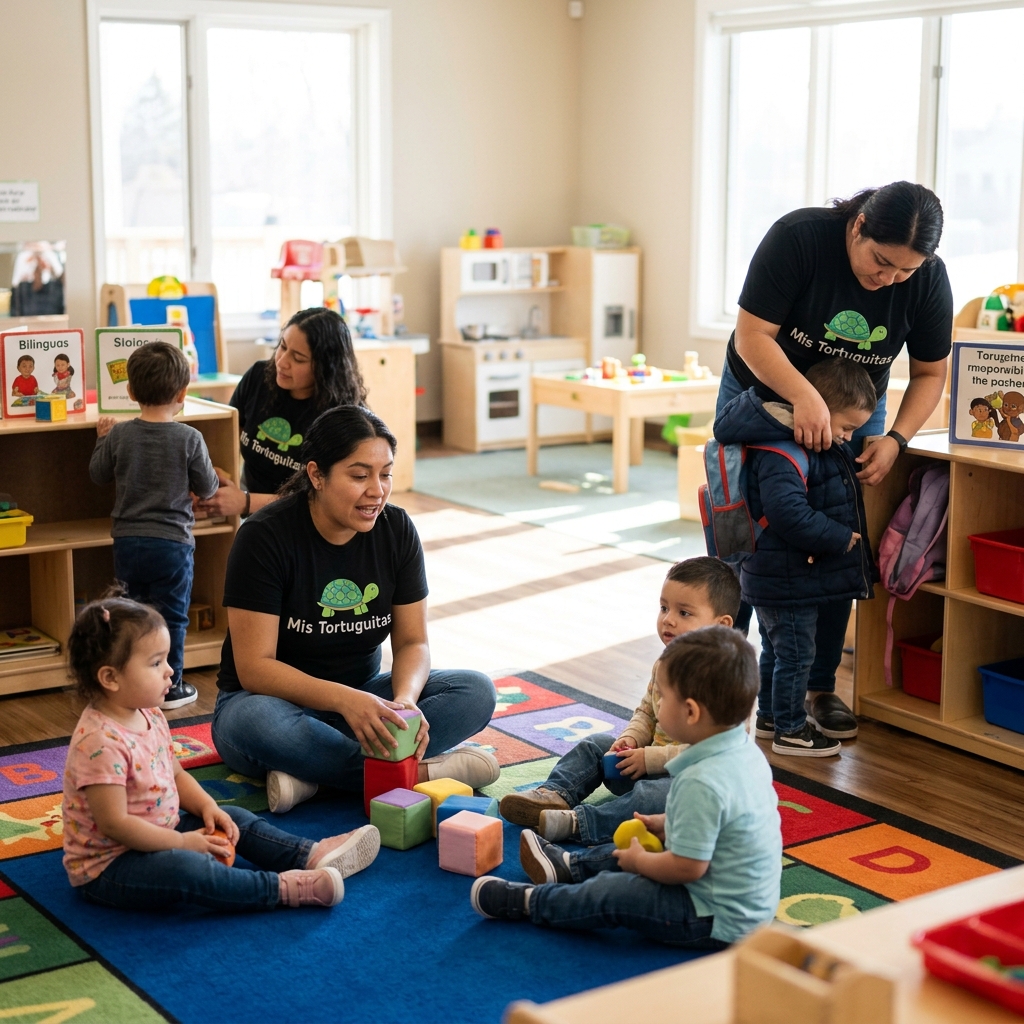
At Mis Tortuguitas, we designed our Spanish immersion daycare programs specifically for busy Farmington families who refuse to choose between flexibility and quality. Unlike full-time-only centers, we offer genuine part-time enrollment: two days per week, three days per week, or four days per week, at proportional pricing. You’re not paying for days you don’t use.
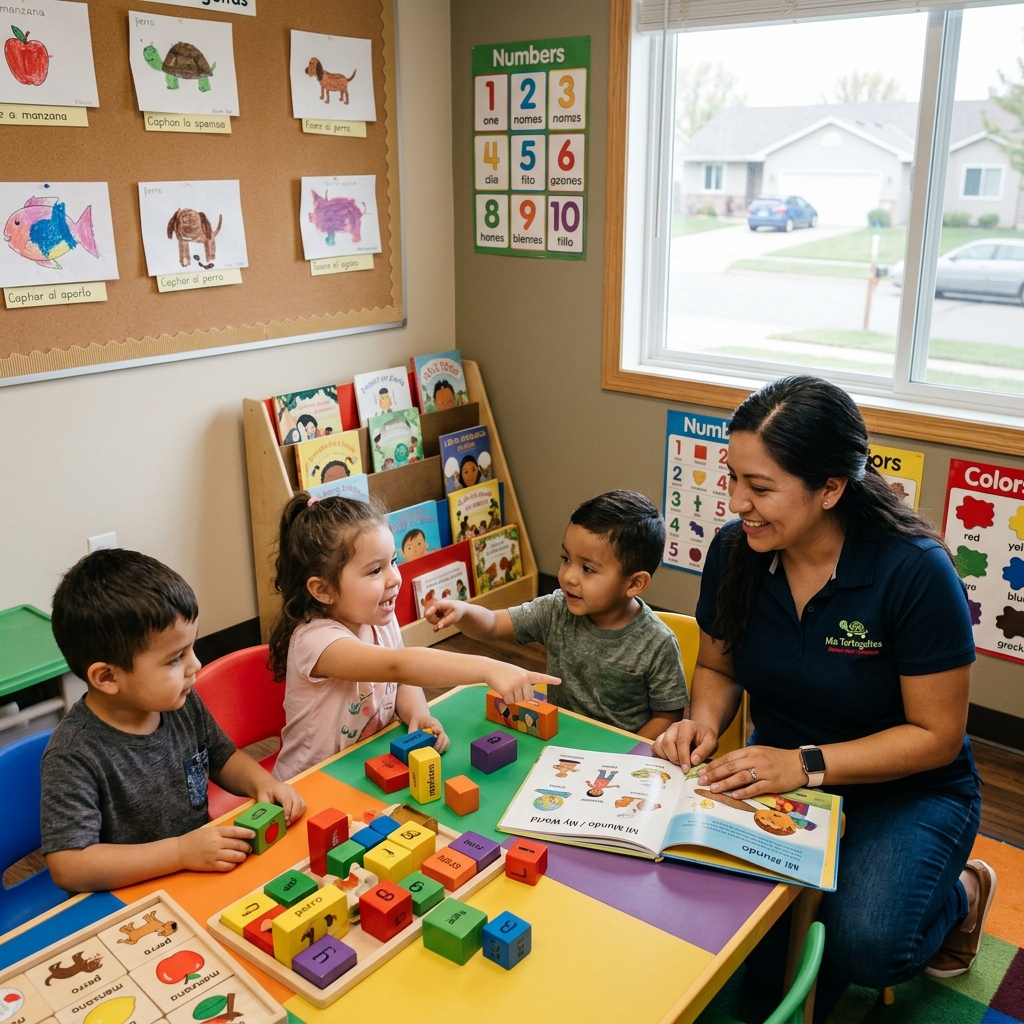
Here’s what sets us apart: your child doesn’t just get care, they get immersed in daily Spanish and a developmentally rich curriculum. From six weeks through six years old, our licensed bilingual staff deliver structured lessons, music, literacy activities, outdoor play, and cultural learning. Every day in our warm, nurturing facility, your child is building early language skills, confidence, and school readiness.

We keep our class sizes small so your child gets the attention and consistency they need. The same caregivers are there day after day, so your child feels secure and develops real relationships. Our teaching team is trained in early childhood development and bilingual education, not just basic childcare supervision.
Part-time enrollment also means flexibility. We work with your schedule and transitions. If you need an extra day one week or have a different arrangement the next, we’ll find solutions with you. We partner with your family, not against it.
Your child benefits from daily Spanish immersion right when their brain is most ready to absorb language. By the time kindergarten arrives, they’ll have a strong foundation in both English and Spanish, plus early literacy skills, social confidence, and curiosity that gives them a real head start.
What to do next: Schedule a tour and see our classrooms, meet our bilingual staff, and ask about our part-time pricing options. You’ll get a feel for whether Mis Tortuguitas is the right fit for your family.
5. School-Based Before and After Care: Why It’s Too Limited for Working Parents
Once your child reaches kindergarten, before and after school programs seem like the obvious solution. They’re affiliated with your child’s school, run by trained staff, and cost less than full-time daycare.
The reality is less appealing. Most school-based programs operate on the school calendar, which means you lose care during winter break, spring break, and summer. For a working parent, that’s a logistical nightmare and an expensive problem to solve. You’re scrambling to find alternative care, arranging unpaid time off, or paying for summer camps in addition to the school program.
These programs also focus on supervision and recreation, not education. Your child does homework, plays games, and stays safe, but they’re not building new skills or getting enriched learning. They’re tired from a full school day and need downtime, not structured curriculum, but they’re also not challenging themselves.
For families who need part-time care for younger children (infants, toddlers, and preschoolers), school-based care doesn’t exist. You need a separate solution for your younger child anyway, so you haven’t simplified anything. You’re managing multiple providers, multiple schedules, and multiple bills.
What to do next: Use school-based before and after care as one piece of your childcare puzzle, but don’t rely on it as your complete solution for working parents. Plan ahead for breaks and consider supplemental programming that keeps learning going.
6. Nanny Shares: High Cost and Coordination Challenges for Farmington Families
A nanny share sounds practical on paper: you split a nanny’s salary with another family, so costs drop from $3,000 to $4,000 per month to maybe $1,500 to $2,000. The nanny comes to your home or a shared space, and both children get one-on-one attention.
In practice, nanny shares require you to manage a lot. You need to find another family with a compatible schedule, ages, and parenting philosophy. Once you do, you’re dealing with two sets of parents, two payment arrangements, and the logistics of either splitting a home space or rotating locations. If one family wants to leave or needs to adjust the schedule, the entire arrangement falls apart.
Nanny shares also lack oversight and curriculum structure. A nanny can be wonderful, but without a facility framework or team, there’s no standardized training, no developmental activities plan, and no continuity if the nanny leaves. You’re hiring someone as an individual, not enrolling with an organization that has backup systems and professional accountability.
For part-time schedules, a nanny share becomes even more complicated. If you only need care Tuesday and Thursday, coordinating that with another family’s schedule is nearly impossible. And if you want bilingual education or a structured curriculum, most individual nannies can’t deliver that level of specialized training.
What to do next: If you’re considering a nanny share primarily to save money, explore part-time center-based programs first. They often cost less and eliminate the coordination headaches.
7. Part-Time Preschool with Spanish Immersion: The Best of Both Worlds
Here’s what we know: when you combine part-time flexibility, a structured bilingual curriculum, and professional care from trained staff, you get the best outcome for your child and your family’s budget.
Our Spanish immersion preschool program at Mis Tortuguitas is designed for families who want their three- to six-year-old to get a real educational head start without the full-time price tag or full-time commitment. You choose two, three, or four days per week. Your child attends consistently with the same caregivers and small class, building friendships and routine. And every single day, they’re immersed in Spanish while learning literacy, numeracy, social skills, and cultural awareness.
This model works because it removes all the compromises:
- Flexibility without sacrifice: You pay for what you use. No paying for full-time enrollment when you work part-time. Adjust your schedule as your work needs change.
- Bilingual enrichment your child actually uses: Not just casual Spanish exposure, but structured, daily immersion that builds real language skills.
- Curriculum that prepares them for kindergarten: Your child learns early literacy, number skills, independence, and cooperation. They’re not just supervised; they’re developing.
- Consistency and security: Same caregivers, same small class, same warm facility. Your child feels at home and bonded, which supports learning and emotional health.
- Peace of mind for you: Licensed, bilingual staff trained in early childhood development. Safe facility. Professional accountability. You know exactly who’s caring for your child and what they’re learning.
- Genuine partnership with your family: We listen to your needs, communicate daily, and work with you to make sure your child thrives.
The cognitive benefits are real, too. Research consistently shows that bilingual exposure in early childhood strengthens executive function, cognitive flexibility, and overall language development in both languages. Your child isn’t just getting childcare; they’re building brain architecture that supports lifelong learning and opportunity.
What to do next: Come see for yourself. Schedule a tour of our Farmington facility, meet our bilingual teaching staff, see our classrooms in action, and talk through which part-time schedule fits your family. We’ll show you exactly how we create that warm, home-away-from-home environment while keeping learning at the center of every day. Your child’s safety is our top priority, and we treat every child like our own. Let’s build the right plan together.