Table of Contents
- Why Language Skills Matter for Your Child's Future
- Understanding Traditional Preschool Approaches
- The Spanish Immersion Difference: What Sets It Apart
- Cognitive Benefits of Growing Up Bilingual
- How We Build School Readiness Through Spanish Immersion
- Creating a Safe, Nurturing Learning Environment
- Real Families Share Their Stories
- Enrollment Options That Work for Busy Parents
- Schedule Your Tour and See Our Program in Action
Why Language Skills Matter for Your Child’s Future
Choosing a preschool feels monumental when your child’s early years are so precious. You want them safe, happy, and ready to thrive in kindergarten and beyond. At the same time, you might wonder: should my child learn in English like most programs around here, or could Spanish immersion offer something special? We understand this question deeply, and we’re here to help you think it through clearly.
Your child’s brain is building language pathways right now. Before age five, children absorb language naturally and effortlessly in ways that become harder as they grow. This isn’t a small thing. Research shows that early language exposure shapes not just how many words your child knows, but how their brain organizes learning itself.
When children grow up with exposure to more than one language, they develop cognitive flexibility. They learn that one concept (say, a dog) can have multiple names. They become comfortable with switching between different sound systems and grammar patterns. Over time, this mental agility spills over into problem-solving, creativity, and adaptability in other areas.
Beyond the brain science, bilingualism opens doors. Spanish is spoken by nearly 500 million people worldwide. Children who grow up with Spanish as a second language inherit access to a global community, richer family connections if your relatives speak Spanish, and genuine competitive advantages in school and career later on. Many employers actively seek bilingual talent.
The window for absorbing language like a native speaker is open widest in these early years. After age seven or eight, learning a language requires more effort and feels less automatic. If bilingualism matters to your family, starting now gives your child an irreplaceable head start.
Understanding Traditional Preschool Approaches
Most preschools in the Farmington area follow an English-only curriculum. They’re wonderful programs, and many serve families beautifully. Typically, they focus on foundational skills like letter recognition, counting, social-emotional learning, and play-based exploration.
Traditional preschools usually offer thematic units (a week on “Community Helpers,” another on “Seasons”), plenty of creative time, outdoor play, and structured circle time where teachers introduce concepts in English. Teachers might play music, read aloud, and create hands-on learning stations. The pacing is often designed for children to build confidence in one language before moving on.
These programs work well for many families. They’re familiar, easy to understand, and proven effective for school readiness. English is the language of instruction in elementary school, so there’s a natural continuity. If your family speaks only English at home, or if you haven’t thought much about bilingualism, a traditional preschool feels like a straightforward, solid choice.
The trade-off is straightforward too: in an English-only setting, your child won’t develop Spanish proficiency unless someone in the family actively teaches it at home. Many working parents find it hard to add a second language to their evening routine, especially when preschool is already full-time.
The Spanish Immersion Difference: What Sets It Apart
We believe bilingual learning from infancy is a gift, and that’s why we built Mis Tortuguitas as Farmington’s first licensed Spanish immersion daycare. Here’s what makes our approach different.
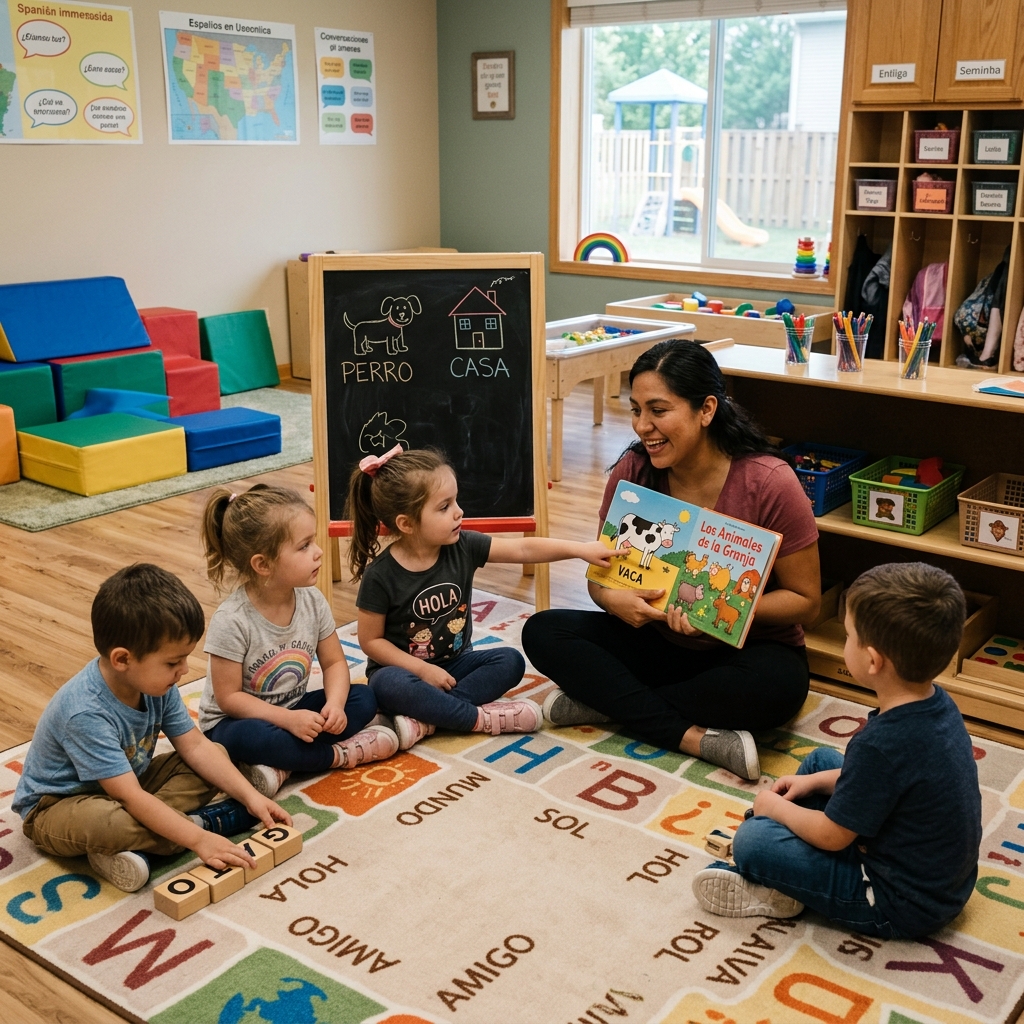
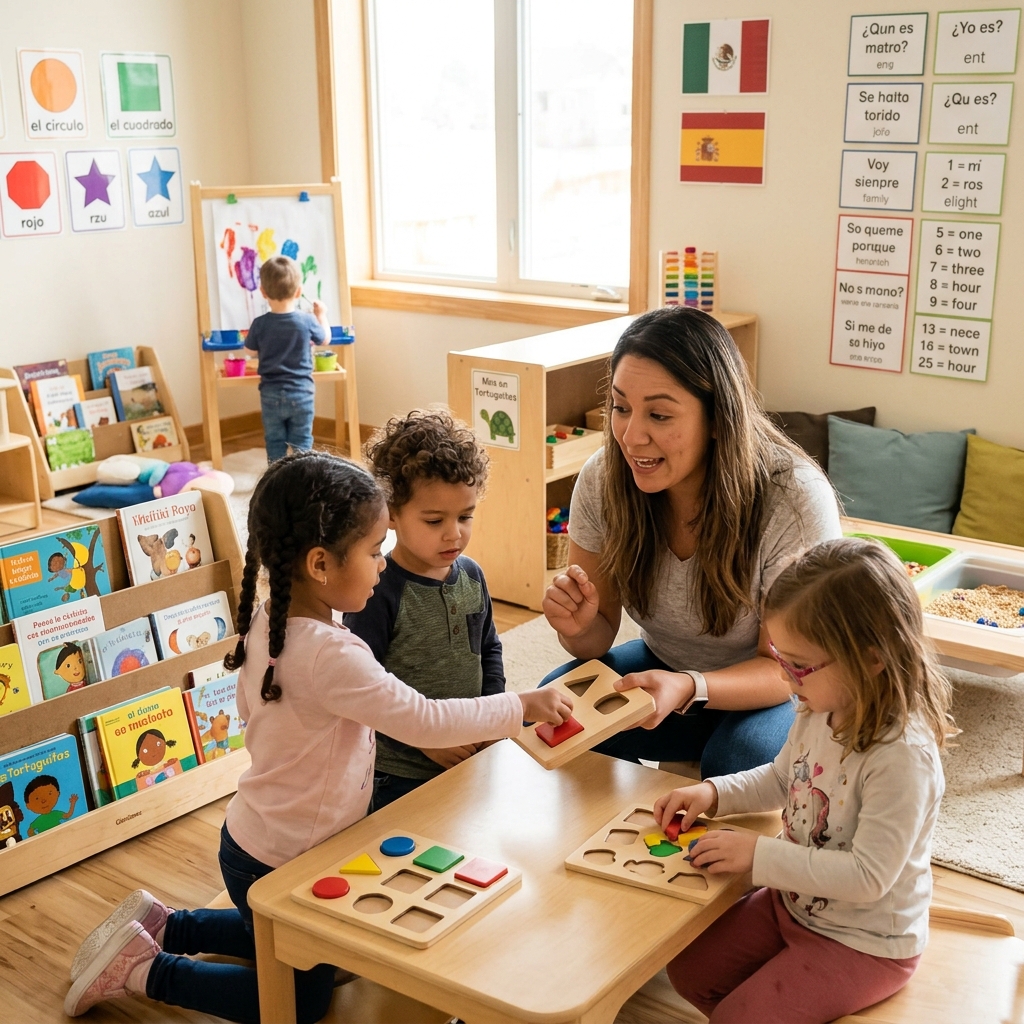
In a Spanish immersion preschool, Spanish isn’t a subject students learn for thirty minutes a day. It’s the language of the entire learning environment. Your child hears Spanish during morning meeting, during snack time, during art, during outdoor play. Teachers speak Spanish to one another. Songs, stories, and play instructions all happen in Spanish. This creates total immersion, the same way a child learns their first language at home.
Our curriculum covers the exact same skills as traditional preschool: pre-literacy, pre-math, social skills, and creative expression. We do circle time, sensory play, and outdoor exploration. The difference is that all of it unfolds in Spanish, with visual supports and gestures that make meaning clear even as children’s understanding grows.
We treat every child like our own, which means we meet children where they are. Infants and toddlers who join us at six weeks will gradually develop Spanish as their primary language. Preschoolers who arrive speaking only English will progress from understanding simple instructions to speaking in short phrases within weeks, then full sentences within months. This isn’t magic, it’s how the brain works when immersed in a language daily.
Our qualified bilingual teaching staff members speak Spanish fluently and understand early childhood development. They’re not just native speakers; they’re trained educators who know how to scaffold language learning while keeping the classroom joyful and playful.
Cognitive Benefits of Growing Up Bilingual
The research here is clear and consistent: bilingual children show specific cognitive advantages that extend well beyond language.
First, bilingual children demonstrate stronger executive function. This is your child’s ability to focus, remember instructions, switch between tasks, and manage impulses. Why? Because speaking two languages requires the brain to constantly manage which language fits which context. That mental discipline strengthens the neural networks involved in attention and planning.
Second, bilingual children often show earlier metalinguistic awareness. In plain terms, they understand that language is a system with rules and patterns. They notice when someone uses a different word or accent. They’re curious about how language works. This awareness actually helps with reading and writing development, because literacy is partly about understanding how language maps onto symbols.
Third, bilingual children tend to have larger conceptual vocabularies. When a child knows both “perro” and “dog,” they’re not just bilingual; they’re building a richer understanding of what “dog-ness” means. They can compare and contrast ideas across languages.
Finally, growing up bilingual is connected to greater cultural flexibility and openness to diverse perspectives. Children who move fluidly between languages learn early that there are multiple valid ways to think, speak, and be in the world.
None of this means bilingual children are automatically smarter. It means immersion gives their brains a particular kind of exercise that pays dividends across learning, problem-solving, and social flexibility.
How We Build School Readiness Through Spanish Immersion
You might wonder: if my child learns in Spanish at preschool, will they be ready for kindergarten taught in English? The answer is absolutely yes, and the research supports it.
Children in Spanish immersion programs in California, Colorado, and Minnesota transition to English-language kindergarten smoothly. Why? Because by age five or six, they’ve built strong foundational literacy and math skills in Spanish. Those skills transfer. When they learn to read in Spanish, they understand phonetics and sound patterns. Adding English reading is easier because they already grasp the concept. It’s not learning to read twice; it’s learning to read in a second language.
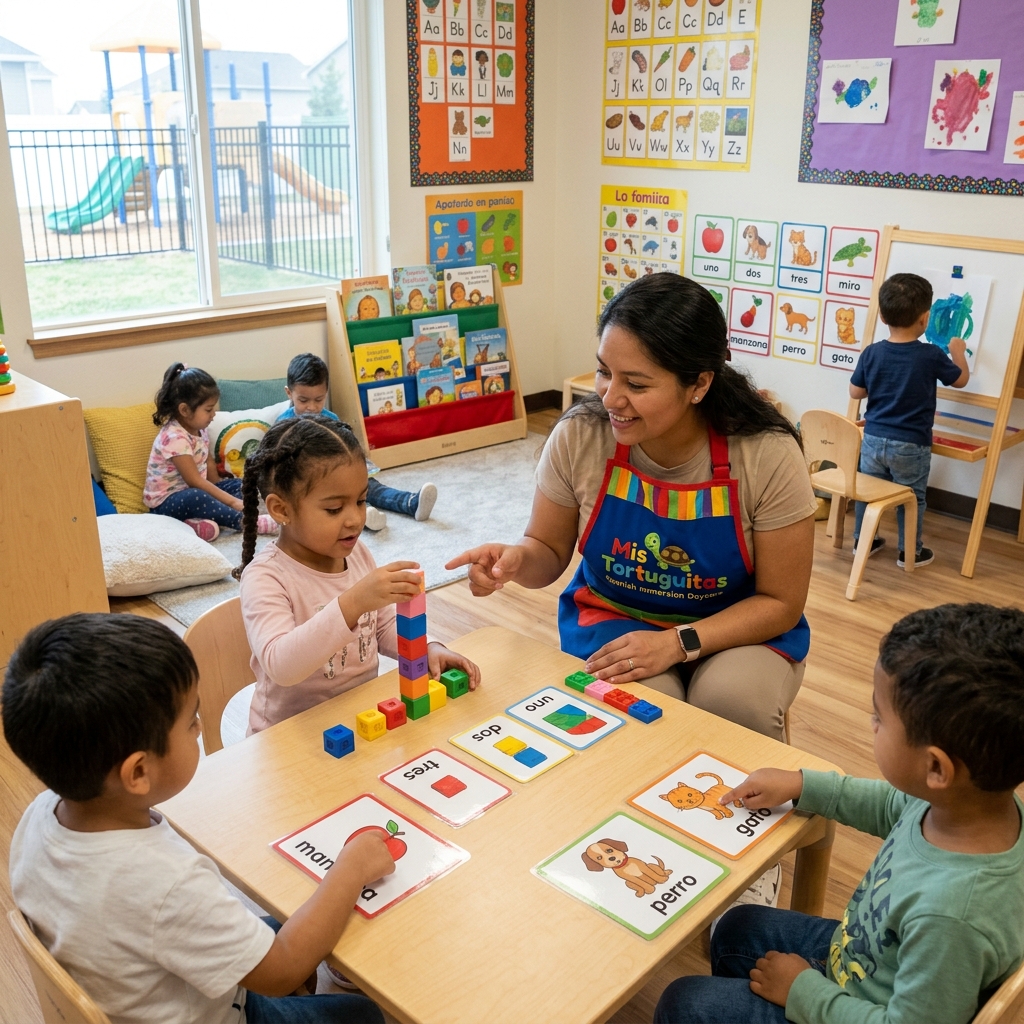
We intentionally build your child’s school readiness through early literacy foundations. Our curriculum includes:
- Letter recognition and sounds in Spanish (and later, English letter names and sounds)
- Phonological awareness activities (rhyming, syllable clapping, sound play)
- Pre-writing skills through art, sensory exploration, and fine-motor activities
- Number recognition, counting, and early math concepts
- Social-emotional skills: taking turns, expressing feelings, problem-solving with peers
- Listening comprehension and vocabulary building through stories and songs
By the time your child enters kindergarten, they’ll have strong language skills in Spanish, emerging literacy awareness, and a warm relationship with learning itself. Teachers report that immersion students transition smoothly to English instruction and often have an academic advantage by second grade.
We partner with your family to make this transition gentle. We send home simple English picture books alongside Spanish ones. We help parents understand how to support bilingualism at home. And we maintain open communication about your child’s progress so you feel confident and informed every step of the way.
Creating a Safe, Nurturing Learning Environment
Your child’s safety is our top priority, and we know you need to feel secure the moment you walk through our doors.
Mis Tortuguitas is fully licensed by the state of Minnesota. Our facility meets all health, safety, and sanitation standards. We have secure entry, staff trained in pediatric CPR and first aid, and clear emergency procedures. Our building is clean, bright, and designed for young children, with age-appropriate furniture, toys, and learning spaces.
But safety is more than rules and locks. It’s also the relationship your child builds with their caregivers. We keep class sizes small and maintain consistent staffing so your child has secure, familiar faces every day. When your child cries at drop-off (and most do), the same warm teacher is there, day after day, to help them feel safe. That consistency builds trust.
Our teachers are trained in responsive, child-centered care. We don’t rush children or dismiss their feelings. If your child is struggling, we listen, we comfort, and we work with you to understand what’s happening. We celebrate your child’s small victories, whether that’s trying a new food, making a friend, or speaking a new Spanish phrase.
The classroom itself feels warm and home-like, not institutional. We have cozy reading corners, sensory exploration stations, outdoor space for climbing and running, and plenty of time for play. Children thrive when they feel safe, and safe looks like familiar people, predictable routines, and a space designed with their wellbeing in mind.
Real Families Share Their Stories
Hearing from parents who’ve walked this path can help you feel more confident in your choice.
Maria and James brought their daughter Sofia to us when Sofia was three years old, speaking only English. Maria’s parents had emigrated from Mexico, and Maria spoke some Spanish but wasn’t fluent herself. She wanted Sofia to grow up with her heritage but wasn’t sure how to make it happen. After six months at Mis Tortuguitas, Sofia was singing Spanish songs, counting to ten in Spanish, and asking her parents questions about Spanish words. Now Sofia speaks Spanish with her great-grandparents over video calls, and Maria says watching that connection bloom has been one of the greatest gifts of preschool.
Another family, the Johnsons, weren’t originally planning Spanish immersion. They chose us because we were close to home and had openings. Their son Marcus was initially shy and reluctant to speak at drop-off. Within weeks, his teacher noticed him humming Spanish melodies. By spring, Marcus was confidently repeating songs, asking for snacks in Spanish, and proud of himself for being “bilingual.” His kindergarten teacher told them Marcus had exceptional focus and seemed to enjoy the challenge of learning.
These stories aren’t unusual. Families tell us they’re amazed by how naturally their children absorb Spanish, how excited they get about learning, and how a preschool choice becomes a family adventure into bilingualism.
Enrollment Options That Work for Busy Parents
We know your life is complicated. You need childcare that fits your schedule, is affordable, and aligns with your values. That’s why we offer flexible enrollment options.
We serve children from six weeks through six years old, so whether you have an infant, toddler, or preschooler, we have a program. Full-time enrollment works for families who need consistent, all-day care five days a week. Part-time enrollment is perfect if you have another caregiver some days, work flexible hours, or want to transition gradually into full-time care.
Our bilingual childcare programs are designed for infants, toddlers, and preschoolers, each with age-appropriate curriculum and smaller group sizes. Infants get the nurturing care and language-rich environment they need. Toddlers explore the world through play while building vocabulary and social skills. Preschoolers engage in more structured learning, preparation for kindergarten, and deeper Spanish language development.
We’re located in Farmington and serve families throughout the area, including Apple Valley, Lakeville, Eagan, and Rosemount. We understand you might have a commute, so we’re here to make drop-off and pick-up as smooth as possible.
Pricing is transparent, and we offer flexible payment options. We’re happy to discuss what works for your family’s budget. We also accept FSA (Flexible Spending Account) dollars, which many employers offer, making childcare even more affordable.
Schedule Your Tour and See Our Program in Action
Reading about immersion education is one thing. Seeing it, hearing it, and feeling the warmth of our classroom is another.
We invite you to come see for yourself. A tour lets you meet our teachers, watch children learning and playing in Spanish, and ask all the questions you have. You’ll see the cozy reading nooks, the outdoor learning space, and the joyful energy that comes from children who feel safe and engaged.
During a tour, you’ll notice things you can’t learn from a website: the way our teachers respond to children with patience and warmth, the Spanish language happening naturally throughout the day, and the community we’ve built with families.
We’re also happy to answer questions about your specific situation. Do you have concerns about your child transitioning from English to Spanish? Wondering if immersion is right for a shy child or a child with speech delays? Want to know how we support families who don’t speak Spanish? We have real, thoughtful answers, and we’re here to help you feel confident.
Reaching out is simple. You can contact us through our website, give us a call, or stop by during business hours. Many families find that a single conversation or tour shifts their perspective on what’s possible for their child’s early education.
Your child’s early years are fleeting and precious. The choice you make about preschool ripples forward, shaping not just their language skills, but their curiosity, confidence, and readiness to learn. We’d be honored to be part of your family’s journey. Come visit us, and let’s talk about how Spanish immersion can give your child a warm, bilingual foundation that lasts a lifetime.