
Why Language Immersion Matters for Your Child’s Future
Your child’s brain is like a sponge right now. Between birth and age five, their capacity to absorb language, culture, and social skills is at its absolute peak. This is the window when bilingual learning doesn’t feel like effort—it feels natural.
Here’s what neuroscience tells us: children exposed to multiple languages early develop stronger cognitive flexibility, better problem-solving skills, and advantages that last well into adulthood. Learning Spanish alongside English during these critical years doesn’t slow down English development. Instead, it expands your child’s neural pathways and opens doors to opportunity—academically, professionally, and culturally.
For families in the Farmington area, the choice of early childcare shapes so much more than just the school day. It shapes how your child sees the world, builds confidence, and connects to their identity and community. When your child spends their formative years in an environment where Spanish is spoken naturally—not as a subject to study, but as a living, breathing part of their daily life—something remarkable happens. They become bilingual without trying.
That advantage compounds over time. Research shows bilingual children tend to perform better on standardized tests, have larger vocabularies overall, and develop stronger executive function skills. But beyond the academic metrics, there’s something equally valuable: cultural awareness and the cognitive flexibility that comes from moving fluidly between languages.
What to do next: Consider your family’s long-term goals. Do you want your child to grow up bilingual? Do you value cultural connection? If so, early immersion during daycare and preschool years is the most natural, effective path.
The Key Differences Between Spanish Immersion Daycare and Public Preschool
Public preschool programs in Minnesota serve an important role in early education. Most offer play-based learning, social development, and a foundation for kindergarten readiness. They’re typically free or low-cost, accessible to families across income levels, and staffed by trained educators.
But there’s a critical difference when it comes to language immersion. In most public preschool settings, English is the primary language. Spanish or another language might be introduced through songs, stories, or a weekly visit, but it’s supplementary. Your child hears English most of the day.
At our Spanish immersion daycare, the entire environment is built around daily Spanish immersion. This means Spanish isn’t a subject—it’s the language of classroom life. Teachers speak Spanish to children throughout the day. Songs, stories, conversations during meals, outdoor play, and teachable moments all happen in Spanish. We include English instruction and gradually introduce English literacy, but Spanish remains the primary language throughout the day.
The structural differences matter, too:
- Hours and flexibility: Public preschool typically runs 2.5 to 3 hours a day, 3 to 5 days per week. We offer full-time and part-time options that align with working parents’ schedules—critical for families who need consistent, extended care.
- Age range served: Public preschool usually starts at age three. We care for children from six weeks old, which means your child can benefit from Spanish immersion from infancy through kindergarten readiness, without switching programs.
- Teaching approach: Public programs follow a general early childhood curriculum. Our bilingual childcare programs integrate Spanish immersion with intentional literacy development in both languages, designed specifically for bilingual learners.
This doesn’t mean public preschool isn’t valuable—it absolutely is. But if bilingual development is a priority for your family, Spanish immersion daycare operates on a fundamentally different model.
Actionable takeaway: If dual-language fluency matters to your family, ask yourself: Where will my child hear Spanish consistently? If the answer is “primarily at home,” you’ll carry much of the language-building work yourself. With daily immersion at daycare, that responsibility is shared and supported by trained bilingual staff.
Daily Spanish Exposure and Real Language Development
Imagine this: Your two-year-old is playing in the sandbox. A teacher sits nearby and narrates what they see: “Mira, estás haciendo un castillo (Look, you’re making a castle). Qué arena tan fría (What cold sand).” This isn’t a lesson. It’s conversation woven into play.
Real language development happens through hundreds of these small moments. When children hear Spanish naturally throughout their day—during meals, transitions, conflicts, celebrations, and play—their brains begin processing it as a living language, not a subject to master.
At Mis Tortuguitas, our licensed bilingual staff speak Spanish as the primary language of the classroom from the moment children arrive. Children hear it in:
- Morning greetings and circle time discussions
- Mealtimes and snack conversations
- Song and movement activities
- Outdoor play interactions
- Conflict resolution and emotional coaching
- Bedtime routines (for younger infants)
- Transitions between activities
The key is consistency. Your child hears Spanish every single day from people they trust and feel safe with. They see that Spanish is how their teachers communicate, how they express care, and how the classroom community functions. There’s no switching to English when things get tricky or when deeper teaching is needed.
Over months and years, children internalize Spanish naturally. They start humming Spanish songs at home. They ask for “por favor” and say “gracias” without prompting. They understand complex Spanish instructions without translation. By the time they reach our Spanish immersion preschool program, many children are genuinely bilingual—able to understand and express themselves in both languages.
What to do next: Ask any daycare provider about their language environment. How much of the day is Spanish actually spoken? Are all staff bilingual? Is it woven into daily routines or reserved for specific activities? The answers tell you whether your child will truly be immersed.
Class Sizes and Individualized Attention: A Critical Advantage
Small class sizes matter more than most parents realize, especially in the early years. In a room with 20 or 25 children and two teachers, individual attention becomes scattered. In a classroom with 8 to 12 children and bilingual caregivers, something different happens—each child is genuinely known.
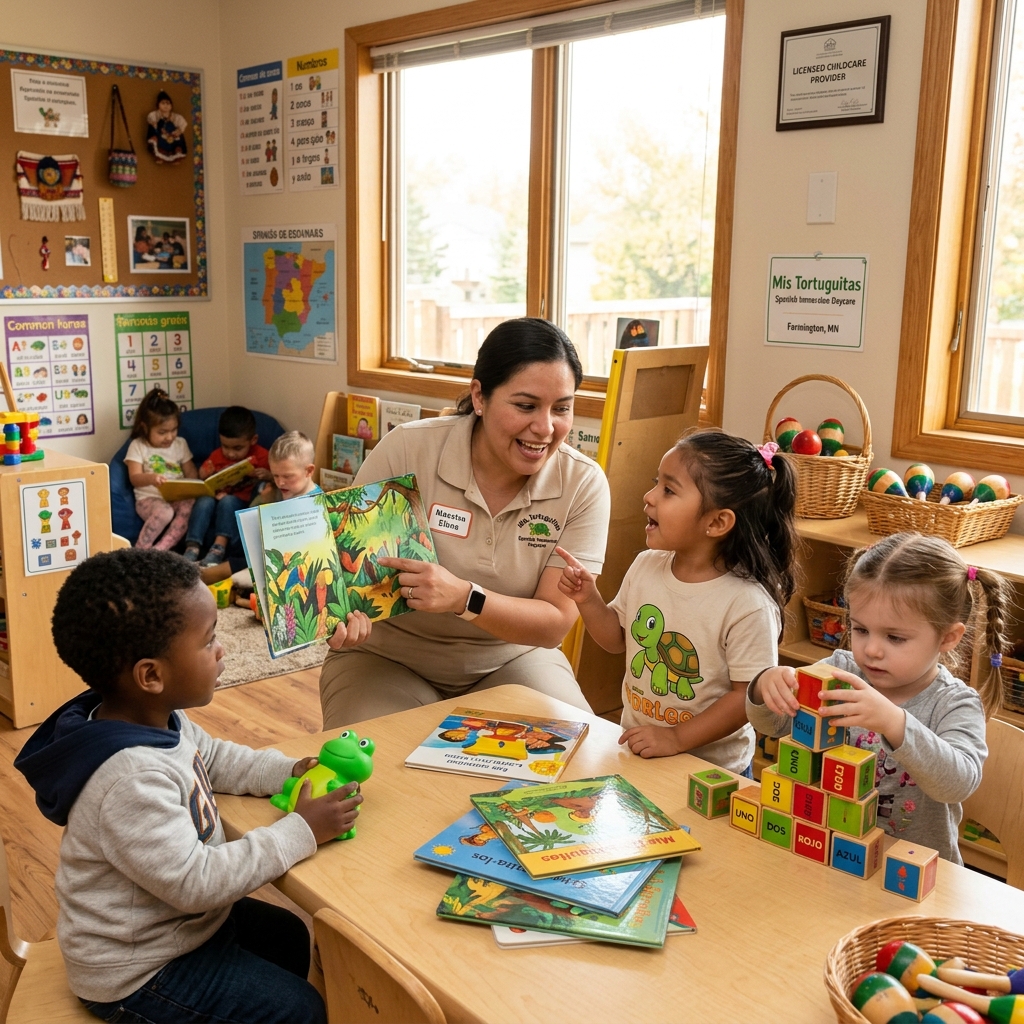
This distinction is especially important when your child is learning language. Language development requires interaction. Your child needs to be heard, responded to, and engaged in conversation—not passively present in a large group.
At our daycare, we maintain small class sizes intentionally. This means:
- Your child gets frequent one-on-one conversations with bilingual caregivers
- Teachers can notice and respond to your child’s individual language development
- Each child receives personalized attention during transitions, meals, and learning moments
- We can adapt our approach to your child’s pace and personality
A smaller group also creates a home-away-from-home feel. Your child develops genuine relationships with teachers and other children. They feel secure, which is essential for language learning. A child who feels anxious or overwhelmed doesn’t absorb language as readily as a child who feels safe and valued.
When your child spends their day in a calm, connected environment with adults who know them well, the emotional foundation for learning is solid. Language flows naturally from that security.
Actionable takeaway: When comparing programs, ask about the adult-to-child ratio during core learning hours. Visit during transition times (arrival, meals, pickup). Do children seem calm? Do teachers engage individually? These observations reveal whether a program truly prioritizes individualized attention.
School Readiness and Literacy Skills Built From Day One
Parents often worry: “Will my child be ready for kindergarten if they’re learning in Spanish?” The answer is yes—and actually, bilingual children often have advantages that accelerate their readiness.
School readiness encompasses more than academics. It includes social-emotional skills, self-regulation, listening comprehension, phonemic awareness, and pre-literacy skills. Children who’ve spent years in a structured, language-rich environment with small class sizes tend to have stronger foundations in all these areas.
Our curriculum intentionally builds toward kindergarten readiness:
- Phonemic awareness in both languages: We teach children to hear and recognize sounds in Spanish and English, which builds the foundation for reading in both.
- Letter recognition and early writing: Children learn letters, their sounds, and begin writing in both Spanish and English.
- Social-emotional development: Through Spanish-language interactions, children learn to express feelings, resolve conflicts, and build friendships.
- Following directions and routines: Bilingual instruction in these foundational skills creates confidence and independence.
- Curiosity and love of learning: When learning feels natural and joyful (not forced), children develop intrinsic motivation—a predictor of long-term academic success.
By the time your child enters kindergarten, they’ve had years of guided learning in a bilingual environment. They understand how to navigate the classroom, follow routines, interact with peers, and engage with literacy concepts. Teachers often note that bilingual children have advantages in phonological awareness—the ability to think about sounds—which translates directly to reading and spelling success.
What to do next: Ask prospective programs about their specific kindergarten readiness approach. How do they assess progress? How do they communicate with families about development? Transparency about your child’s growth is a sign of a strong program.
Peace of Mind With Licensed Bilingual Caregivers
Your child’s safety and wellbeing aren’t negotiable. When you choose a daycare, you’re trusting staff to care for your most precious person. That trust must be earned through credentials, training, and proven commitment.
All our staff at Mis Tortuguitas are licensed bilingual childcare providers. This means:
- They’ve completed formal training in early childhood development and safety
- They maintain current CPR and first aid certifications
- They understand child development and can respond appropriately to your child’s needs
- They speak Spanish fluently and can teach and care for children in Spanish
- They’ve passed background checks and meet all licensing requirements
Being bilingual is different from being trained in bilingual education. Our team doesn’t just speak two languages—they understand how to support language development, recognize developmental milestones in both languages, and create an environment where bilingualism is nurtured.
We treat every child like our own. That’s not just a phrase—it’s how we operate. Your child’s safety is our top priority, and our training and licensing reflect that commitment.
Beyond credentials, it’s about relationships. Our staff develop genuine connections with the children in their care. They know your child’s temperament, their comfort level, what makes them laugh, and what soothes them when they’re upset. That consistency and care is what creates a secure attachment—essential for healthy development.
Actionable takeaway: Before choosing any program, verify that all staff are appropriately licensed for the ages they serve. Ask about ongoing training in bilingual education, child safety, and development. A program that invests in staff expertise is investing in your child’s wellbeing.
Creating a Home-Away-From-Home Learning Environment
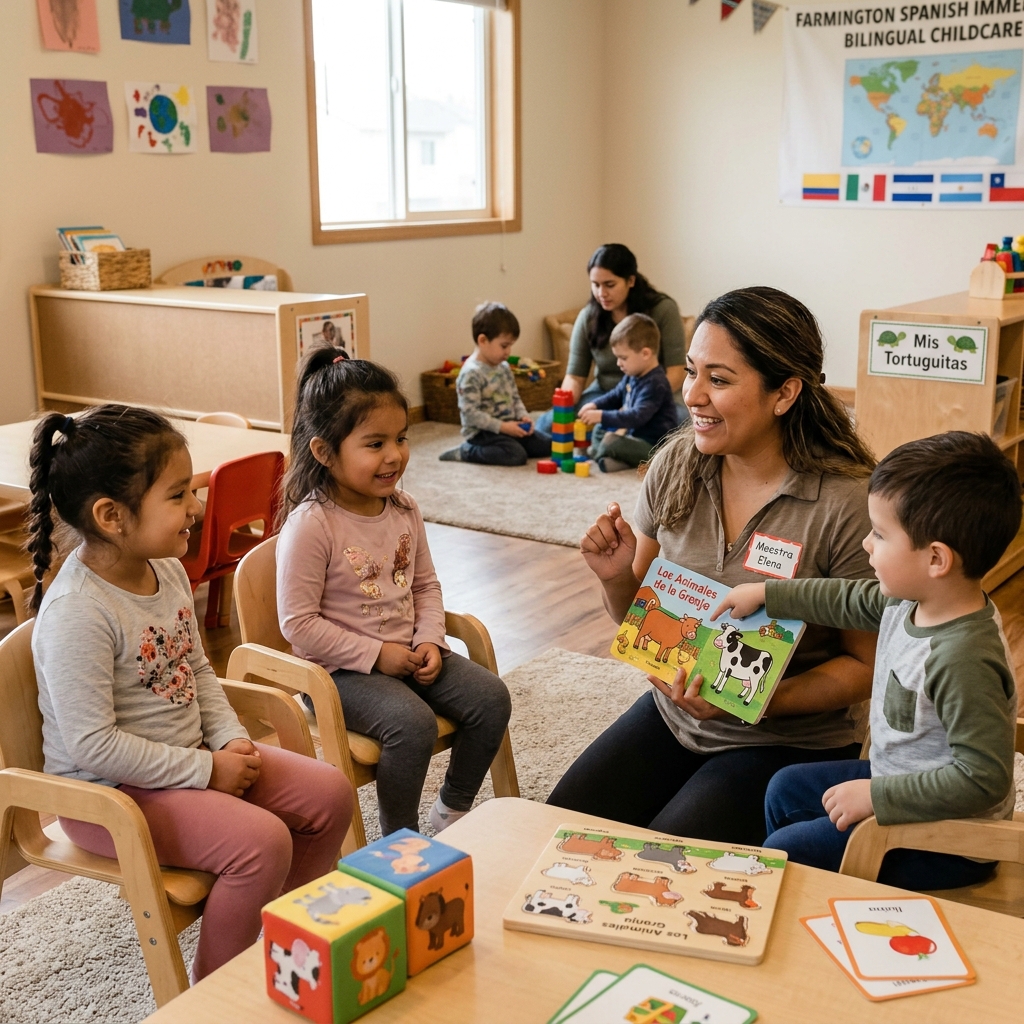
Your child spends a significant portion of their waking hours at daycare. That space should feel warm, secure, and nurturing—less like an institution and more like an extension of home.
We design our classrooms around this philosophy. Our facility features:
- Bright, welcoming spaces organized for play, learning, and rest
- Age-appropriate materials and toys that encourage exploration and development
- Calm, organized routines that help children feel secure
- Natural light, comfortable temperature, and clean, safe areas
- Spaces for small-group activities and one-on-one interaction
But the physical space is only part of it. What truly creates a home-away-from-home environment is the human connection. It’s how our teachers greet children in the morning. It’s the warm tone used during meals and transitions. It’s the genuine interest in how your child’s evening was, and the small updates we share about their day. It’s consistency, predictability, and unconditional care.
Children thrive when they feel they belong. When they walk into Mis Tortuguitas, they’re walking into a place where they’re known, valued, and cared for as individuals—not just one of many. That emotional safety is the foundation for every bit of learning that happens there.
How We Partner With Your Family’s Goals
We don’t raise children alone. Our most important partnerships are with families. We see ourselves as working alongside you to support your child’s growth and development.
This partnership looks like:
- Regular communication: We share updates about your child’s day, their development, and their progress in both languages. We use a combination of daily notes, progress reports, and conversations.
- Listening to your goals: During enrollment and throughout the year, we ask about your family’s priorities. Do you want to emphasize Spanish at home? Do you have specific developmental concerns? Are there cultural traditions you want to share? We listen and adapt.
- Transparency: We’re honest about your child’s strengths and areas where they’re growing. If there are developmental questions or concerns, we discuss them openly and offer resources.
- Flexibility: We understand that families are complex. We work to accommodate your needs, preferences, and values where we can.
- Celebrating milestones together: When your child reaches a language milestone, learns a new skill, or shows growth in confidence, we celebrate it with you. These moments matter, and you deserve to be part of them.
Our goal isn’t to replace the parent-child relationship. It’s to support and enhance it. We help your child develop skills, confidence, and love of learning while strengthening the foundation they build with you.
What to do next: When you visit a program, pay attention to how staff interact with parents. Do they seem genuinely interested in your child and family? Do they ask questions and listen? These interactions reveal whether the program truly partners with families or simply provides childcare.
Flexible Enrollment Options That Work for Working Parents
Many working parents face a practical reality: standard preschool hours don’t align with work schedules. You need care that fits your life, not care that complicates it further.
We offer flexibility that works for real families:
- Full-time enrollment: 7 a.m. to 5:30 p.m., Monday through Friday. For families who need consistent, comprehensive care, this is our core offering.
- Part-time enrollment: Options that fit schedules that don’t run 9 to 5. Whether you need 2 or 3 days a week, mornings only, or afternoons only, we work with you.
- Drop-in care: For occasional needs, we can sometimes accommodate single days or weeks.
- Year-round programming: We operate year-round (with closures on holidays). Your child stays in one place, with consistent caregivers, throughout the year—no scrambling for summer care.
- Multiple locations: We serve Farmington, Apple Valley, Lakeville, Eagan, and Rosemount, so you can choose the location that works best for your commute.
This flexibility gives working parents peace of mind. You know your child is in safe, bilingual hands while you’re at work. You’re not juggling multiple programs or paying for care you don’t fully use. And your child isn’t experiencing disruption from constantly switching environments.
Actionable takeaway: When comparing programs, be honest about your scheduling needs. Ask directly whether a program can accommodate them without feeling rushed or undervalued. The right program will work with you, not make you feel like you’re asking too much.
The Long-Term Benefits of Early Bilingual Education
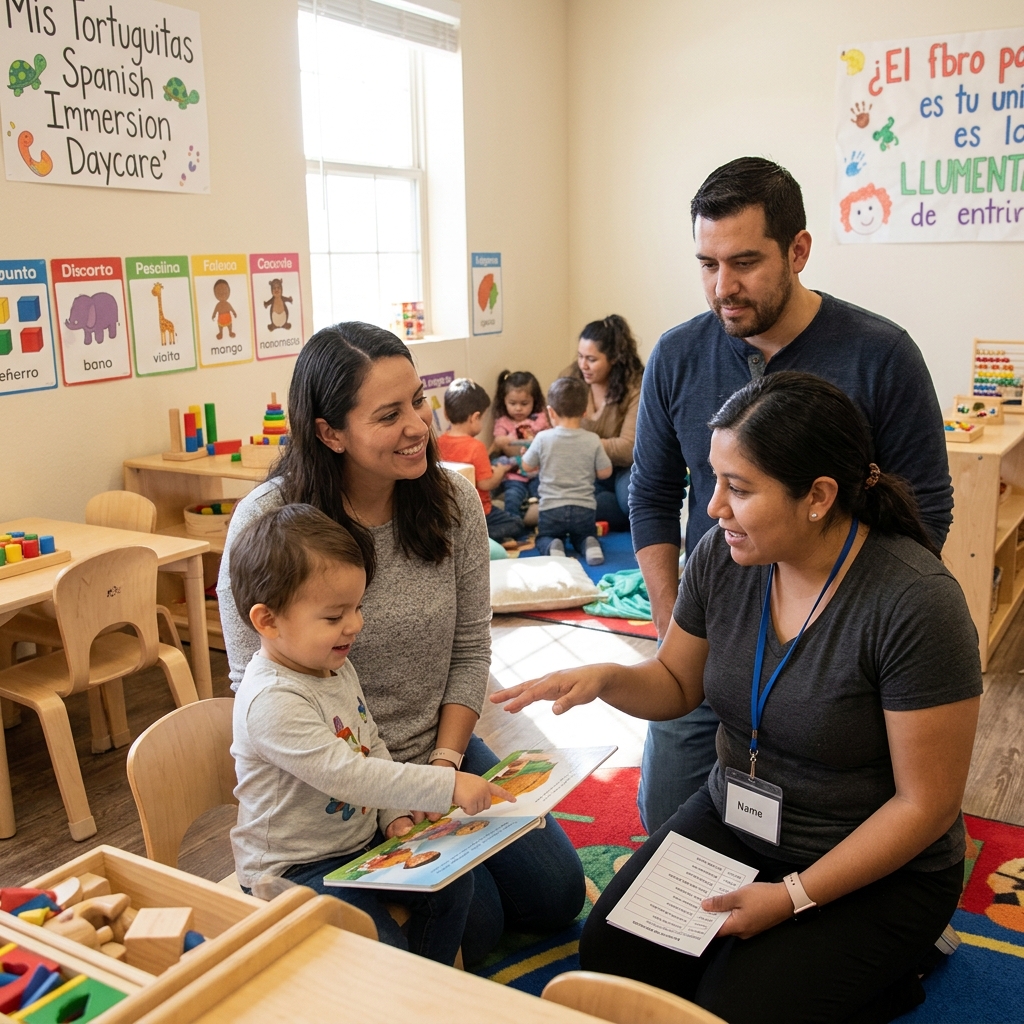
The benefits of Spanish immersion daycare don’t end when your child starts kindergarten. In fact, that’s when the foundation you’ve built starts paying dividends.
Children who’ve spent years in bilingual environments tend to show:
- Stronger literacy skills: Bilingualism enhances phonological awareness, which directly supports reading and writing in both languages.
- Cognitive advantages: Bilingual children often perform better on problem-solving tasks and show greater mental flexibility—the ability to think about multiple perspectives and solutions.
- Academic confidence: Coming into kindergarten already bilingual gives children a sense of achievement and confidence that spills into all learning.
- Cultural identity and pride: Children who grow up bilingual in a setting that celebrates Spanish language and culture develop stronger cultural identity and self-esteem.
- Future opportunities: In our increasingly diverse, global economy, bilingualism is a competitive advantage. Employers value bilingual employees. Universities value bilingual applicants. Your child’s early bilingual foundation opens doors.
- Family connection: If Spanish is spoken in your extended family, your child’s fluency strengthens those relationships. Language carries culture, history, and belonging.
Perhaps most importantly, bilingual children develop an openness to the world. They understand that there are multiple ways to communicate, multiple perspectives, and multiple cultures to celebrate. That awareness becomes a foundation for empathy, curiosity, and belonging in an increasingly connected world.
What Sets Mis Tortuguitas Apart in the Farmington Area
We’re Farmington’s first licensed Spanish immersion daycare—but what does that mean beyond being first?
It means we were founded on a specific vision: to create a place where Spanish immersion isn’t an add-on, but the foundation of everything we do. We didn’t adapt an English-based program to include Spanish. We built our entire approach around bilingual learning from the ground up.
Here’s what distinguishes us:
- Bilingual expertise: Our entire team consists of bilingual educators trained in how children develop language. We understand the nuances of bilingual development and can support children thoughtfully.
- Community focus: We’re part of the Farmington community, serving families from Farmington, Apple Valley, Lakeville, Eagan, and Rosemount. We understand the families we serve and their values.
- Genuine immersion: Spanish is the language of our classroom, not a subject we teach. Children are immersed naturally, every day.
- Small, intentional groups: We maintain small class sizes because we believe every child deserves to be known and cared for individually.
- Parent partnership: We see families as essential partners in your child’s growth. We communicate regularly and transparently.
- Comprehensive care: From infants (six weeks) through preschoolers (six years), we support your child’s development across the full early childhood span.
We’re not perfect, but we’re committed. We show up every day for the children and families in our care. We invest in our staff, maintain high standards, and hold ourselves accountable to the trust you place in us.
Schedule Your Tour and See the Difference
Reading about our program online is one thing. Walking through our doors and seeing your child’s potential future is another.
When you visit Mis Tortuguitas, you’ll see Spanish being spoken naturally. You’ll watch our staff interact with children with warmth and intention. You’ll notice the calm, organized spaces and the small class sizes. You’ll feel the difference that genuine care and bilingual expertise make.
Come see for yourself. Schedule a tour and experience what a true Spanish immersion daycare feels like. Bring any questions you have—about our curriculum, our staff, our approach to bilingual learning, flexible schedules, or anything else that matters to your family.
You can reach us through our website at https://mistortuguitas.com/ or contact us directly to set up a time that works for your schedule. We’re here to answer your questions and help you make the right choice for your child.
The early years are precious and fleeting. They shape who your child becomes and what they’re capable of. When you choose Spanish immersion daycare at Mis Tortuguitas, you’re investing in your child’s future—their language skills, their confidence, their cultural identity, and their love of learning. We’d be honored to be part of your family’s journey.