
The Farmington Parent’s Dilemma: Choosing Between Local Immersion and Big National Daycare Chains
Finding the right daycare feels overwhelming, doesn’t it? You’re juggling work schedules, wondering if your child will be safe and happy, and hoping they’ll actually learn something meaningful. Then you see the big national chains with their polished websites and promises, next to smaller local options you’ve heard whispered about at the grocery store. It’s hard to know where to start.
Here’s what most Farmington parents don’t realize: the choice isn’t just about convenience or cost. It’s about whether your child gets warehoused in a big facility with high turnover, or welcomed into a close-knit community where staff know your family by name and genuinely care about your child’s growth.
We get it because we’ve talked to hundreds of families in Farmington, Apple Valley, Lakeville, Eagan, and Rosemount who felt torn between these options. The national chains offer familiarity and marketing muscle. But they rarely deliver on the most important things: small class sizes, consistent caregivers, and a real curriculum that stretches your child’s brain—especially when it comes to bilingual learning.
The good news? You don’t have to choose between safety and something special. You don’t have to sacrifice quality for flexibility. That’s exactly why we built Mis Tortuguitas: to show Farmington families that a licensed, professional Spanish immersion daycare can feel like a warm home-away-from-home while delivering everything your child needs to thrive.
Why Spanish Immersion Matters for Your Child’s Future
Spanish fluency used to be a nice-to-have skill. Today, it’s becoming essential. The world is smaller, workplaces are more diverse, and bilingual children start school with a cognitive advantage that never disappears.
Here’s what research shows: children exposed to language-rich environments before age six develop stronger neural pathways for learning. They’re better at problem-solving, switching between tasks, and picking up additional languages later. Plus, they grow up comfortable in multiple cultures—a skill that serves them well in college, careers, and life.
Most daycare chains offer “Spanish class” a couple times a week. That’s a start, but it’s like saying a child learns to swim by touching water once a week. Real language happens through immersion: when a caregiver speaks Spanish during snack time, during playtime, during transitions. When your child hears it, uses it, thinks in it throughout the day.
We designed our Spanish immersion daycare so that Spanish isn’t a subject. It’s the air your child breathes. From infants to six-year-olds, every interaction, every story, every song happens in Spanish. Your child doesn’t learn Spanish as a second language squeezed into their day. They grow up bilingual naturally, the way children do when they’re raised in homes where two languages are spoken.
By the time your child enters kindergarten, they’ll have a five-year head start on peers who begin Spanish in elementary school. That’s not hype. That’s how language acquisition actually works.
What Sets Us Apart: Our Licensed Spanish Immersion Model
We’re Farmington’s first licensed Spanish immersion daycare, and that distinction matters more than you might think. Licensing means we meet state safety standards, health protocols, and staff qualifications that big chains often treat as bare minimums. For us, licensing is just the foundation. Everything we build on top of it is about going deeper.
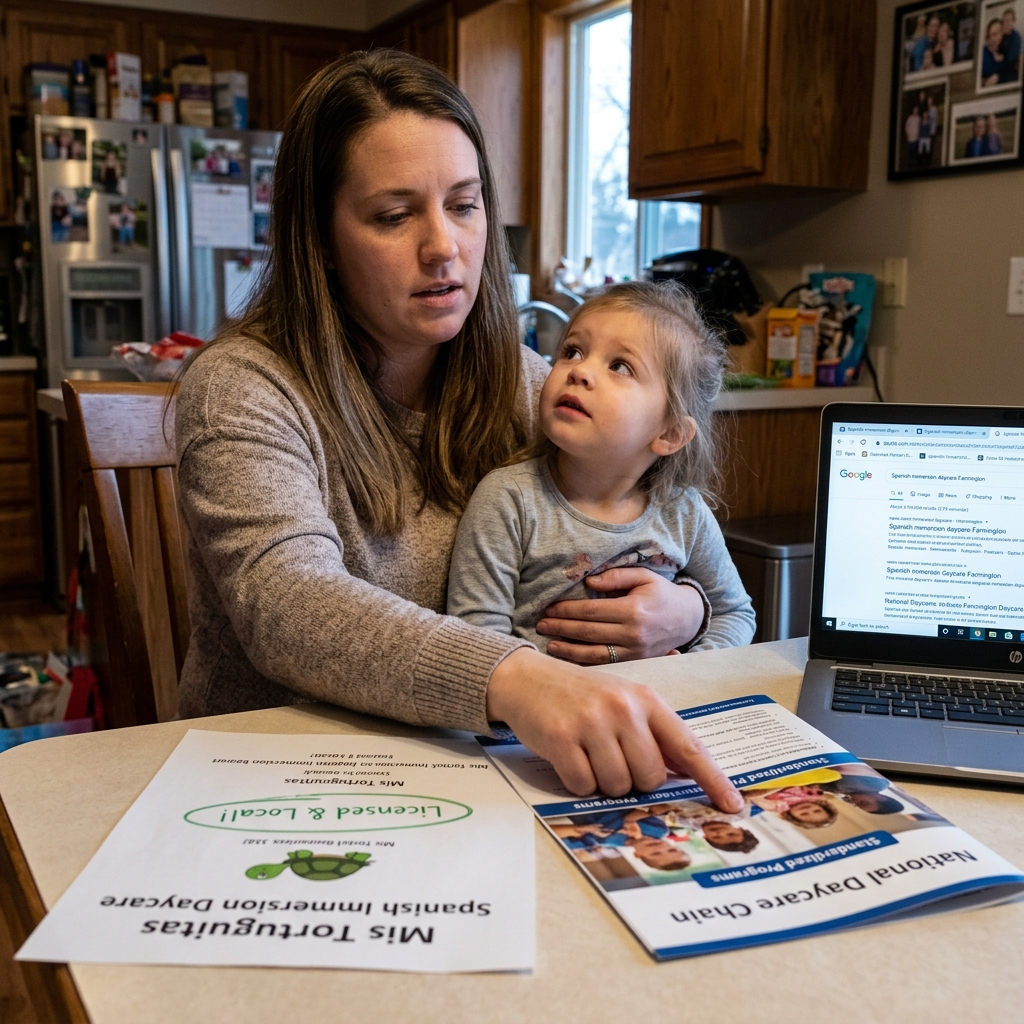
Our curriculum isn’t borrowed from a corporate playbook made in some office far away. We’ve designed every lesson, every activity, every routine around authentic Spanish immersion plus school readiness. Your infant hears proper Spanish pronunciation and rhythm. Your toddler learns numbers, colors, and emotions through play in Spanish. Your preschooler reads, writes, and thinks in Spanish while building the literacy and social skills they’ll need in kindergarten.
We keep our class sizes intentionally small. When there are fewer children per caregiver, something magical happens: your child actually gets noticed. We see when they’re struggling with a concept, when they need a challenge, when they’re ready for the next step. We see them as individuals, not as one of twenty faces in a room.
Our bilingual childcare programs serve children from six weeks through six years. That means your child can grow with us through every critical developmental stage. You’re not moving them around every year. Your family stays connected to our staff, and we stay invested in your child’s journey.
Action step: Come see for yourself. A tour shows you things no website can convey: how our caregivers interact with children, how calm and joyful the environment feels, how Spanish flows naturally through the day.
Full-Time and Part-Time Flexibility That Works for Busy Parents
Life as a working parent isn’t one-size-fits-all. Some weeks you need full-time care. Other weeks, maybe you’re working from home and need part-time support. Or perhaps you’re looking ahead to kindergarten and want your child to start gradually.
We offer both full-time and part-time enrollment options because we understand that families have different needs throughout the year. You’re not locked into a single schedule that doesn’t fit your life. Talk with us about what works for your family, and we’ll find the arrangement that gives you peace of mind without forcing you into a rigid mold.
Busy parents need reliability. You need to know that drop-off happens smoothly, that your child is safe, and that they’re genuinely having a good day—not just surviving it. With smaller class sizes and consistent staff, your child actually looks forward to coming. That makes mornings easier and evenings more joyful when you pick them up with stories to share.
Our Qualified Bilingual Staff and Small Class Sizes
Here’s a hard truth about national chains: high staff turnover means your child gets a different caregiver every few months. That’s stressful for kids and stressful for you. With us, you meet the same caring faces every day.
Every member of our teaching team is bilingual and trained in early childhood education. They’re not just speakers of Spanish. They understand how young children learn, how to keep them safe, and how to build the warm relationships that make daycare feel like a second home. We hire for heart as much as credentials, and we invest in ongoing training so our staff grows alongside your child.
Small class sizes mean your child isn’t one of dozens. Our caregivers know your child’s temperament, their favorite songs, what makes them laugh, what worries them, and exactly where they are in their learning. When something matters to your child, it matters to us. When they hit a milestone—their first Spanish word, learning to count to ten, writing their name—we celebrate together.
This consistency builds trust. Your child knows their caregivers genuinely care. You know your child is being noticed and nurtured, not just monitored. That’s the difference between daycare and a real community.
Why National Chains Fall Short on Immersion and Personal Care
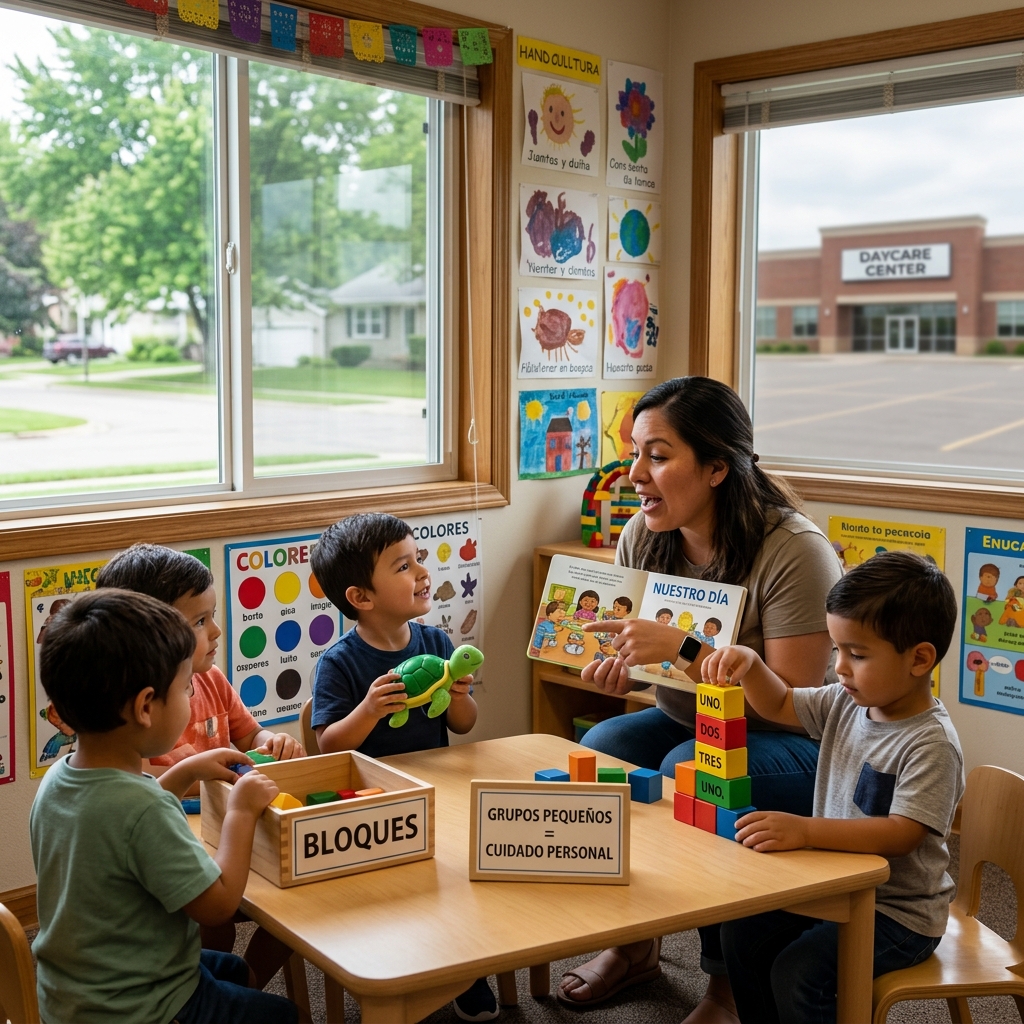
National chains operate on efficiency. They have to. With hundreds of locations and shareholders expecting returns, the math doesn’t leave room for small class sizes or bilingual staff in every classroom. They’re solving a business problem, not a child-development problem.
When it comes to bilingual programs, many chains offer “Spanish enrichment” through a part-time instructor who visits once or twice a week. It’s a nice add-on for marketing, but it’s not immersion. Your child spends most of their day in English and gets a dose of Spanish here and there. That’s not how language becomes natural. Real bilingualism happens when a child is genuinely immersed.
Staff turnover at national chains is a documented challenge. When caregivers are underpaid, overworked, and treated as interchangeable parts, they leave. A lot. That means your child is constantly adapting to new faces, new voices, new routines. Young children thrive on consistency and attachment. High turnover disrupts that.
Class sizes at big facilities are often larger, which means less one-on-one attention. Your child’s developmental concerns might not get noticed until they’re bigger problems. Behavioral issues that could have been gently redirected early instead become frustrations for staff and confusion for your child.
We chose a different path. We’re willing to serve fewer families so we can serve them exceptionally well. That trade-off—fewer children, more attention, deeper relationships—is what sets us apart.
Safety, Curriculum, and School Readiness: Where We Lead
Your child’s safety is our top priority. We meet all state licensing requirements for health, safety, and sanitation. But safety is more than a checklist. It’s the calm awareness in a room where caregivers know exactly where each child is, what they’re doing, and what they need.
Our curriculum builds school readiness without feeling like pressure. We focus on the foundational skills kindergarten teachers look for: listening, following directions, working with others, and curiosity about learning. But we teach these through play, through stories, through real relationships—not worksheets.
Literacy is especially important to us. By preschool age, we’re reading together, engaging with Spanish-language books, and building the awareness that letters and sounds form words and meaning. When your child arrives at kindergarten, they won’t be starting from zero. They’ll be ahead, confident, and genuinely excited to keep learning.
School readiness also means emotional and social skills. Our children learn to name feelings, navigate friendships, ask for help, and solve simple problems. These skills matter as much as academics, and we weave them into every day.
A Warm Home-Away-From-Home vs Institutional Corporate Care
There’s something important that happens in small, family-centered daycare that doesn’t scale well at big facilities: your child feels known and cared for as an individual.
When you drop off your three-year-old in the morning, her caregiver notices that she’s quieter today and asks if everything’s okay at home. When your son is struggling to take turns at the sandbox, his teacher gets down beside him and guides him through it with patience, not just redirecting him to another activity. When a milestone happens—a child finally masters a new skill or overcomes a fear—we tell you about it with genuine joy because we’ve been watching this journey with you.
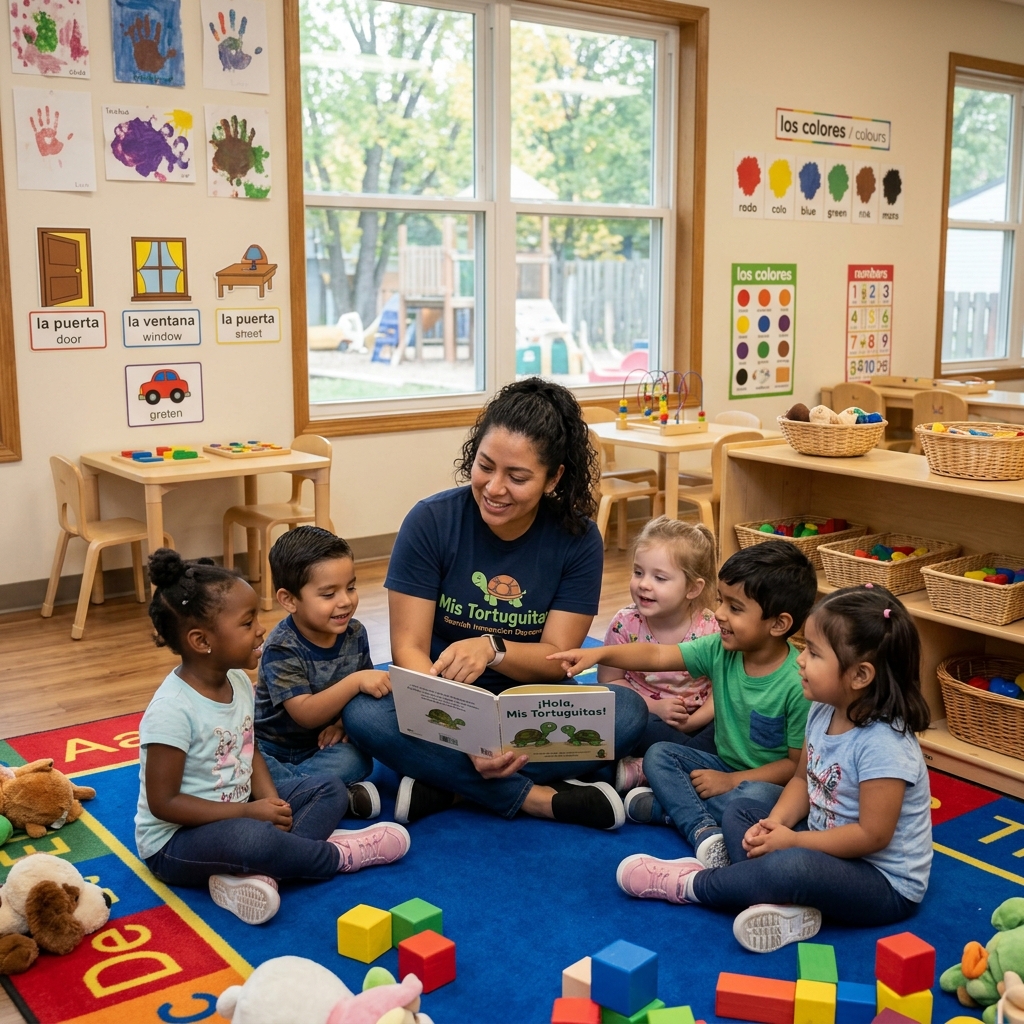
This isn’t institutional care. This is a nurturing learning community where small children thrive because they’re truly seen.
We keep our facility warm and homelike. It doesn’t feel like a big commercial building with fluorescent lights and industrial everything. It feels like a place where children can be fully themselves—curious, messy, emotional, silly, learning. Parents often tell us they feel relieved when they walk in, like their child is being cared for by people they trust.
That peace of mind matters. When you’re in back-to-back meetings at work, knowing your child is safe, happy, and learning—that lets you actually focus on your job instead of worrying.
The Real Cost of Quality: Investment in Your Child’s Foundation
Let’s talk about money, because it’s real and it matters. Quality Spanish immersion daycare costs more than big national chains. There’s a reason.
When we pay competitive salaries, we attract excellent bilingual educators who stay. When we keep class sizes small, we serve fewer families and need more staff. When we invest in thoughtful curriculum, Spanish-language materials, and ongoing training, that’s not free. When we maintain a warm, nurturing facility instead than packing in as many children as regulations allow, that affects our numbers.
But here’s what we’re asking you to consider: What’s the value of your child growing up bilingual? What’s the long-term benefit of a strong language foundation that opens doors throughout their life? What’s the peace of mind worth when you know your child is genuinely safe, happy, and thriving—not just checked on, but cherished?
Early childhood is the best time for language learning. The neural windows are open. If you wait until your child is older, fluency takes much longer and doesn’t sink as deep. You’re not choosing between an expensive option and a cheap option. You’re choosing whether this is the right time to give your child this gift.
Many families tell us that tuition at Mis Tortuguitas is one of the best investments they’ve made in their child’s future. We’re not asking you to take that on faith. We’re asking you to compare: What are you actually getting at a national chain versus what your child receives here? The difference is clear.
Schedule Your Tour Today and See the Difference Yourself
You’ve read about our approach, but the real story is lived, not described. When you visit, you’ll see our caregivers interact with children. You’ll feel the warmth in our space. You’ll hear Spanish as the natural language of the day. You’ll watch children playing, learning, growing—genuinely happy to be there.
That’s what matters. Not promises on a website, but a real place where your child will be safe, nurtured, and given the gift of growing up bilingual.
We’re located in Farmington and serve families from Farmington, Apple Valley, Lakeville, Eagan, and Rosemount. We have infant, toddler, and preschool programs with flexible full-time and part-time options.
Reach out today to schedule a tour. Come see the difference for yourself. Your child’s foundation starts here.